
19 Pantry Organization Ideas That Look Clean and Stay Useful
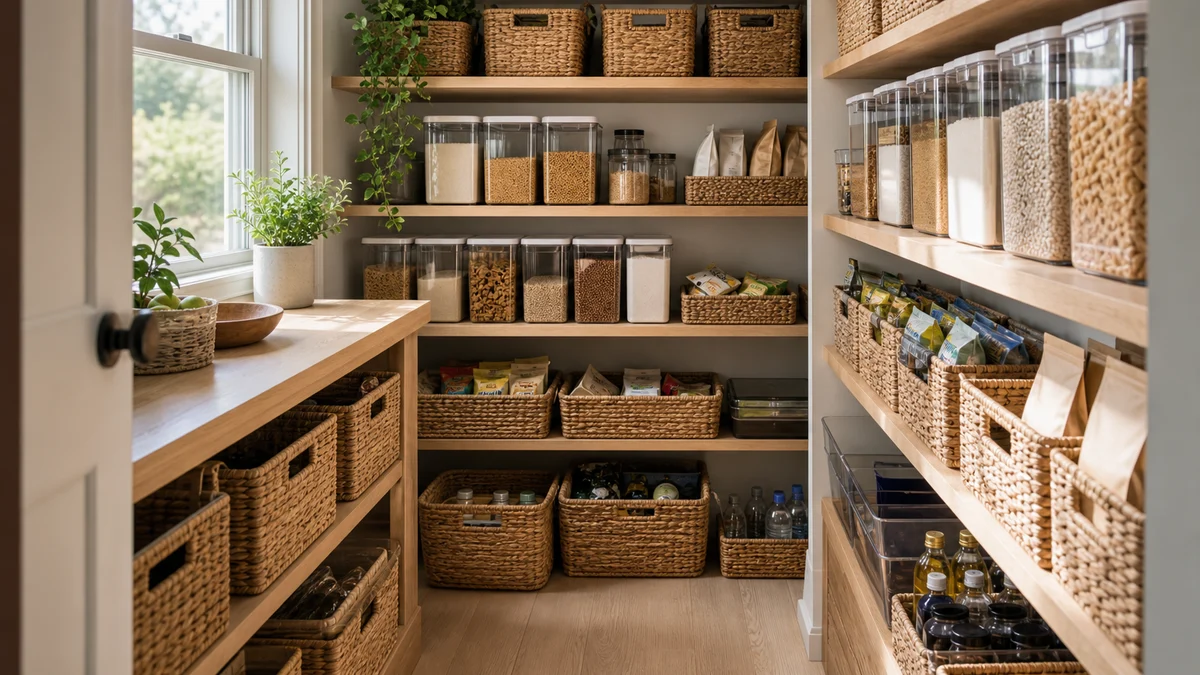
Most pantry organization advice fails because it’s designed for the photo, not the week. You decant everything into matching jars on Sunday, and by Thursday there’s a half-empty cereal box on top because nobody had time to refill the container.
These nineteen ideas are the moves that hold up against real groceries — real packaging, real backstock, real kid snacks — and still look calm enough to leave the pantry door open on a video call. Use the table of contents to jump to the shelf giving you the most trouble, or read straight through to plan a one-weekend reset.
Skim the list, jump to the shelf giving you trouble. Each idea is one image and one move you can copy this weekend.
- 1Daily shelf
- 2Daily vs backstock
- 3Baskets for noise
- 4Clear staples
- 5Snack bins
- 6Breakfast zone
- 7Baking shelf
- 8Oils tray
- 9Turntable jars
- 10Cans in rows
- 11Rolling cart
- 12Door rack
- 13Kid snack zone
- 14Heavy items low
- 15Empty landing
- 16Dinner staples
- 17Sparse labels
- 18Cabinet pantry
- 19Reset before shopping
Start With the Shelf You Actually Use Every Day
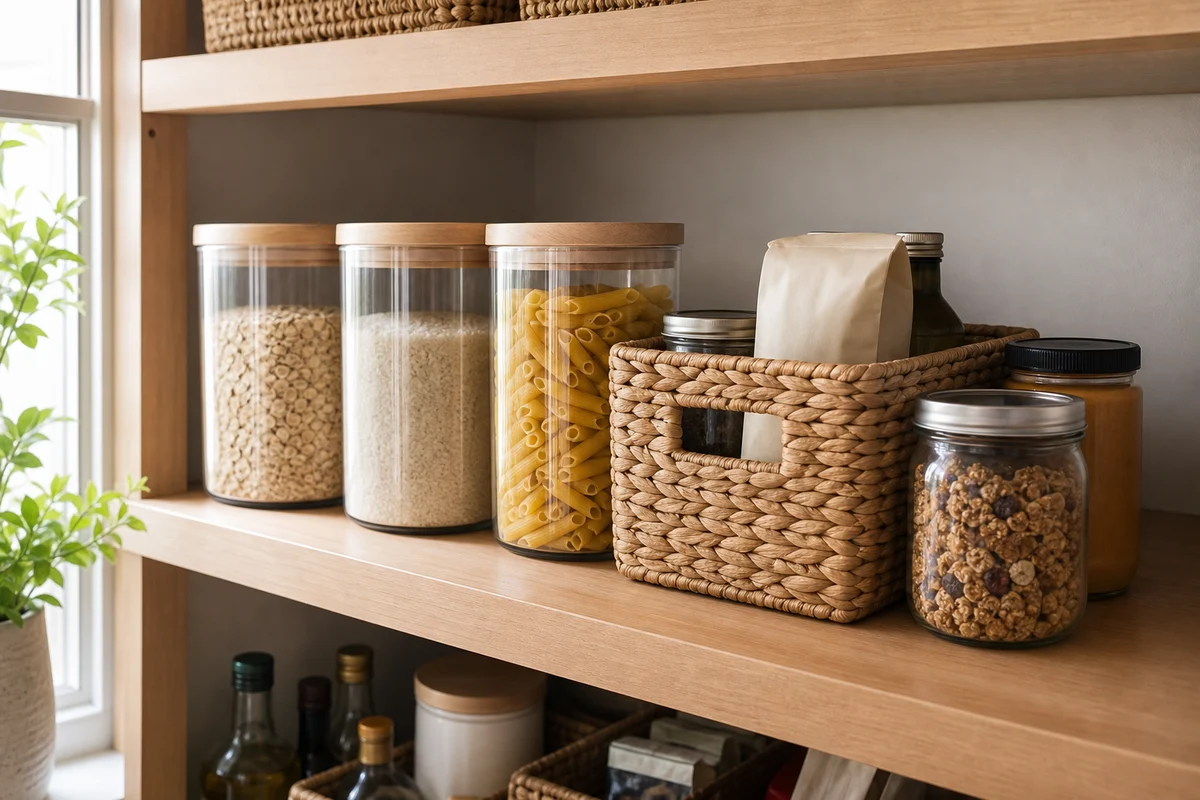
The eye-level shelf in this pantry holds three tall glass canisters with bamboo lids — oats, rice, penne — plus a small seagrass basket with a kraft refill bag and a dark bottle slipped inside.
The granola jar sits next to a smaller amber jar of peanut butter. Below the shelf, a row of olive oil bottles hints at backstock, but the eye-level shelf itself is reserved for the four or five things this household actually reaches for every day.
Decide what your “daily shelf” holds before you buy a single bin. Pull the items you touch every morning and every dinner, set everything else aside, and give those staples the easiest shelf in the pantry. A daily shelf with five things that get used wins against a perfect shelf with twelve things that look pretty.
Separate Daily Food From Backstock
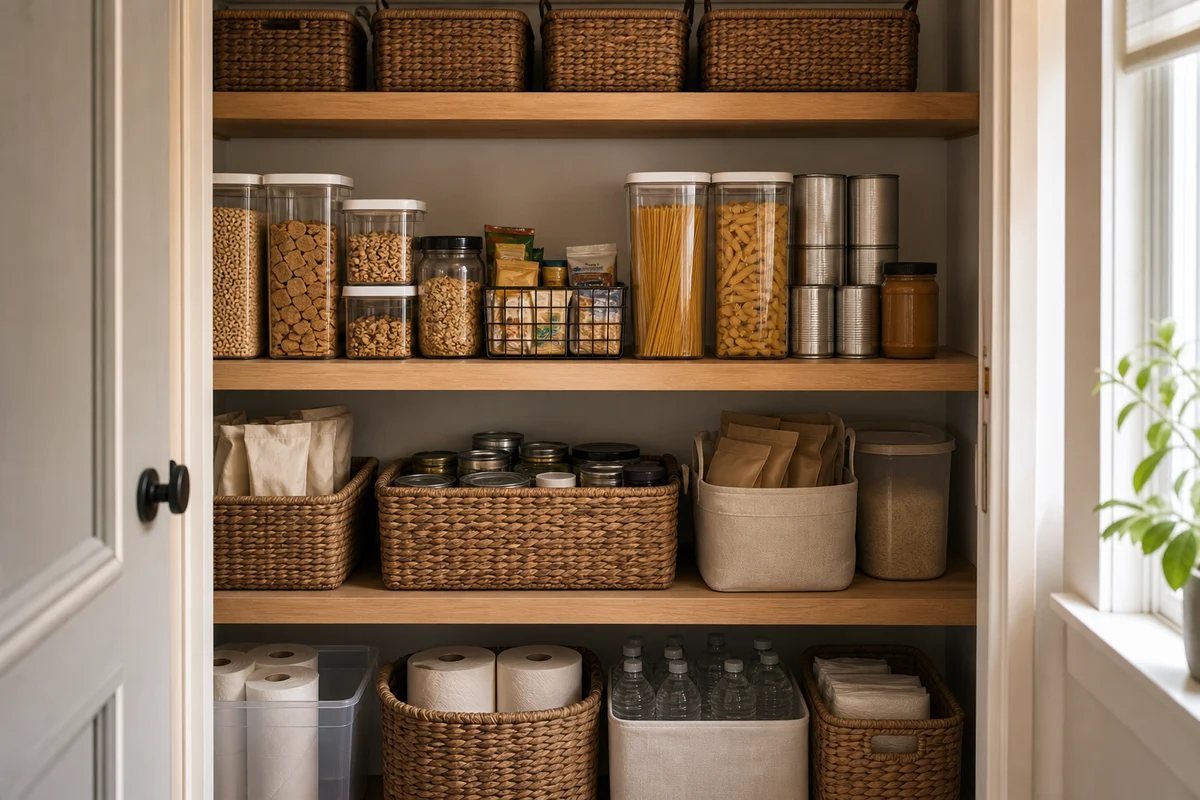
This pantry stacks by frequency, not by category. Top shelf: four woven baskets of overflow, the stuff you don’t need to see this week.
Middle shelf: clear airtight canisters of cereal, grains, spaghetti, plus a small wire basket of packets and a row of stacked cans — all the daily food at hand height. Bottom shelf: another row of baskets for refills and dry goods. Floor: paper towel rolls and water bottles in tall plastic bins.
The split between daily and backstock is what keeps a pantry calm at the end of the week. When backstock lives in the same row as daily food, you reach past four extra cans every time you want pasta. Two zones — eye-level for daily, top or bottom for backstock — solve the problem without buying anything.
Use Baskets to Absorb the Visual Noise
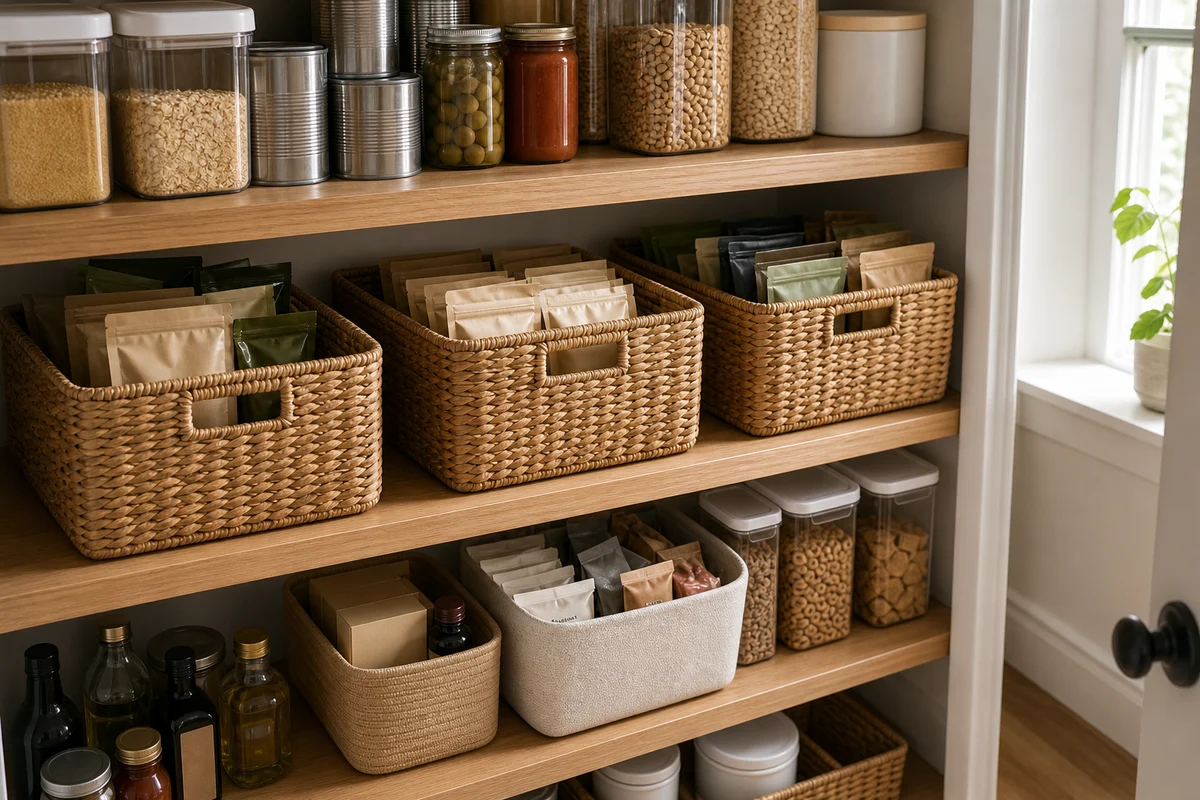
Three matching seagrass baskets sit on the middle shelf here, each one absorbing the mess of real packaging — kraft pouches, jars, soft pouches with colored caps — into one calm woven shape. Above, clear airtight containers hold the staples that look good visible. Below, two more baskets and a slim cream fabric bin keep the bottom shelf from showing every label.
You don’t need to decant everything. You need to hide the categories that are visually loud. Snacks, refill pouches, mixed packets, and anything with bright marketing color belongs in a basket. Anything with calm packaging — glass jars, kraft, plain canisters — can stay visible. The basket is the cheapest, fastest fix in pantry organization.
Keep Clear Containers for the Staples That Earn It
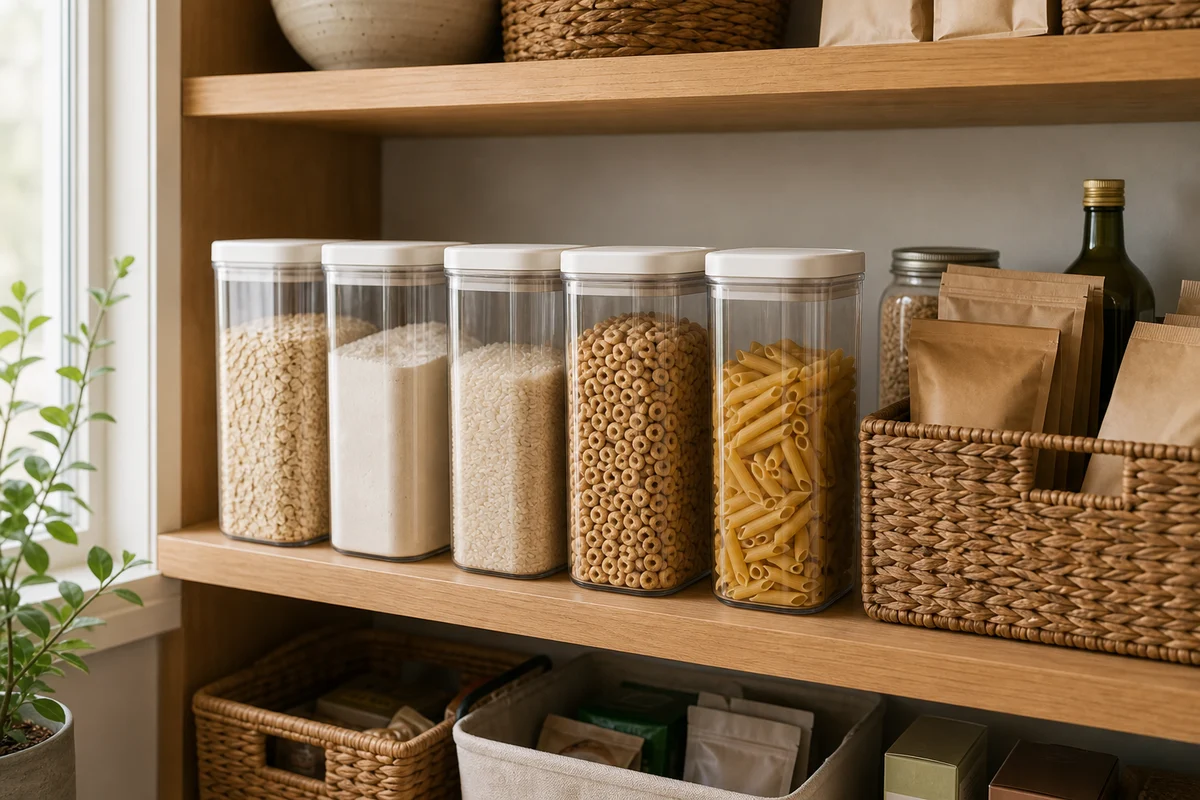
Five identical square clear canisters with white tops sit in a row on this shelf — brown lentils, flour, white rice, oat cereal, penne pasta. Five. Not fifteen. To the right, a woven basket holds the kraft pouches that didn’t earn a container.
Clear containers work for the ingredients you use weekly and refill from a known source. They don’t work for the snack you only buy sometimes, the spice you tried once, the bag you might not finish.
Pick the five-to-eight staples your household actually goes through, decant those, and let everything else stay in its original packaging behind a basket. An all-clear-container pantry looks great on Pinterest and falls apart by month two.
You don’t need all nineteen. Pick the row that matches your worst shelf and jump to the two or three moves that fix it.
Make Snacks Easy to Grab But Hard to Scatter
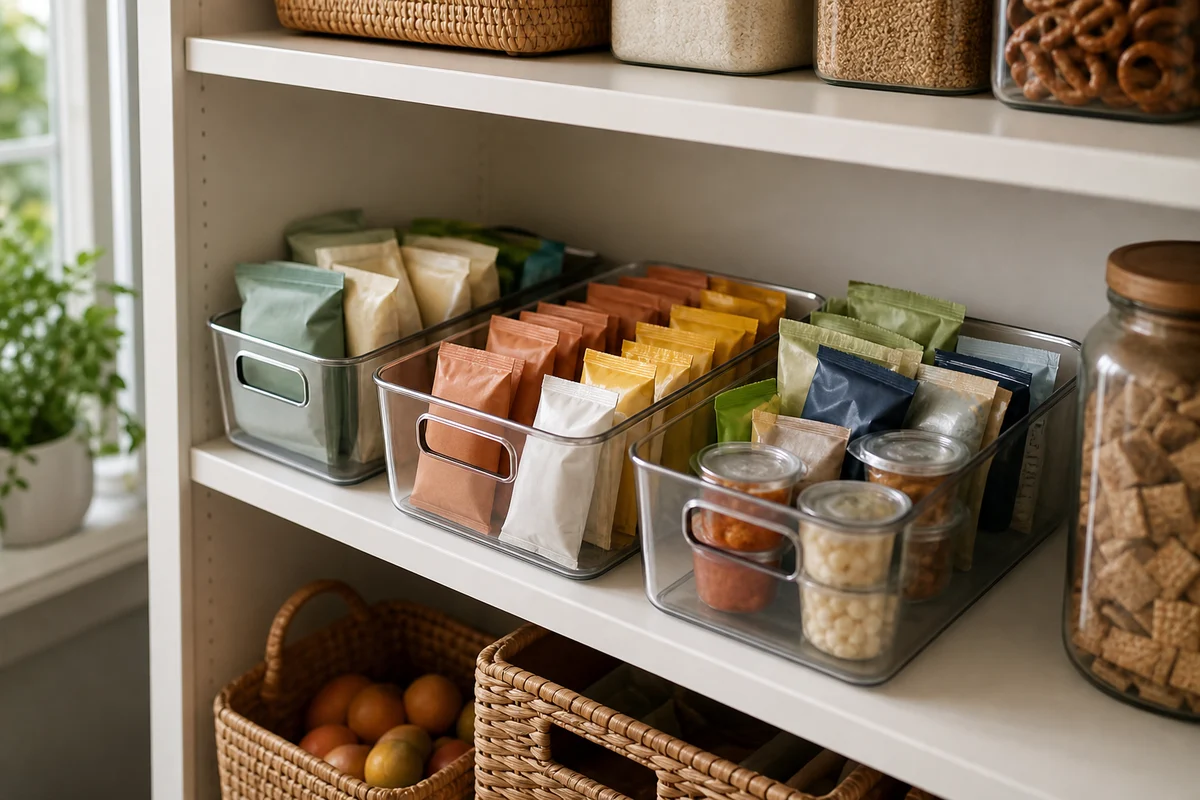
Three clear plastic bins on a soft white shelf, each holding a single snack category — the left bin in pastel pouches (granola bars), the middle in colorful chip-style packs standing on edge, the right in mixed pouches plus stacked deli cups of dried fruit. A kid (or you) reaches in, grabs a pouch, and the rest stays upright because the bin walls hold them in place.
The trick is the bin wall. Snacks scatter when there’s nothing keeping them vertical — they tip over, slide forward, and the back ones get forgotten until they’re expired. A bin tall enough to hold a pouch upright plus narrow enough to make pouches lean on each other equals a self-organizing snack shelf. One category per bin.
Create a Breakfast Zone So Morning Takes One Shelf, Not Three
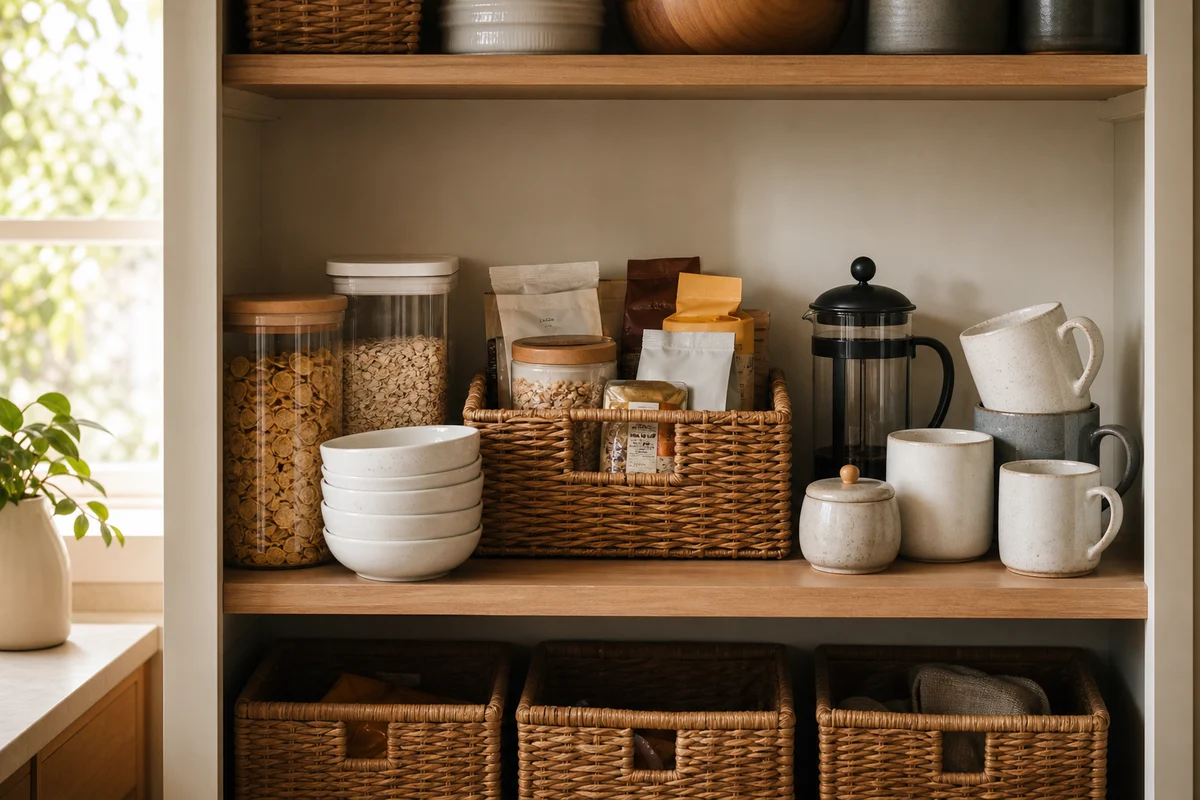
This corner of the pantry collapses breakfast into one shelf. A tall glass jar of cereal flakes, a shorter canister of oats, a small woven basket with coffee and tea pouches, a French press, a stack of bowls, three matching stoneware mugs. Below, three identical woven baskets hold the overflow. Above, a hint of weekend mugs and ceramics.
A breakfast zone works because mornings are the slowest decision-making time in your week. The fewer cabinet doors you have to open between waking up and pouring coffee, the better the morning goes. Group it tight: cereal plus oats plus coffee plus tea plus bowls plus mugs, all within one arm sweep. The premium feel here is just calm tones and matching shapes — not anything expensive.
Give Baking Supplies One Shelf, No More
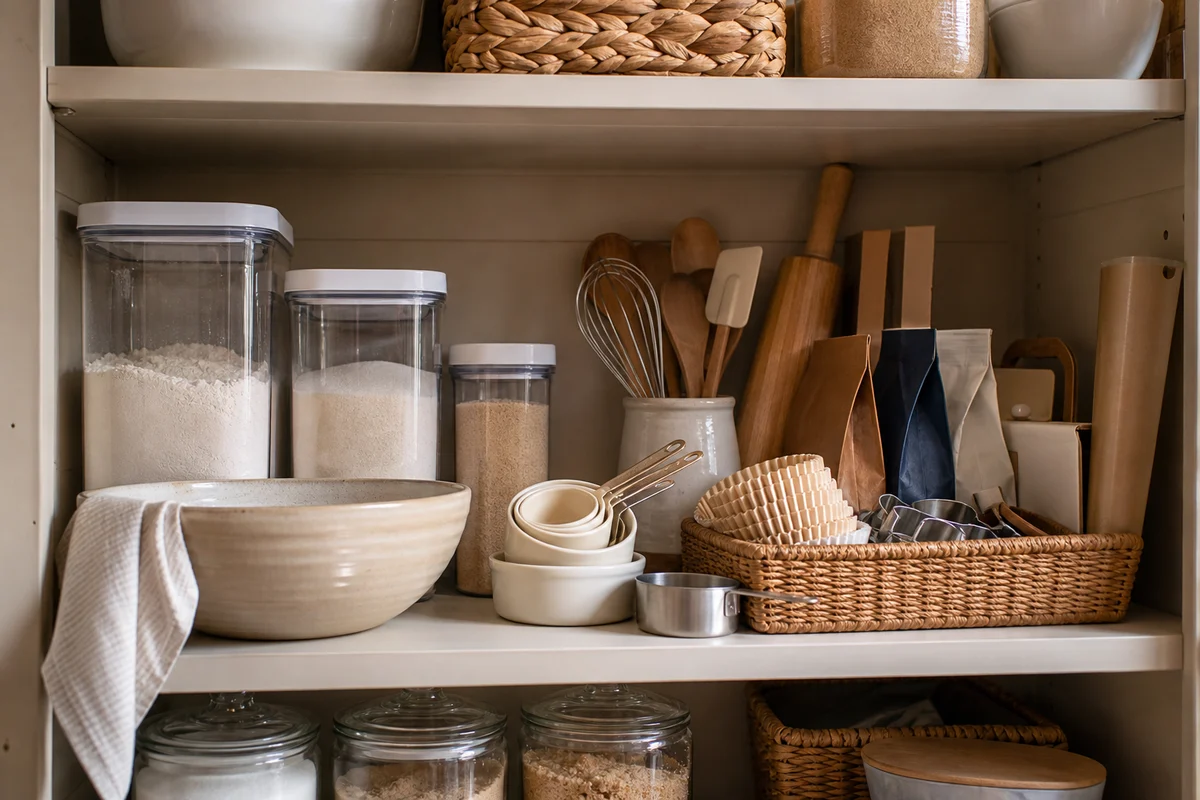
One shelf, the full baking world. Three square clear airtight canisters with flour, sugar, brown sugar — at scoop height. A tall ceramic crock with whisks, a rubber spatula, a rolling pin, measuring spoons. A large stoneware mixing bowl with a folded cloth napkin tucked in. Nested measuring cups.
A woven basket holding cupcake liners, cookie cutters, kraft paper bags, and folded parchment. Above and below, more storage for what doesn’t need to be at hand.
Baking gets unmanageable when it leaks across three shelves. One dedicated shelf — flour at scoop height, tools in a single crock, paper goods in one basket — turns “I want to bake this weekend” from a search problem into a one-shelf problem. If you bake more than twice a month, this shelf earns its space ten times over.
Park Oils and Vinegars on a Shallow Tray
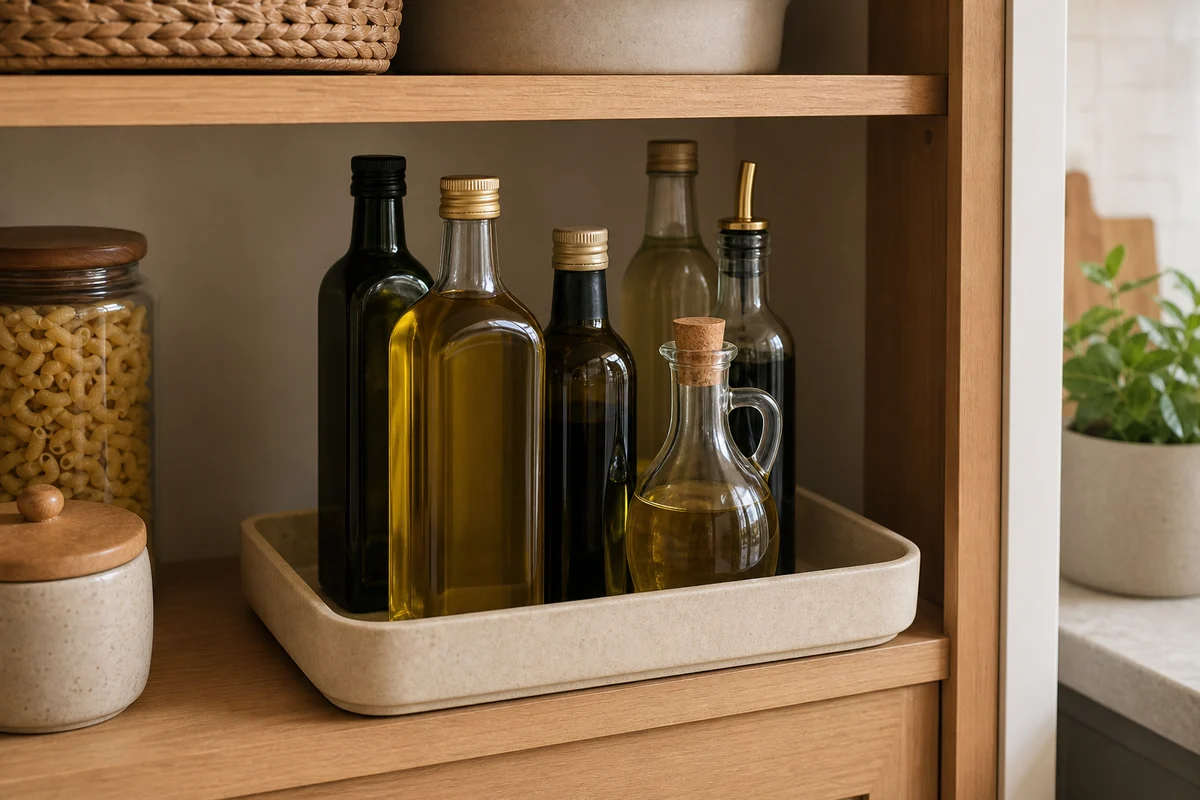
Five or six oil and vinegar bottles cluster on a low stoneware tray inside this pantry cabinet — dark green olive oil, a gold-cap bottle, a corked carafe with a brass pour spout, two amber sauces. Around them, a pasta jar, a woven basket, a plant in a small pot. The tray gives the cluster a visible edge.
Bottles are the messiest pantry item because they drip, leak, and slowly stain whatever shelf they sit on. A shallow stoneware or wood tray contains the drips, gives the bottles a defined zone, and lets you lift the whole group out when you wipe the shelf underneath. The tray is also what stops oils from spreading sideways across the shelf the way they always do.
Use a Turntable for the Small Jars and Condiment Cluster
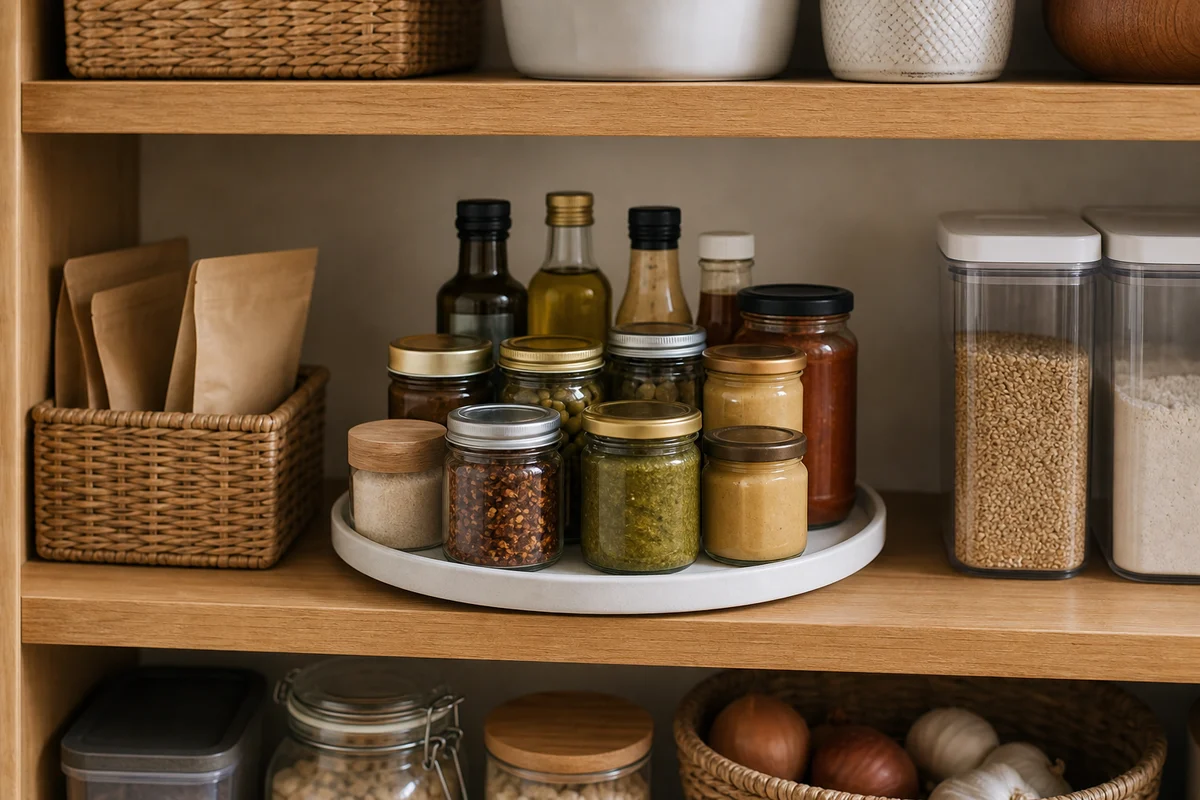
A round white ceramic lazy susan rotates inside this shelf, holding the small-jar tribe: chili flakes in a clamp jar, green pesto, dijon mustard, tomato sauce, marble-lid spice jar, plus three taller bottles in the back row. To the left, a wicker holder of kraft pouches. To the right, tall clear grain canisters. Below, a basket of shallots and garlic.
The turntable is the answer to the “back of the shelf” problem. Small jars hide behind taller ones, you forget you have them, you buy duplicates. Spin the susan once and you see every jar in three seconds. One 10-12 inch turntable per problem shelf is usually enough — they cost less than a single drawer organizer and they outlast labels.
Pantries fail for predictable reasons. These four rules keep the system running through a real week of grocery shopping, snacks, and family use.
Keep Cans in Short Rows, Not Towers
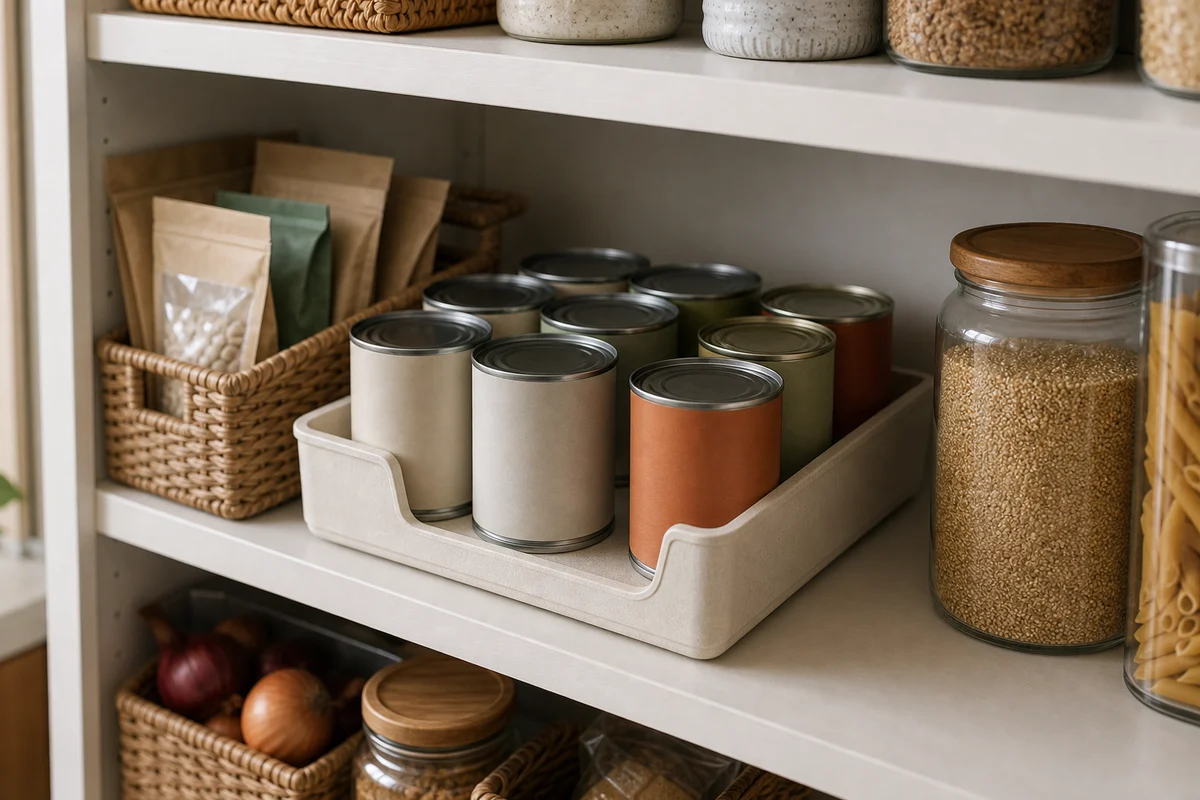
Nine plain cans sit in a low cream pull-out tray — three across in two rows with a smaller front row. The labels are calm earth tones (off-white, sage, coral, olive) so the row reads as one block, not nine competing fronts. Around the tray: a basket of kraft pouches on the left, tall grain canisters on the right, baskets of onions below.
Stacking cans is what eventually breaks a pantry. The bottom can has a dent before you reach it, the middle row gets forgotten, the top row falls over when you grab the wrong one. Short rows in a shallow tray solve all three problems and let you see the entire inventory standing up. If the tray pulls out, even better — back-row cans get used instead of expiring.
Add a Slim Rolling Cart When There’s No Real Pantry
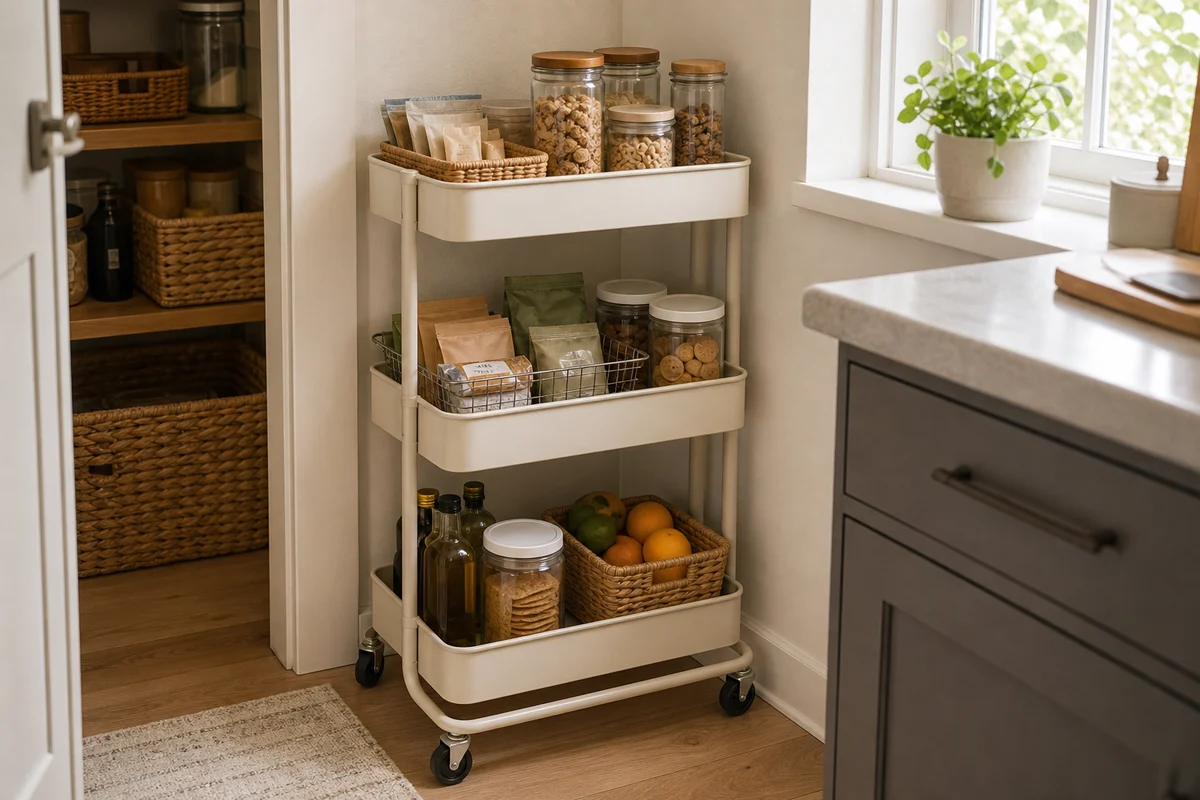
This rental-friendly kitchen solves the no-pantry problem with a slim white three-tier rolling cart. Top tier: wicker basket of kraft pouches plus three clear jars with bamboo lids.
Middle: wire basket with packets and a cookie jar. Bottom: woven basket with citrus, an olive oil bottle, a cracker jar, a plain canister. Through the doorway behind, an actual pantry exists for somebody else — but here, the cart is the pantry.
For renters, small kitchens, or any home without a real pantry, a rolling cart absorbs 60-70 percent of what a pantry holds at a fraction of the build-out cost. Pick one in a calm color (cream or matte black, not chrome), park it in a 12-inch gap, and rotate it for cleaning. More small-space furniture moves like this work alongside the cart for the rest of the kitchen.
Mount a Door Rack for the Light, Flat Stuff
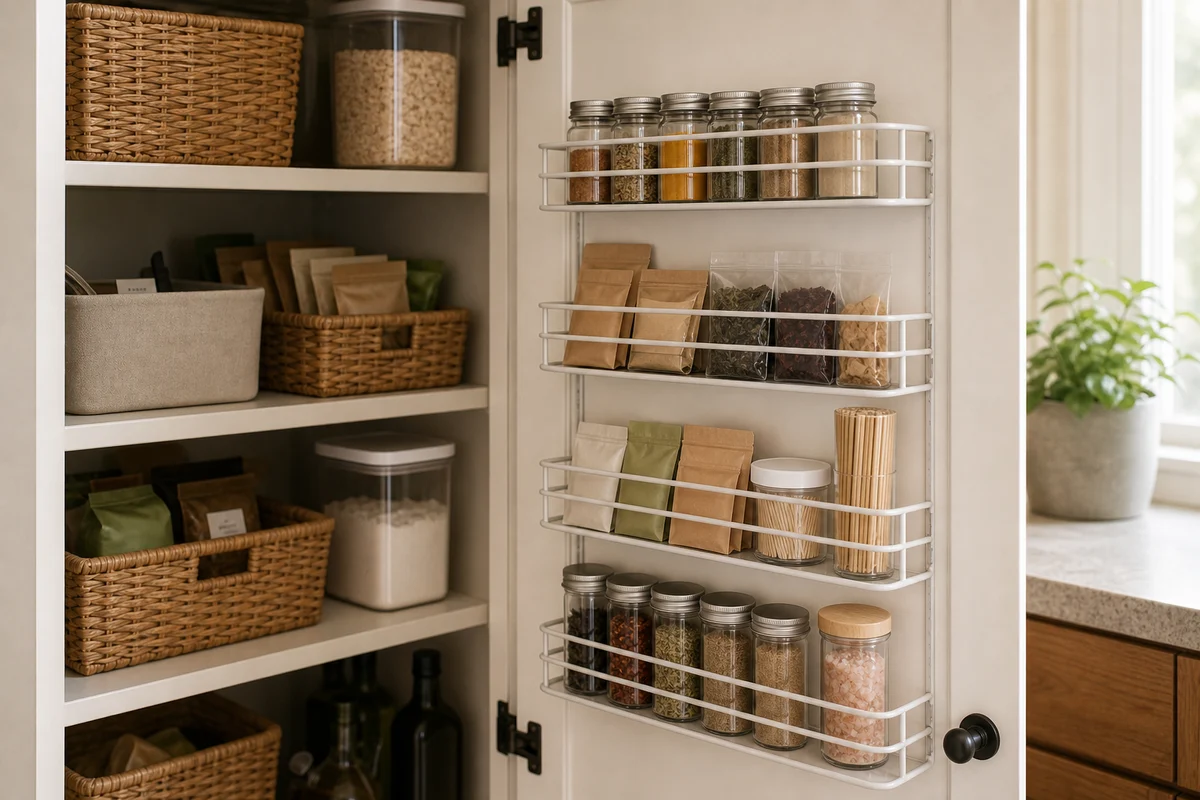
The inside of this pantry door wears a white wire 4-tier rack: top row of spice jars, second row of kraft pouches plus clear single-serve packets, third row of more pouches and tall thin items (skewers or pasta sticks in a clear jar), bottom row of seven more spice jars. The cabinet behind keeps its full depth for baskets and bins.
Door racks are pure free real estate, and they’re best for one specific category: light, flat, frequently-reached items. Spice jars, single packets, pouches, foil and parchment boxes if they’re short enough. Don’t try to put cans or heavy jars on a door — they’ll pull the hinges over time. Keep it light, keep it busy, and you’ll buy back a full shelf inside the cabinet.
Build a Kid Snack Zone That Survives a Real Week
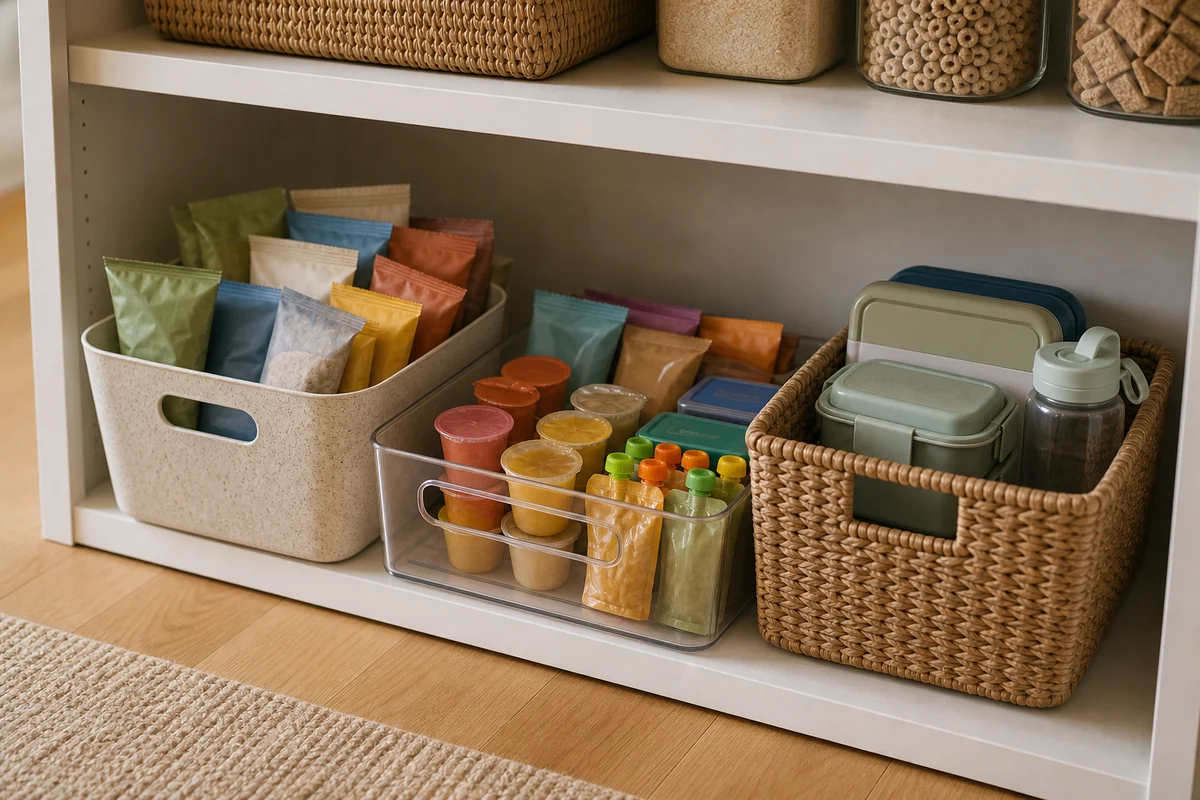
A low shelf with three bins side by side: cream plastic with cream and pastel pouches, clear plastic with rows of pastel snack pouches plus small plastic cups of fruit and applesauce, woven basket with stacked mint-green bento boxes and an insulated water bottle. Everything at kid height, everything in its own bin.
A kid snack zone works because the bins enforce the rule “one pouch at a time” without anyone saying it. A kid grabs one, the rest stay upright. The bento boxes live next to the snacks so packing lunch is one stop. Keep the zone low enough for them to self-serve and small enough that you can scan it in a glance to know what to restock.
Keep Heavy Items Low, Always
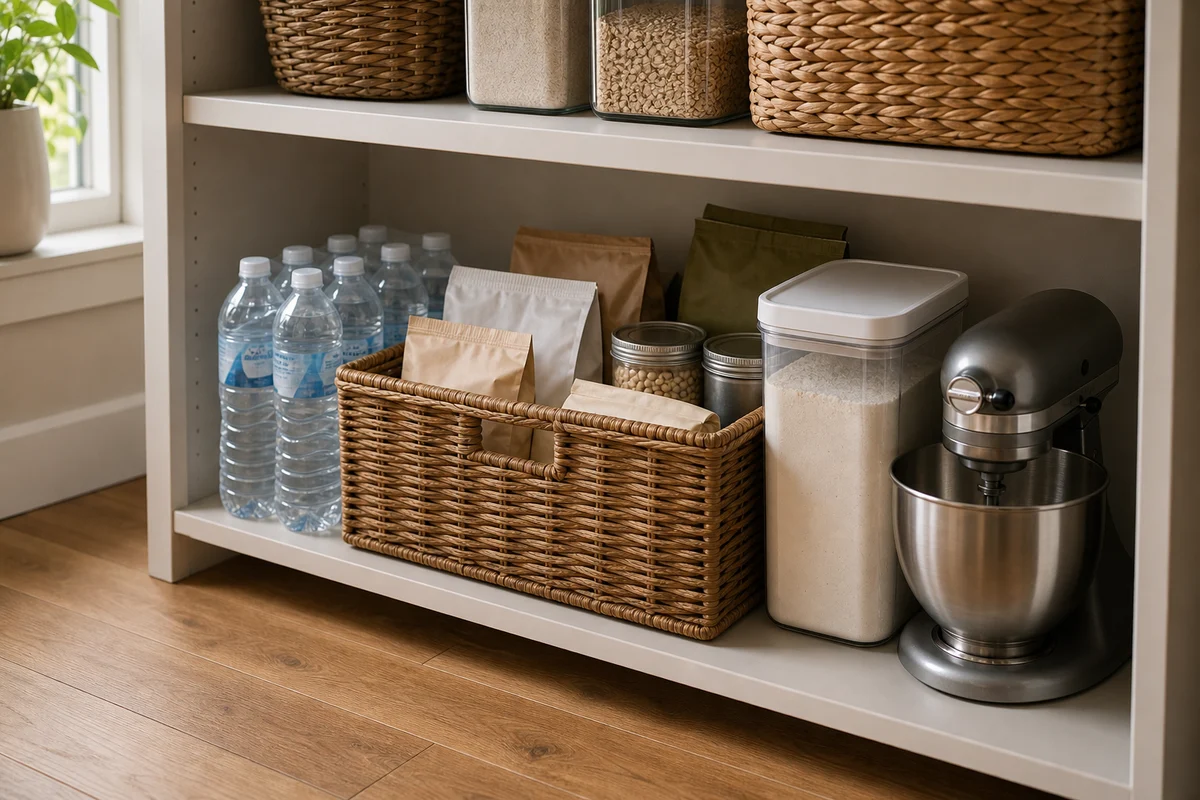
The lowest shelf in this pantry holds the weight: a row of 1.5L water bottles on the left, then a large woven basket of refill pouches and small canisters, a tall airtight plastic bin of flour, and a stainless stand mixer on the far right. Above, lighter grain canisters and woven baskets.
There’s no upside to lifting heavy things off a high shelf. Bulk drinks, big flour bins, appliances, backup oil bottles — all of it belongs at knee height or floor. Top shelves are for paper goods, snacks, and the lighter overflow. If your current pantry has the heavy stuff up top, swap shelves before you organize anything else.
The 4-Rule Pantry Formula
- 1Zone firstDaily, backstock, snacks, baking, dinner, kid zone — every item earns one zone.
- 2Basket the noiseMatching baskets absorb the messy packaging that decanting can’t fix.
- 3Heavy items lowBulk drinks, flour bins, appliances, oil refills — knee height or floor, never top shelf.
- 4Reset weeklyA two-shelf scan before grocery shopping keeps the system from drifting all month.
styledhomenotes.com
Leave One Shelf Intentionally Empty
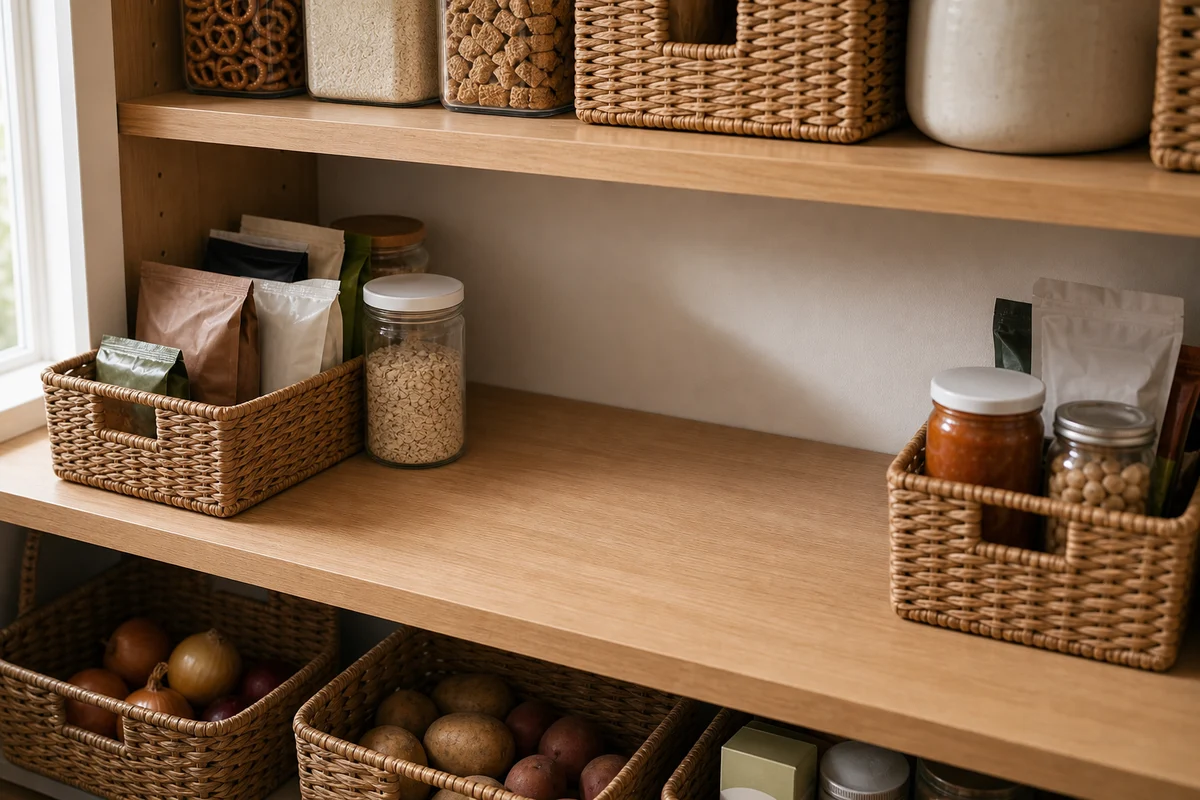
This pantry shelf is half full and half empty on purpose. Left side: a small basket of kraft pouches plus a clear jar of oats. Right side: a tiny basket with a sauce jar and a chickpea jar. The center: a 24-inch stretch of bare wood. That gap is the landing zone for grocery bags before they get put away.
Most pantry-organization advice forgets the moment groceries actually arrive. They sit on the counter for an hour because there’s no shelf to land them on.
One intentionally-empty shelf or one clear stretch of counter solves that — you put the bag down, sort, and put away. The shelf doesn’t need to stay empty forever, but giving it a default of empty keeps the pantry working on grocery day.
Group Dinner Staples So Cooking Starts in One Place
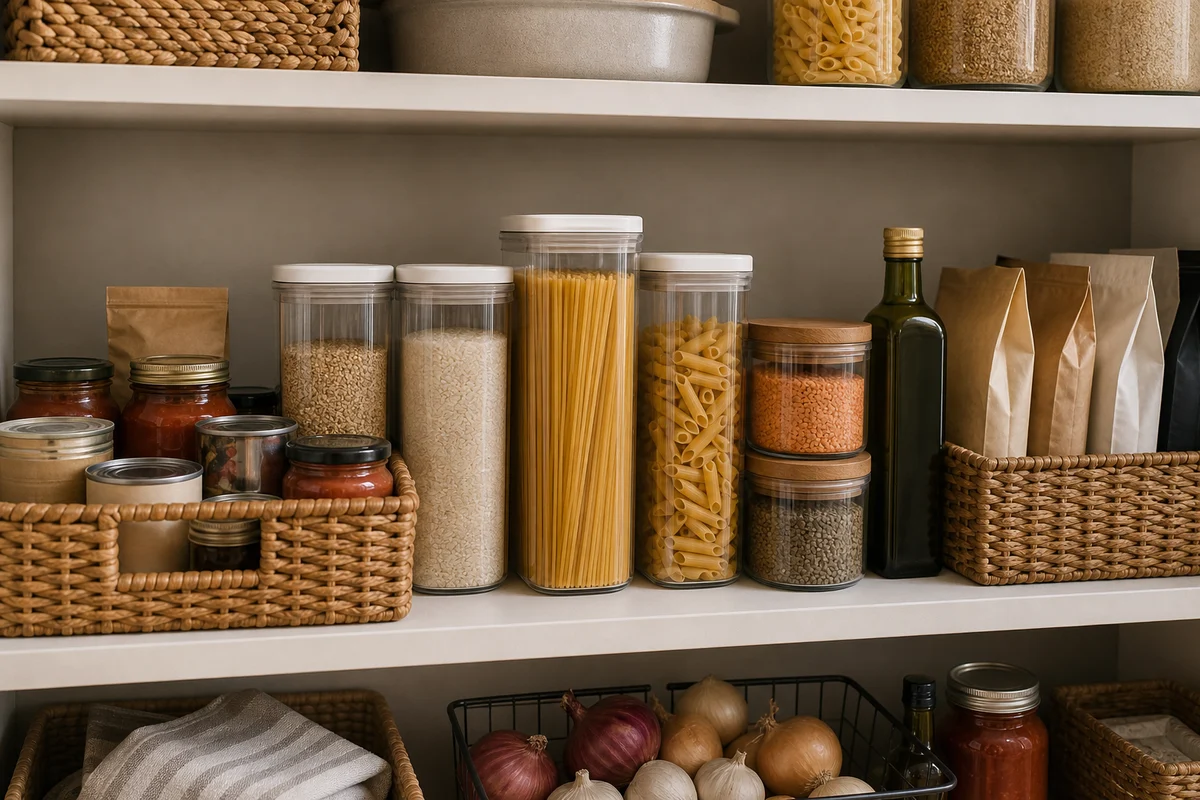
This shelf is the dinner shelf. Clear airtight square canisters of basmati, spaghetti vertical in a tall jar, penne in another, jars of marinara and pesto on the left, a basket of kraft pouches on the right, smaller jars of orange and brown lentils. Below: a basket of cloth napkins, a basket of onions and garlic, more grain jars.
Dinner cooking starts faster when pasta, sauce, grains, and aromatics are all on one shelf. You’re not opening four cabinets to assemble a Wednesday meal — you grab pasta, you grab sauce, you go. Pair this with the cooking-zone drawer beside your stove (covered in our kitchen organization guide) and a weeknight dinner gets ten minutes faster.
Use Labels Sparingly, Never as Decoration
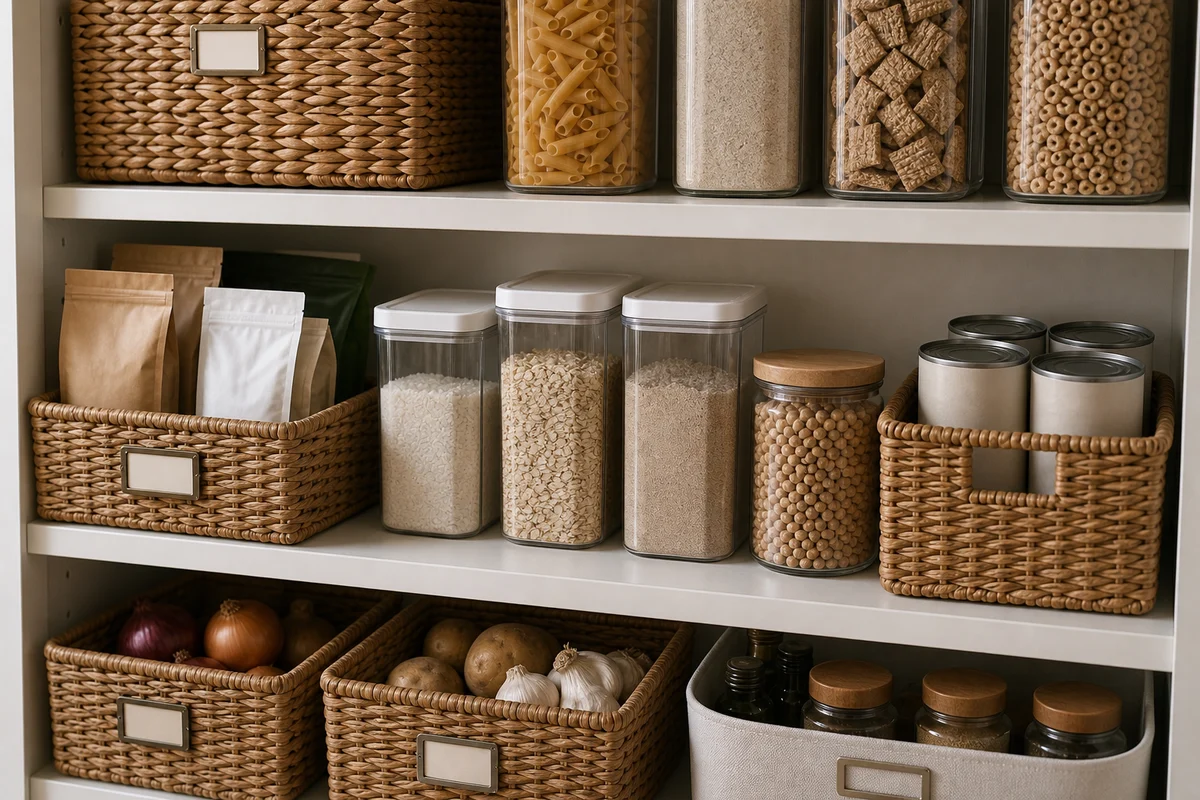
Each basket on these pantry shelves wears a small white tag tied to the front — tiny, faded, almost invisible from a distance. Just enough to remind you what’s in the basket from across the room. The tags aren’t a design feature; they’re a sticky note that happens to look calm.
The pantries that survive label rules: keep them small, keep them few, and never let them become the visual focus. One small tag per basket is enough. If you’re tempted to print a 36-jar label set with fonts and icons, skip it — that pantry photographs once and then a kid puts the cereal back in the wrong jar and the system breaks. Sparse labels age better.
Build a Cabinet Pantry When There’s No Walk-In
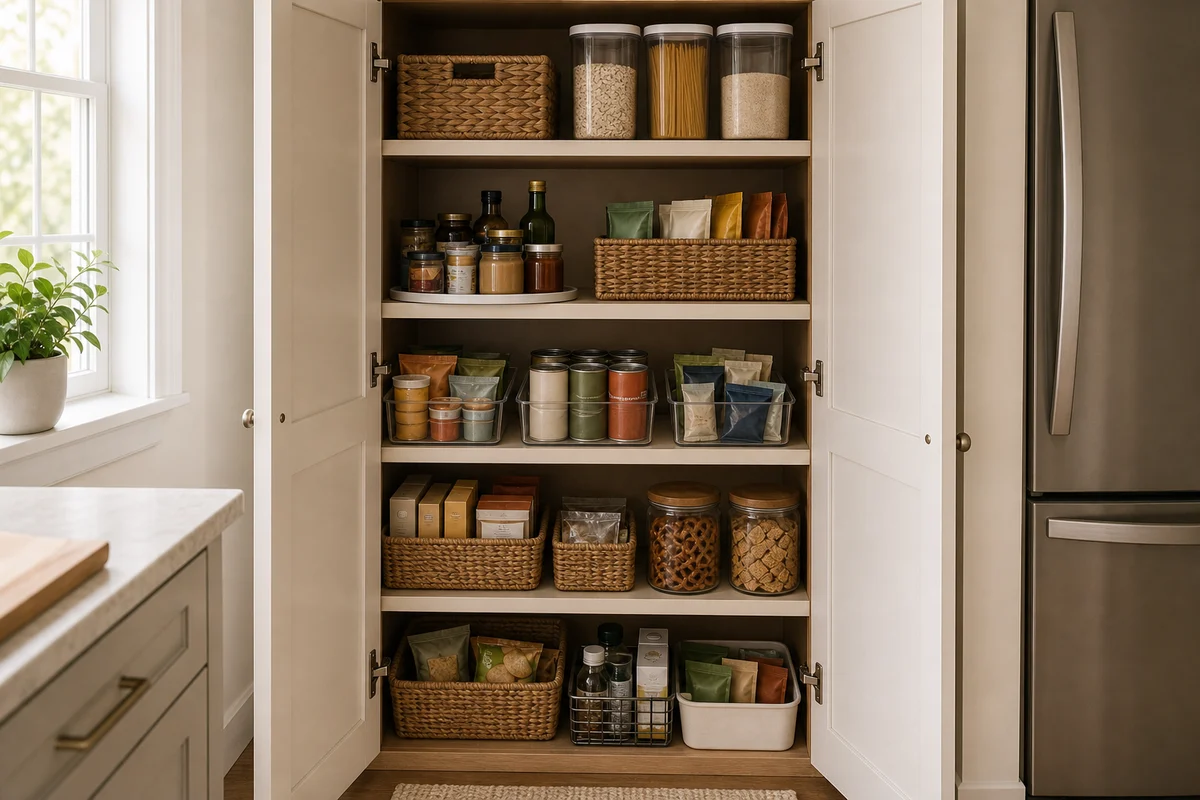
Both doors swing open on this floor-to-ceiling cabinet pantry, beside a stainless fridge.
Five shelves, every shelf zoned: top for daily grain canisters, second for oils on a marble lazy susan plus a basket of color-block kraft pouches, middle for snack bins and a row of plain cans, fourth for baskets of boxes and cookie jars, bottom for refill baskets and a wire holder of olive oil. Inside one tall cabinet: a whole pantry’s worth of organization.
A cabinet pantry is the realistic upgrade for any home without a walk-in or butler’s pantry. The trick is treating it like a real pantry — zones by frequency (daily, weekly, backstock), one shelf per task, and doors that close when you’re done. Don’t put dishes or anything non-food in it; pantries fail when they become “miscellaneous storage” with cereal on the side.
Reset the Pantry Before You Go Shopping
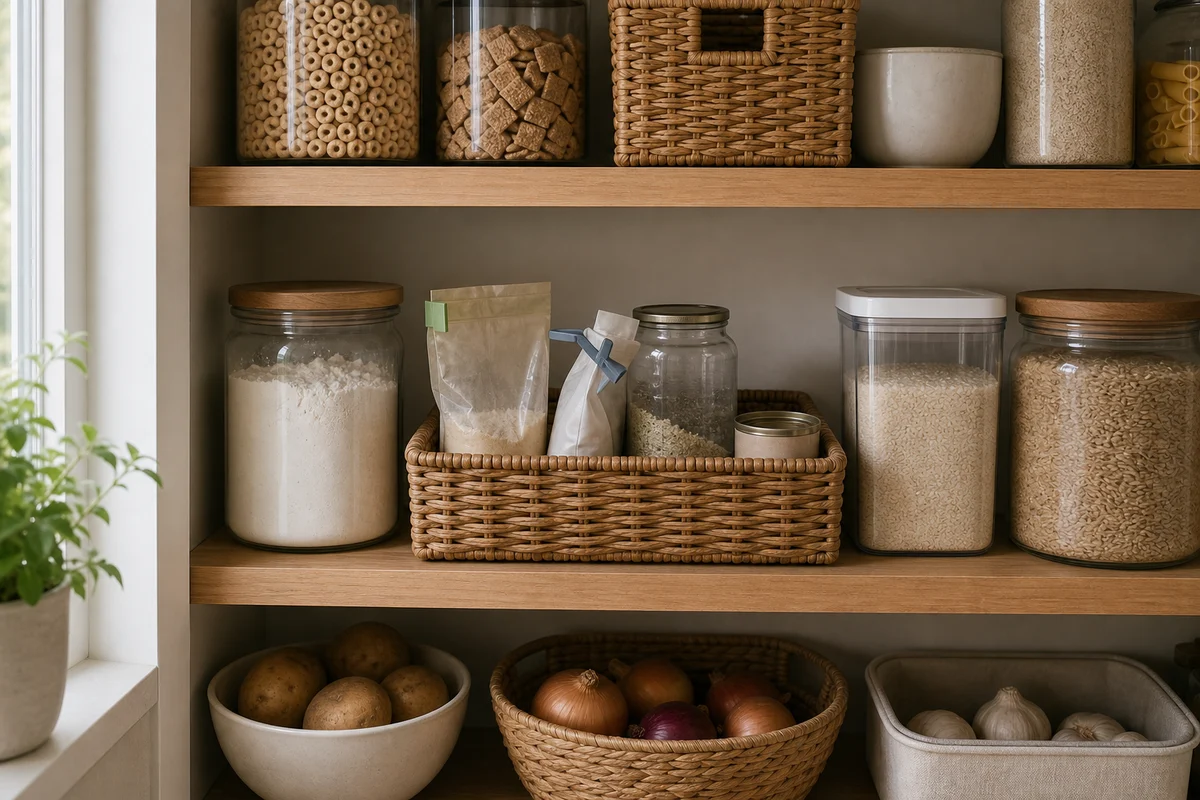
A modest two-shelf view: a row of clear airtight glass containers with light wood lids holding oats, beans, grains, plus a smaller jar of dark beans. Middle shelf: a small basket of kraft pouches, two clear smaller canisters, and a glass jar of granola. Bottom: a ceramic bowl of potatoes, a wicker basket with onions and garlic, a partial cutting board.
The reset shelf is the only weekly habit that keeps a pantry from drifting. Friday afternoon or Sunday morning, before the grocery order, scan two shelves: what’s almost empty, what’s about to expire, what needs to be used this week. The list writes itself. Skip this and you’ll buy the third jar of lentils because nobody noticed there were already two.
You don’t have to do all nineteen
Pick the shelf that frustrates you most this week — the snack bin that scatters, the can shelf that towers, the door that closes on a wrap box — and fix that one. Next week, pick another.
A pantry that holds up isn’t the one that photographs well on Sunday. It’s the one that still works on a busy Thursday.
The order is always the same: zone by frequency, contain the visual noise, leave a landing space, reset before shopping. For more practical kitchen and small-space moves that work alongside this pantry guide, see our kitchen organization guide and our small-space storage ideas.

Nora Ellis edits Styled Home Notes, where she shares practical decorating, organization, and small-space ideas for creating a more styled and functional home. Every article is reviewed for clarity, usefulness, image sourcing, and Pinterest-to-page alignment before publication. Visit the Nora Ellis author page.