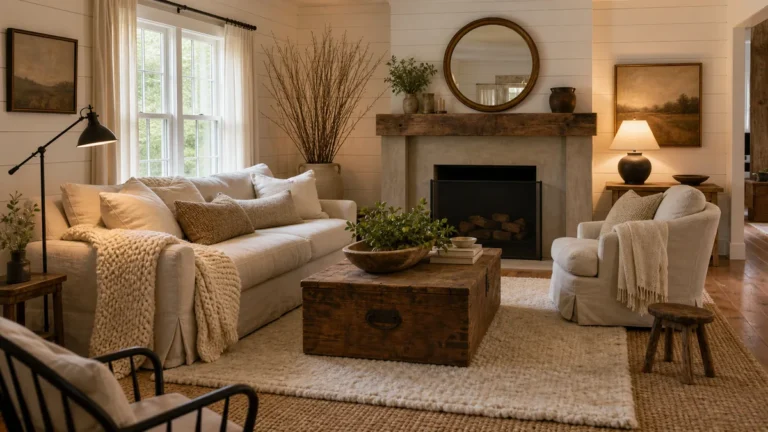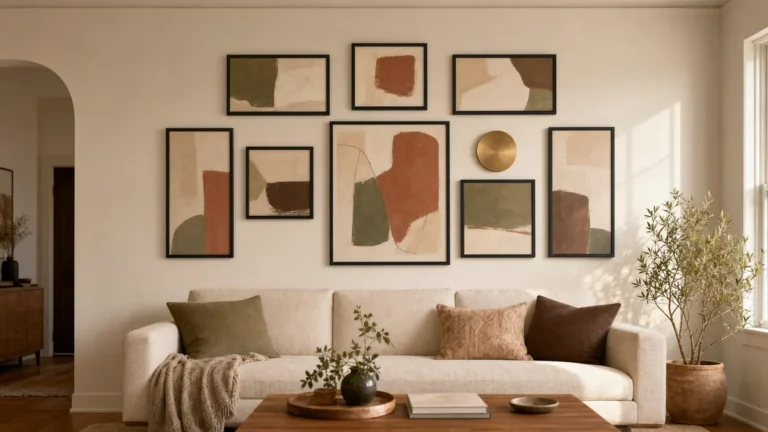
10 Boho Living Room Ideas for a Relaxed, Layered Space
“Boho” gets used so loosely that it has stopped meaning anything specific. String lights, a single macramé piece, one cactus on a windowsill — somehow that gets called a boho corner. A real boho living room is doing something different. It is layered, lived-in, warm, anchored in earth tones, and built from a small number of defining moves rather than a starter pack you buy in one trip.
Below are 10 of those moves, each shown in a real living room. None of them requires a full redesign. If you want a warmer room without committing to one specific style yet, the cozy living room ideas piece covers warmth across registers — this one narrows it down to one.
Skim the list, jump to the move you want to try first. Ten boho-defining ideas grouped from core furniture to atmosphere — you can do them one weekend at a time.
Anchor the Room with Rattan and Woven Core Furniture
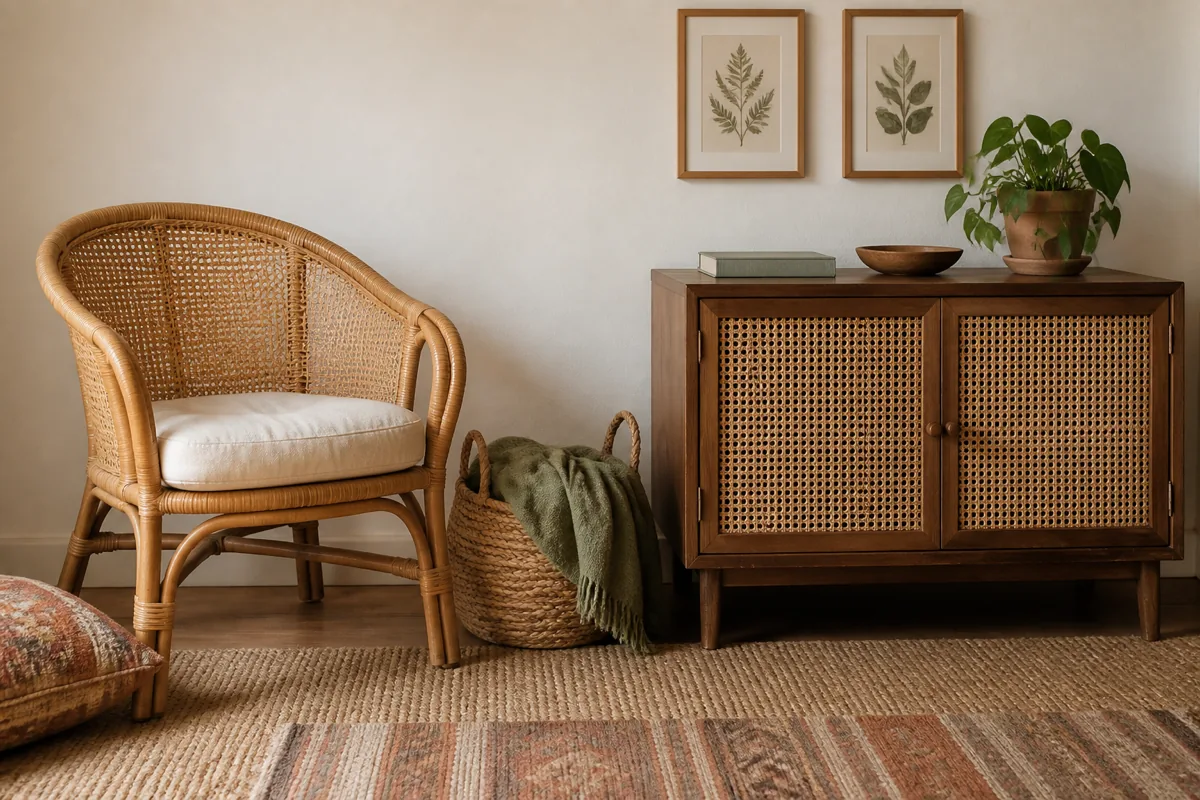
The fastest way to make a room read as boho without leaning on accents is to put rattan, cane, or seagrass into the core furniture — not just the decor.
The picture above shows that idea at its most efficient. One curved-back rattan armchair on the left, one cane-fronted sideboard on the right, and the room is already reading as boho before you add a single throw pillow. The woven texture in two pieces of furniture does more visual work than ten small accents would.
A few notes on choosing the pieces. A rattan accent chair is the lowest-commitment way in — it sits next to whatever sofa you already own. A cane-fronted sideboard, console, or media cabinet replaces a piece you probably already need, so the upgrade pays its way. Skip the “peacock fan” rattan chair shape — it has become so over-shared on Pinterest it now reads as costume rather than style.
Hang One Large Macramé Piece Over the Sofa
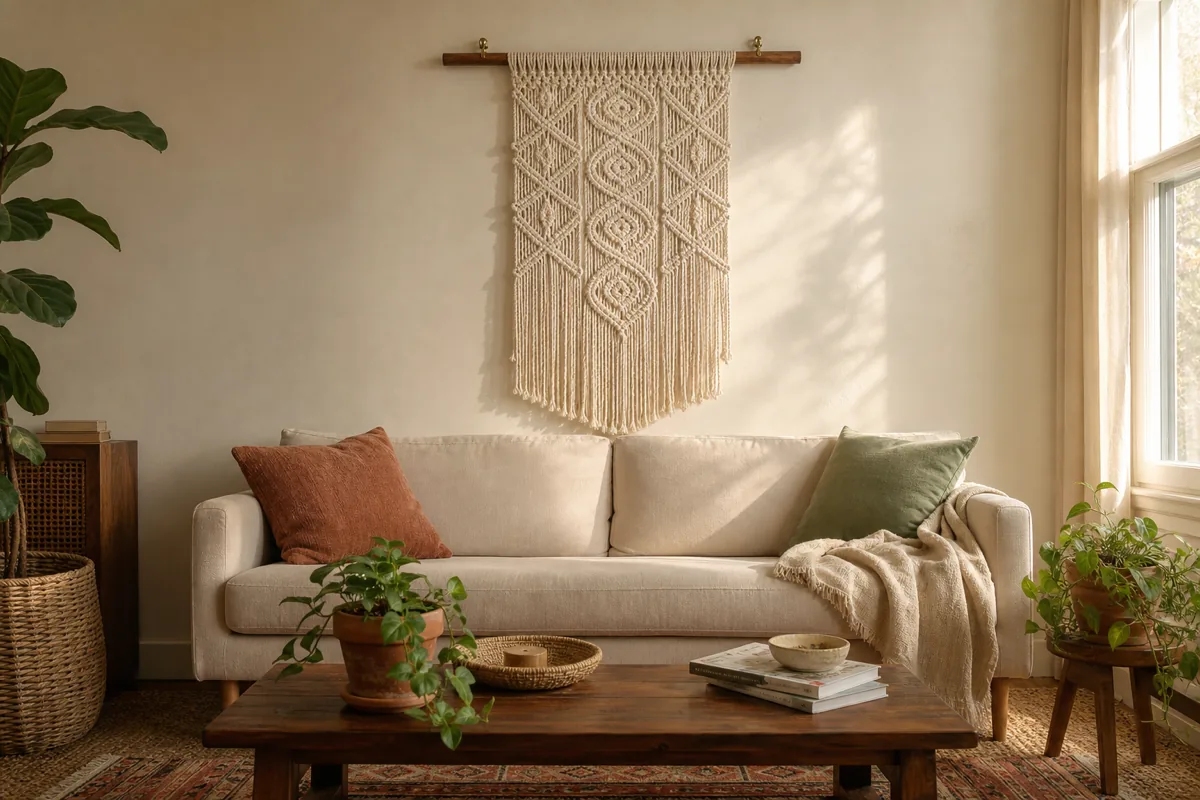
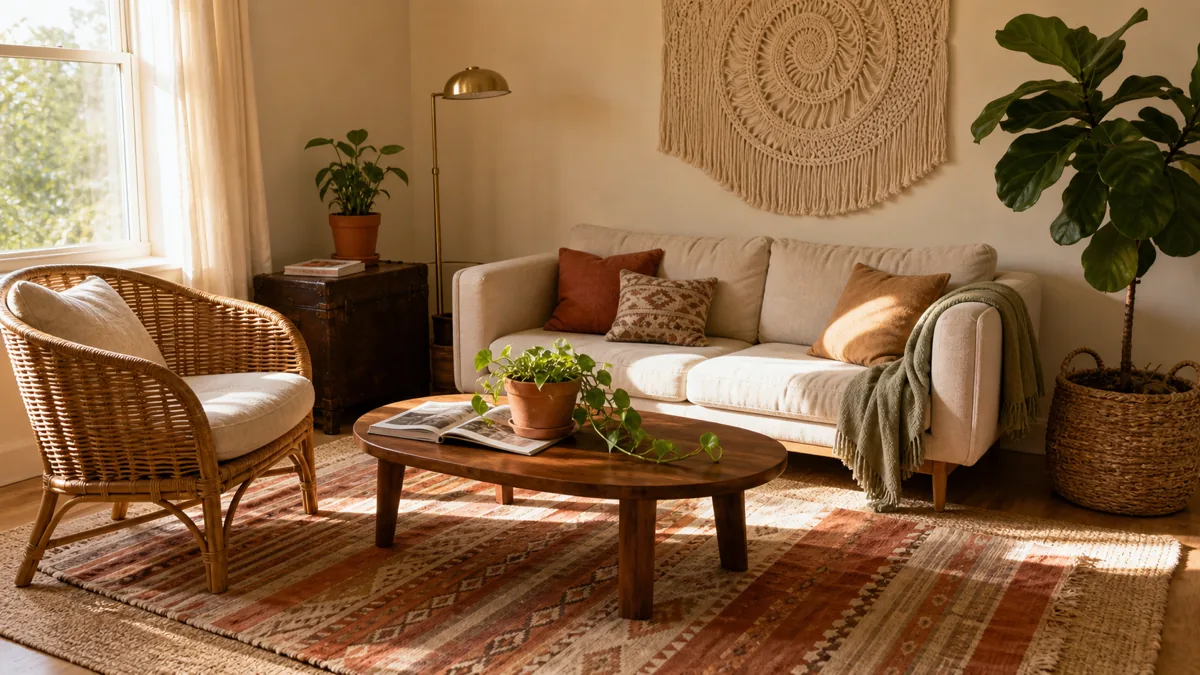
The reflexive boho move is to hang a lot of small macramé pieces in a wall cluster. The better move is one large piece, centered above the sofa, with nothing competing.
The hanging in this picture is roughly a third the sofa’s width and most of the wall height behind the headrest line. That scale is the point — small macramé in a big wall slot reads as an afterthought; one large piece reads as a deliberate anchor. The wooden dowel rod is visible at the top, which is exactly what you want — visible structure is part of the texture, not a flaw to hide.
If you can only do one wall move in this room, this is the one. Skip the cluster of three or four small pieces unless you already own them — you can usually trade them on Facebook Marketplace for the price of one larger piece.
Boho splits into three reading lanes. Pick the one that matches the room you actually want, then start with the three ideas tagged below — the others can wait.
Layer a Vintage Kilim Over a Natural Jute Rug
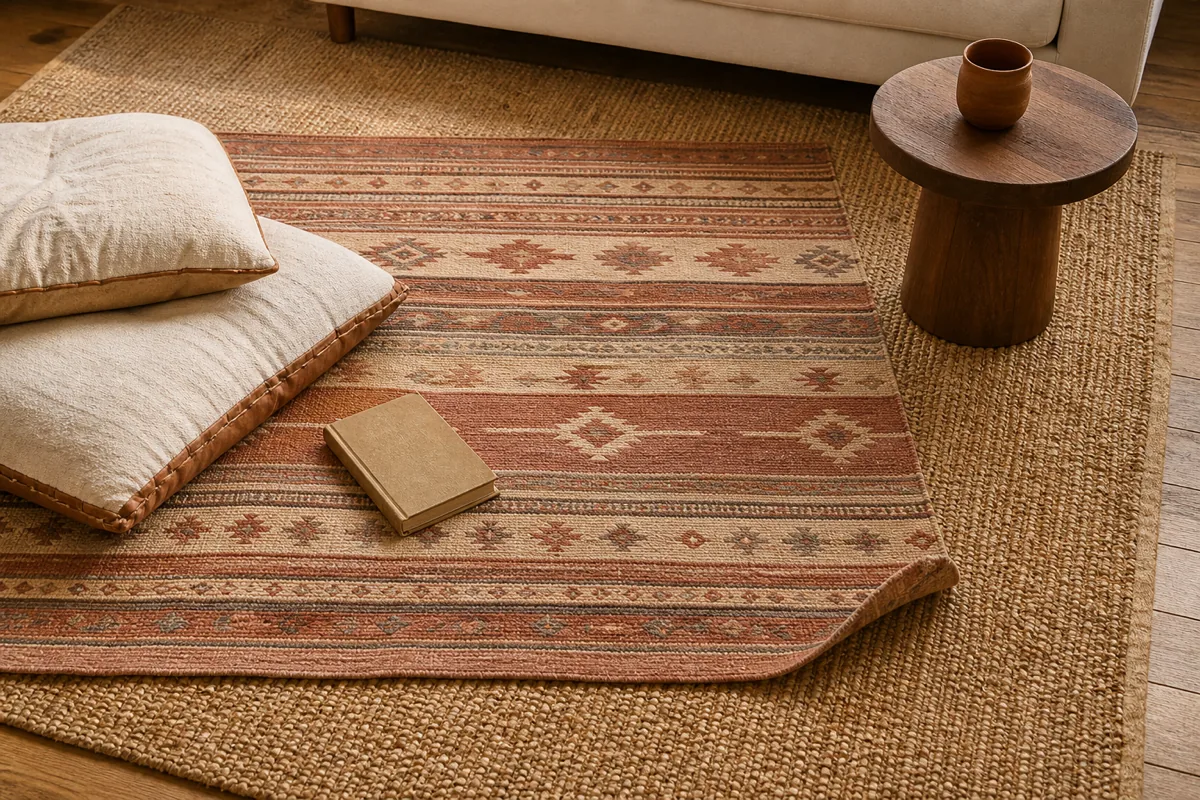
A single jute rug is sturdy but visually flat. A single kilim is patterned but thin and slippery on a hardwood floor. Stack them and each one solves the other’s problem.
The image above shows how the proportions should land. A large jute rug as the base — its border visible on at least two sides of the smaller rug — and a smaller patterned kilim sitting centered on top. The visible “step” where the kilim sits about a half-inch above the jute is part of the look. It tells the eye that two rugs were placed deliberately, not that one rug bunched up.
If your living room is on the smaller side, layered rugs do the unexpected thing of making the room read bigger — the larger jute defines the whole zone, the smaller kilim defines a conversation area inside it. The small living room ideas piece covers more layout moves that stack on top of this one.
Add Floor Cushions and Low-Slung Seating for a Lounge Zone
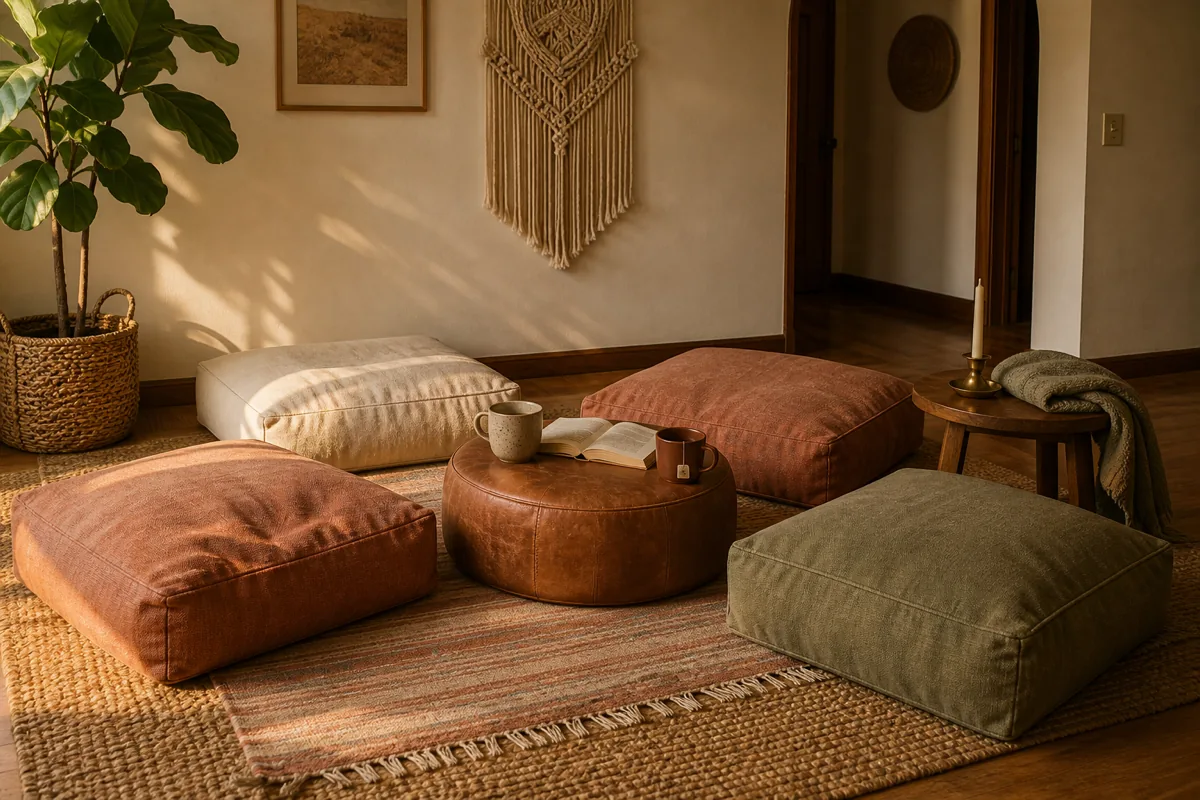
A second seating zone changes how the living room is used. Most rooms have a single sofa. Adding a floor cluster — four cushions and a low center — gives the room a place to lounge that is not the sofa, which makes the sofa feel less like the only option.
What matters here is structured floor cushions. The picture shows four cushions that hold their boxy shape rather than collapse like throw pillows misplaced on the floor. The center pouf sits at about 15 inches — sittable height — and works as a side table when nobody is using it. Together the cluster reads as planned, not improvised.
This works best in a room with a corner or an alcove a little out of the main traffic line, where the floor cluster does not get walked through. If you only have a center room, a smaller version — two cushions and one pouf next to the sofa, not a full cluster — does the same trick at lower commitment.
Mix Three or More Patterns in Throws and Pillows
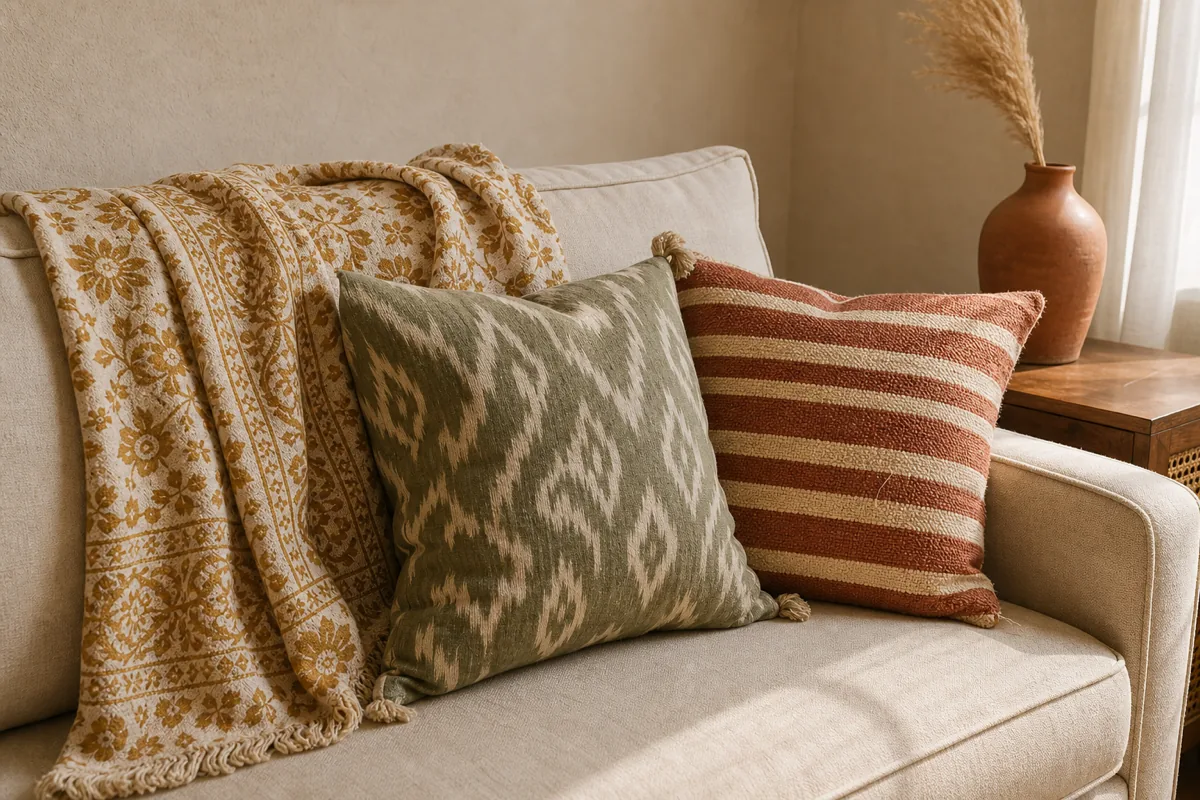
The instinct is to match. A matching pair of cushions, a coordinating throw, all in one color. That instinct is the wrong one for boho. Matching reads as a furniture-showroom set; boho reads as a slow accumulation.
The image shows the safe version of the mix. Three patterns — a block print, an ikat, and a stripe — each with a different pattern logic. The block print is geometric and repeating. The ikat is organic and blurred. The stripe is linear.
Three different rhythms, but every textile sits inside the same earth-tone palette (ochre, sage, rust, cream). That is what keeps the mix from going chaotic — the patterns vary, the palette does not.
If you are nervous about pattern-mixing, this is the rule that holds: pick three patterns from three different families, but lock the palette to four or five earth tones across all of them. Anything you can fit into that palette can go in.
Boho is one of the styles most likely to overshoot. These four rules are the difference between a layered, lived-in room and a themed display.
Use a Vintage Trunk or Wood Crate as a Coffee Table
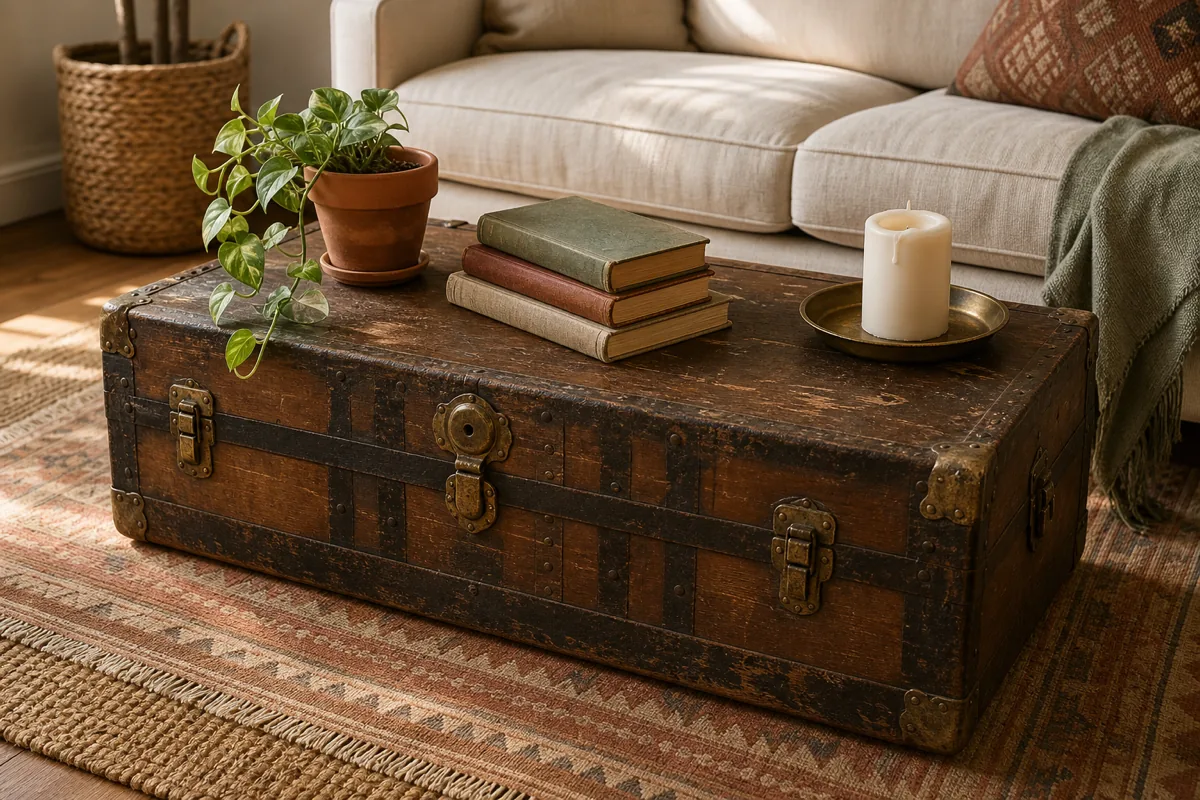
Coffee tables date themselves the fastest of any piece in a living room. A round wood trunk does not date — it was already old when you got it, and it stays old in a way that flatters the room around it.
The trunk in the picture is the right kind of old. The wood has actual scratches across the lid, not factory distressing. The brass corner protectors are tarnished from real years rather than chemically aged.
The leather straps are dark and worn at the edges. The whole piece reads as a thing that arrived in your living room with a history attached, which is exactly what boho wants — patina, not a costume of patina.
What lives on top matters too. The styling in the picture is the minimum that signals “this is a usable surface, not an altar” — a short stack of books, one small plant, one candle on a small tray. Anything more starts to look posed.
Build a Plant Cluster at Three Different Heights
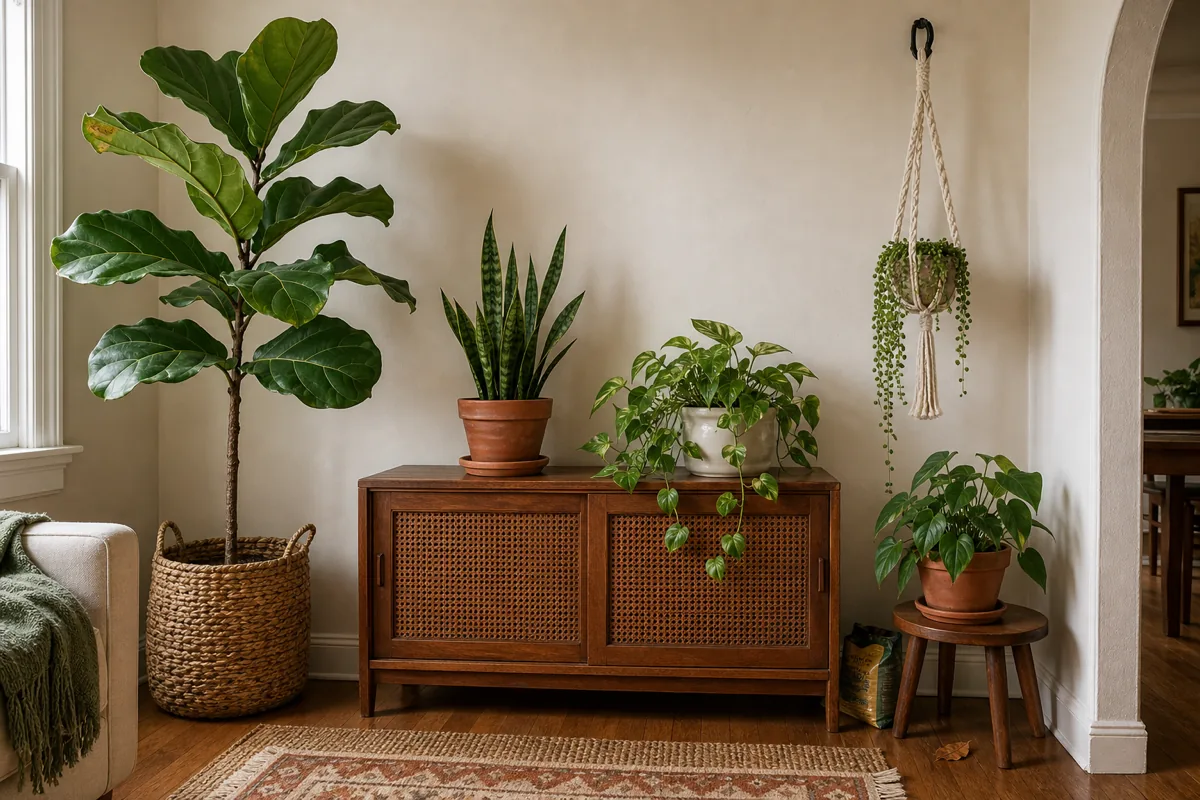
One plant in a corner is decoration. Three or more plants at three different heights starts to feel like life happening in the room.
The cluster in this picture is laid out the way it should be. One tall plant on the floor in a seagrass basket — about five feet — defines the vertical axis. Two or three mid-height plants on a sideboard or low cabinet fill the middle of the wall.
One hanging plant suspended from a visible ceiling hook does the work of pulling the eye up to the ceiling line, which most living rooms ignore. The pots vary: terracotta, woven, matte ceramic, cotton macramé hanger. Mixed materials are doing as much visual work as the plants themselves.
If you have less wall to work with, two heights — floor + hanging — gets you most of the way there. Mid-height plants are the most replaceable; cull those first if the cluster starts to feel crowded.
The 5-Direction Boho Move System
- 1TextilesMix three patterns — block print, ikat, stripe — in throws and cushions, all locked to four earth tones. Pattern variety inside palette discipline.
- 2PlantsCluster at three heights — a tall floor plant, a couple at mid-height on a sideboard, one hanging from a ceiling hook. Mix the pot materials (terracotta, woven, ceramic, macramé hanger).
- 3LightingSwap the default flush-mount ceiling fixture for a woven rattan dome or paper lantern. A warm 2700K bulb inside the pendant projects the weave pattern onto the ceiling.
- 4FloorLayer a smaller vintage kilim over a larger jute base rug. Keep the jute’s edge visible on at least two sides — that visible step is what reads as deliberate layering.
- 5WallOne large macramé, mirror, or piece of art over the sofa — scaled to about a third the sofa width or wider. Skip the wall cluster of small pieces; one deliberate anchor does more.
styledhomenotes.com
Anchor the Palette with Earth Tones — Terracotta, Ochre, Sage, Cream
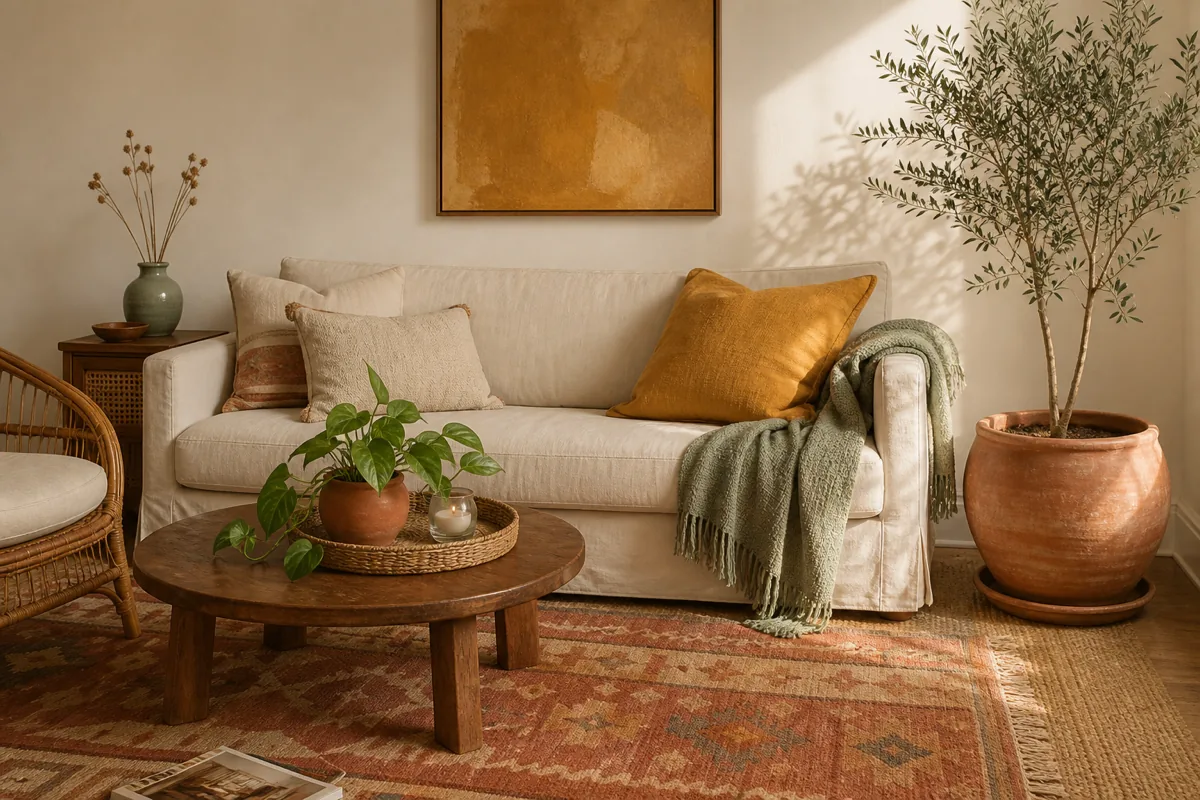
A consistent palette is the difference between a boho room and a boho-store. Without an anchor palette, the room collects warm and cool tones, jewel tones, neutrals — and ends up reading as a thrift haul rather than a styling choice.
The image is showing the four-tone palette doing its job across different materials. Cream is the wall paint and the sofa fabric — the lightest tone, used most. Terracotta shows up in the rug and the large floor planter — the warmth anchor.
Ochre is the cushion and the framed canvas — the saturation accent. Sage is the throw blanket and the small ceramic vase — the cool counter-note that keeps the warm tones from going monotone.
The principle to take away: each tone wants to appear in at least two different materials. Terracotta in paint only is not enough. Terracotta in a textile and a ceramic gives the eye permission to read the tone as a deliberate palette choice.
Layer Curtains with Sheer Linen Behind a Woven Outer Panel
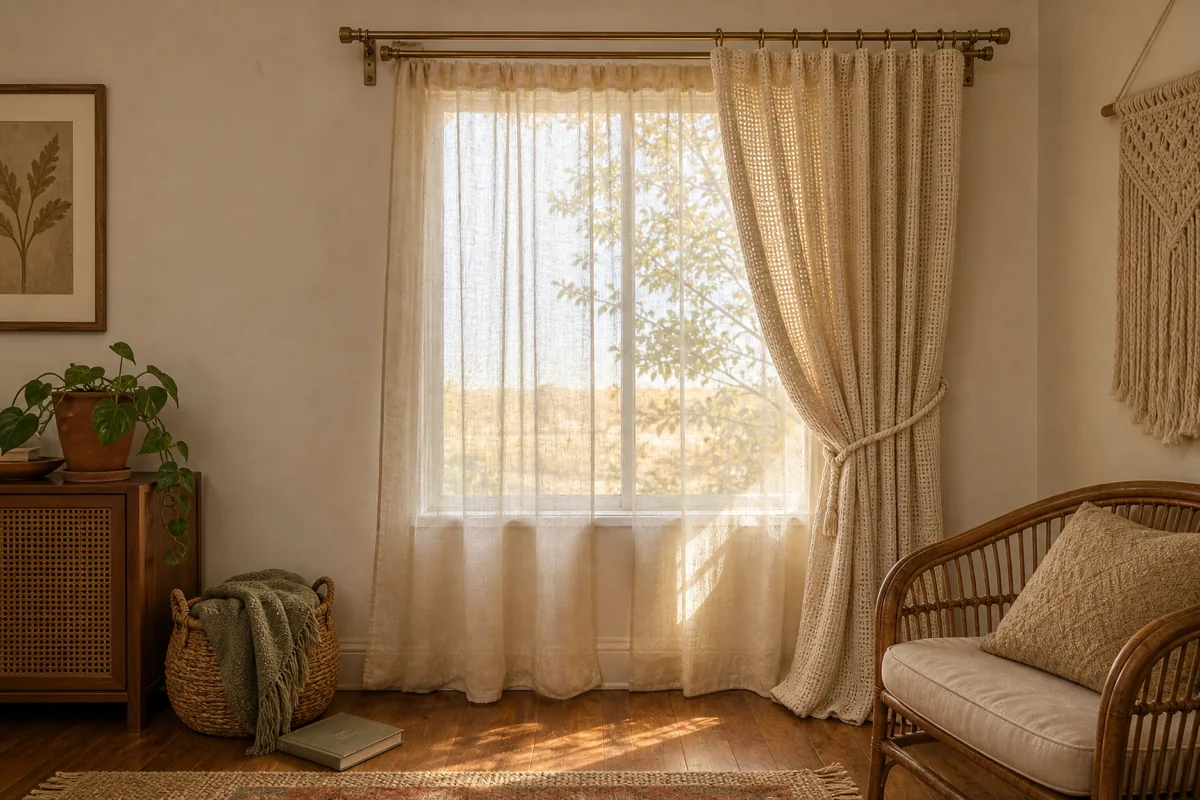
A single curtain layer asks one panel to do two jobs at once — privacy plus light. The single panel ends up doing one of those jobs well and the other badly. Two panels split the workload.
The image shows the double-rod setup at the cleanest. The sheer linen sits directly against the glass and handles privacy plus diffused light — the late afternoon sun in the picture is filtering through softly rather than glaring.
The textured outer panel sits a few inches forward on its own rod, and the rope tieback in the picture lets the outer layer pull aside in daytime without removing it. At night the outer panel closes, the sheer stays, the room reads finished.
The hardware does matter here. A genuine double-rod bracket — visible in the picture — is what makes the two layers behave as separate elements. A single rod with both panels gathered on it bunches up and never sits right. Spend the extra eight dollars on the double bracket.
Replace the Generic Ceiling Light with a Rattan Pendant or Paper Lantern
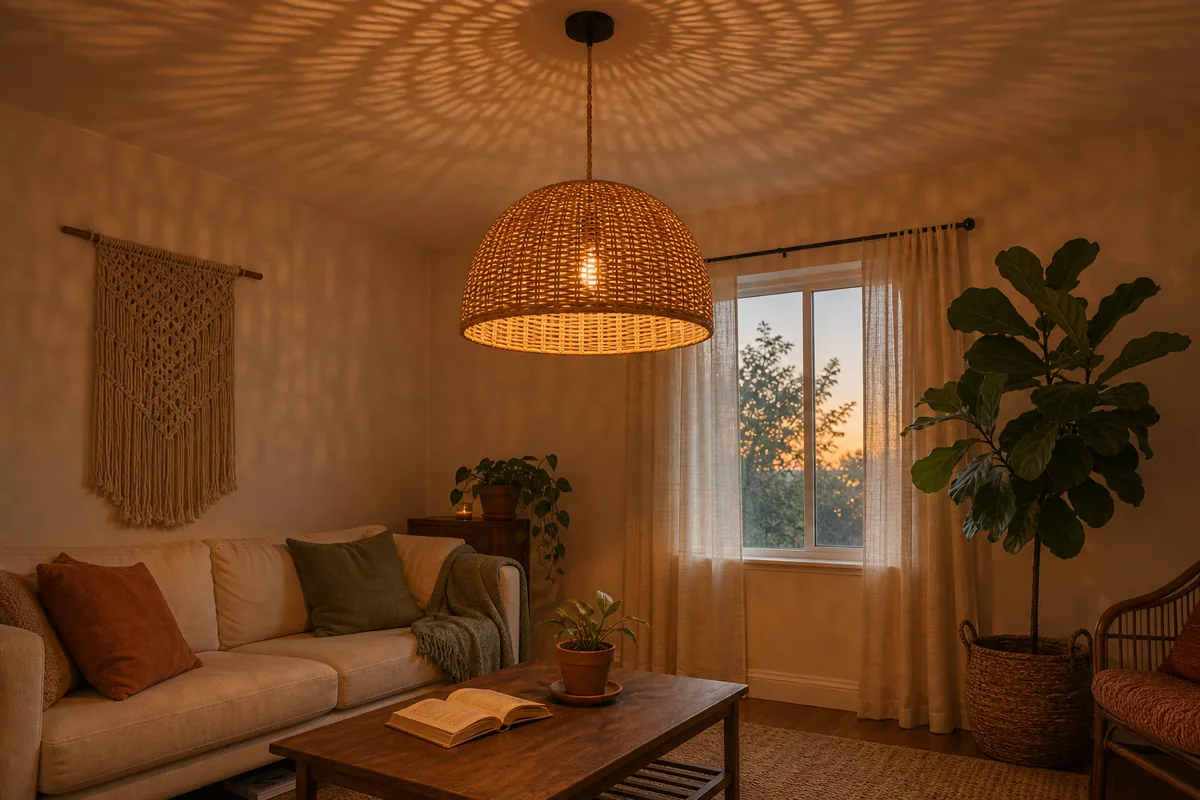
The default ceiling light in most rentals is a flush-mount dome of frosted plastic. It works, but it has no texture to contribute to a boho room. Swap it out and the ceiling line — the most-ignored surface in most living rooms — starts pulling its weight.
A woven rattan dome is the most flexible swap. The pendant in this picture is doing two things at once. The first is obvious: it adds a woven natural-fiber texture exactly where the room had a blank ceiling. The second is the bonus.
With a warm bulb inside (2700K, the same temperature your lamps probably use), the weave casts a patterned shadow onto the ceiling itself when the light is on. The room is lit twice — once directly, once by the pattern.
For a renter, this is usually a screw-out / screw-in swap of the ceiling rose plus the fixture. Keep the original flush-mount in a labeled box; it goes back on when you move out. Paper lanterns are a slightly lower-commitment alternative — they hang from a hook rather than a wired ceiling rose, no fixture work required.

Nora Ellis edits Styled Home Notes, where she shares practical decorating, organization, and small-space ideas for creating a more styled and functional home. Every article is reviewed for clarity, usefulness, image sourcing, and Pinterest-to-page alignment before publication. Visit the Nora Ellis author page.