12 Farmhouse Living Room Ideas That Feel Warm, Not Staged
A farmhouse living room goes wrong the same way every time: bought all at once from one catalog, the result reads like a showroom instead of a room someone actually lives in. Real farmhouse warmth comes from texture, age, and restraint — not from a shopping list of signs that say “gather.”
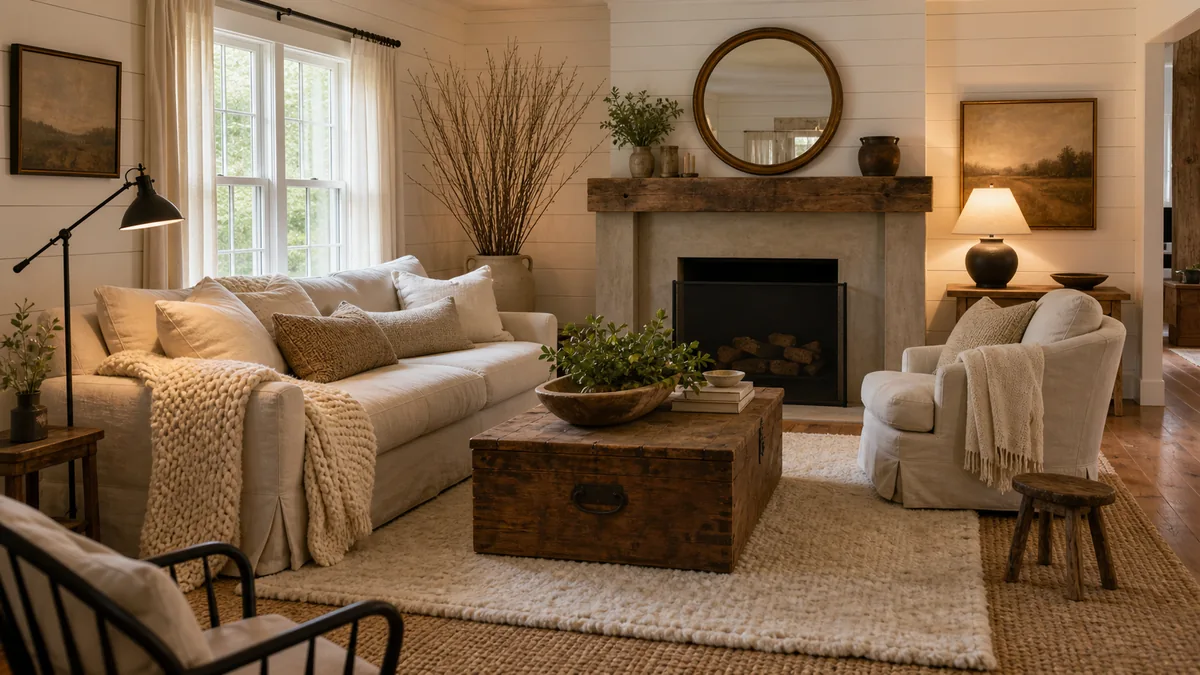
What separates a warm farmhouse room from a staged one is twelve specific choices — the right sofa, layered rugs, worn wood, a tight neutral palette — each made for how the room gets used, not how it photographs.
These moves work in a rental and on a budget, with no renovation. For the broader style framework behind them, see our modern living room ideas guide.
From a slipcovered linen sofa and layered jute rugs to a tight warm-neutral palette, these twelve moves are about texture, age, and restraint. Jump to the part of the room you are working on right now.
- 1Anchor the Room with a Slipcovered Linen Sofa in a Warm Neutral
- 2Layer a Soft Wool Rug Over a Larger Jute Rug for Grounded Texture
- 3Hang a Round Antique Mirror Above a Reclaimed Wood Mantel
- 4Center the Coffee Table with a Wooden Dough Bowl and Trailing Greenery
- 5Mix Matte Black Metal and Warm Wood in the Lighting
- 6Pile a Chunky Knit Throw and Mixed-Texture Cushions on the Sofa
- 7Lean a Vintage Wooden Ladder in the Corner for Blanket Storage
- 8Add a Woven Bamboo Shade Behind Linen Panels for Texture and Privacy
- 9Lean One Oversized Vintage Landscape Instead of a Busy Gallery Wall
- 10Swap the Coffee Table for a Reclaimed Wood Trunk or Crate
- 11Fill the Empty Corner with Tall Dried Branches in a Stoneware Crock
- 12Hold the Whole Palette to Warm White, Oatmeal, and Soft Black
Anchor the Room with a Slipcovered Linen Sofa in a Warm Neutral
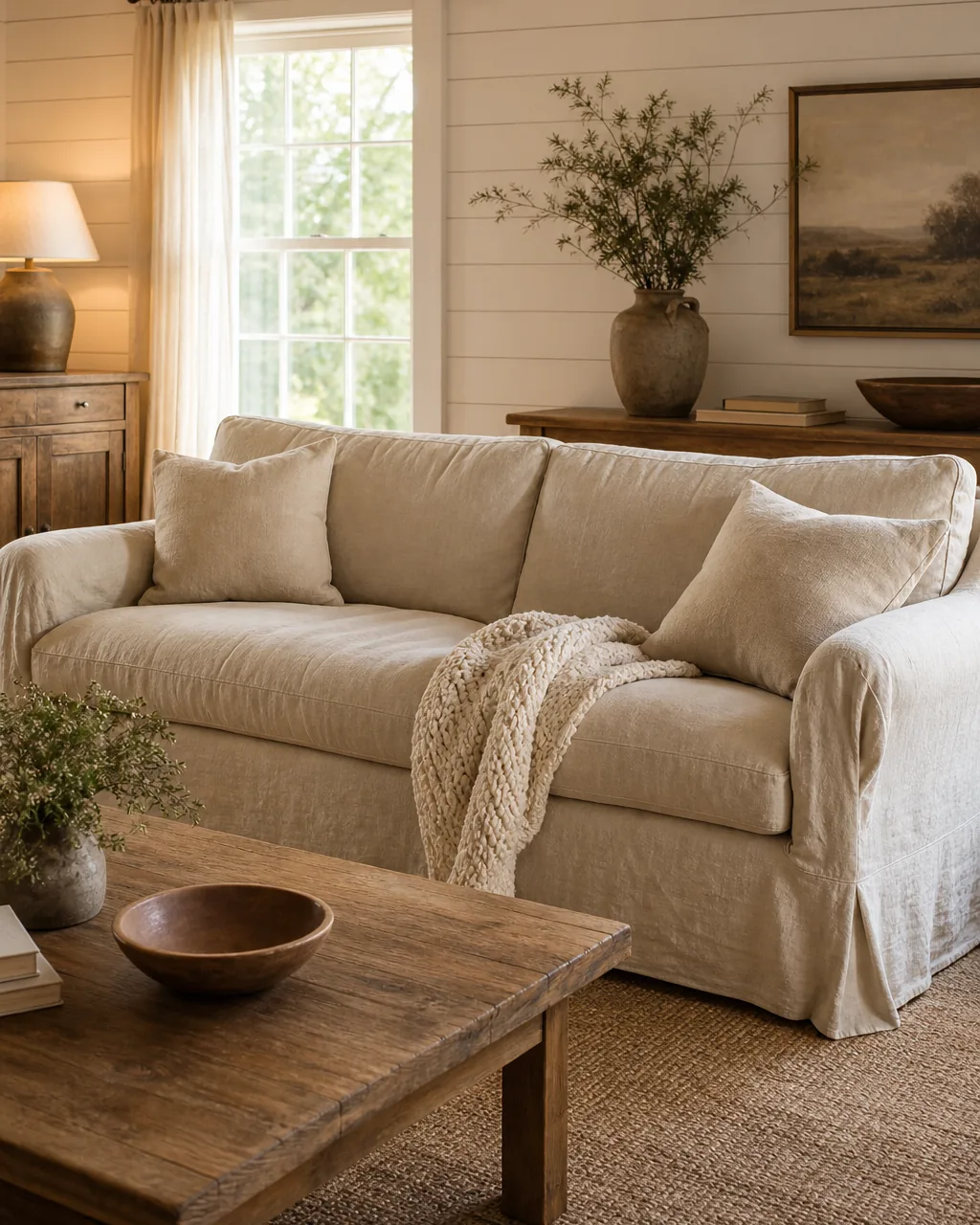
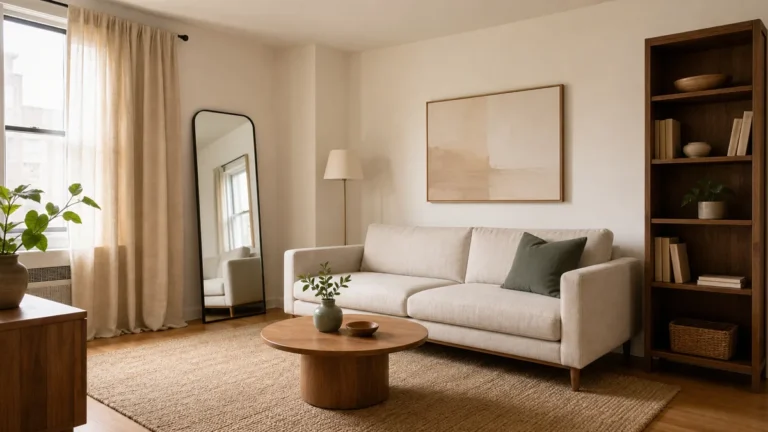
The sofa sets the whole tone of a farmhouse living room, and a slipcovered linen one in a warm neutral does the job better than a structured leather or velvet piece. The loose cover reads relaxed instead of formal, the warm oatmeal or flax color recedes so the wood and texture around it can carry the room, and the slipcover comes off to wash when someone spills coffee on it.
That last part is the quiet reason slipcovers belong in a real farmhouse room. A farmhouse living room is supposed to be used — kids, dogs, blankets, Sunday afternoons — and a sofa you cannot clean is a sofa you guard instead of live on.
Skip the bright white slipcover that fills every catalog. Pure white reads staged and shows every mark within a week. A warm oatmeal, flax, or soft greige hides life, pairs with warm wood, and still feels light. Buy the sofa with a second slipcover if the maker offers one, so one is always in the wash while the other is on.
- Choose a warm neutral — oatmeal, flax, soft greige — over bright white, which reads staged and marks fast
- Confirm the slipcover is removable and machine washable before buying, not a decorative non-removable cover
- Pick a relaxed loose-fit slipcover, not a tight tailored one — the slight rumple is the farmhouse look
- Add a second slipcover in the same color if available so one washes while the other stays on the frame
- Keep the cushions and throw on the sofa in the same neutral family so the sofa reads as one calm mass
Layer a Soft Wool Rug Over a Larger Jute Rug for Grounded Texture
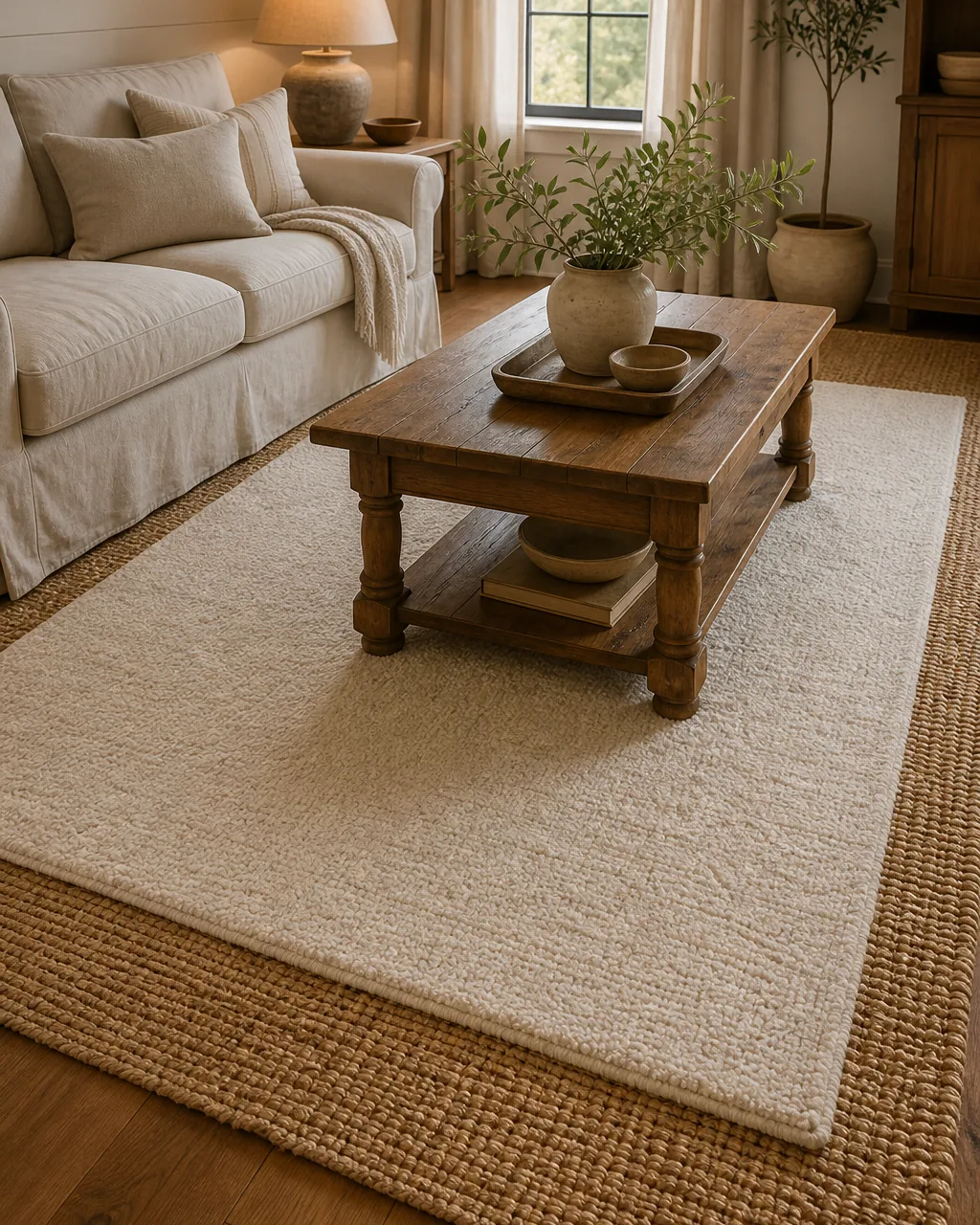
A single thin rug floating in the middle of a living room is the most common farmhouse mistake, and layering fixes it for less than buying one large expensive rug. A big natural jute rug goes down first, sized to slip under the front legs of all the seating. A smaller soft wool or cotton rug layers on top, centered under the coffee table.
The jute gives the room its grounded, textured base — that woven, slightly rough natural fiber is the backbone of the farmhouse look. The soft rug on top gives your feet somewhere comfortable to land, because jute alone is hard underfoot.
The layered look also reads intentional in a way one rug rarely does. The border of jute showing around the soft rug frames the seating area and makes the floor feel designed. Pick the top rug in a tone close to the sofa so the layers read as warmth, not as two competing patterns fighting on the floor.
- Size the jute rug large — front legs of every seat should touch it — and the wool rug smaller, centered under the coffee table
- Leave six to ten inches of jute border showing on all sides so the layering reads intentional
- Keep the top rug low-pile and soft underfoot since jute alone is rough — wool, cotton, or a flatweave
- Choose the top rug close to the sofa tone to keep the floor calm, not a bold contrast pattern
- Use a thin rug pad between the two layers so the soft rug does not slide on the jute
Hang a Round Antique Mirror Above a Reclaimed Wood Mantel
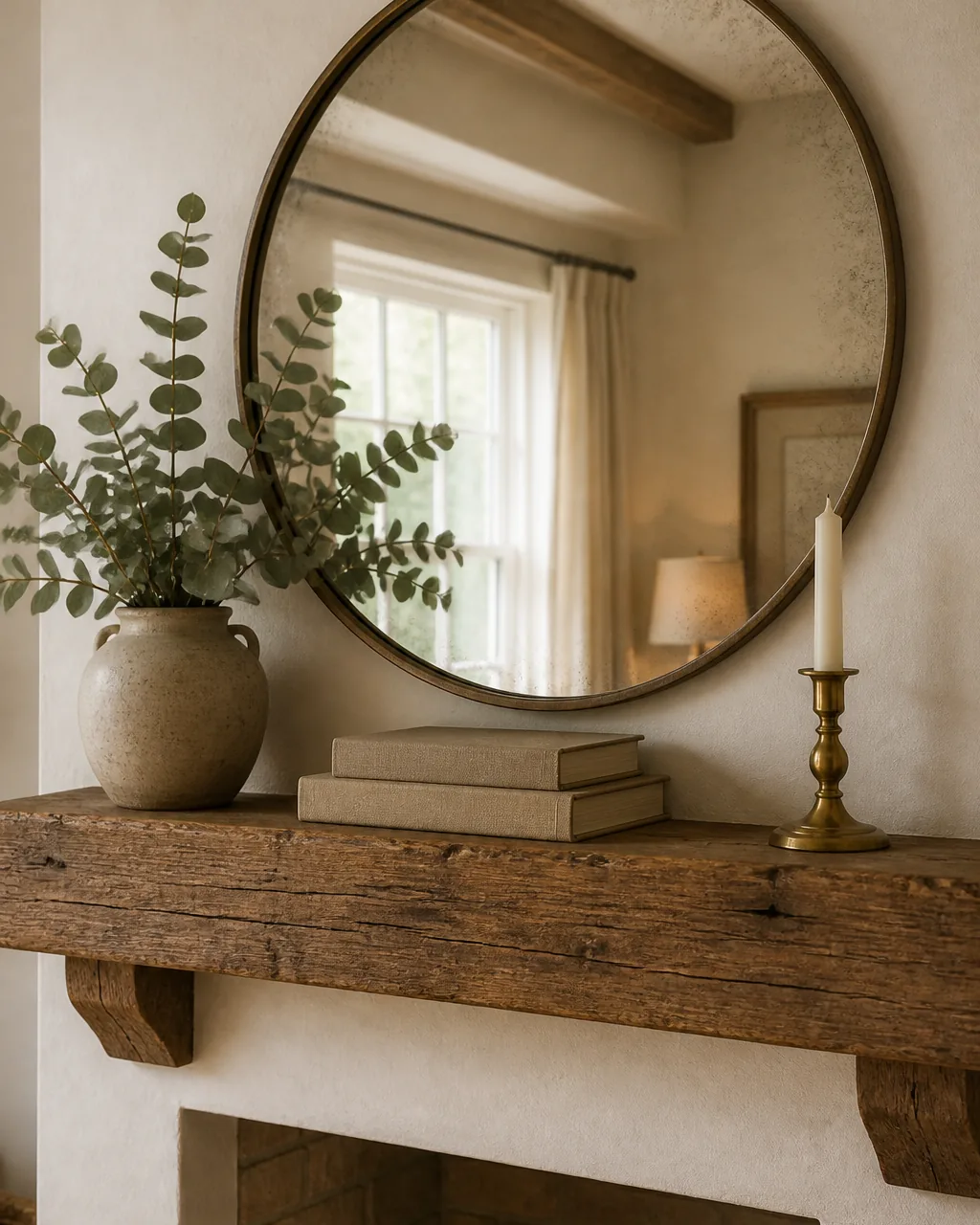
The mantel is the natural focal point of a living room, and a round mirror above it is the single most reliable farmhouse move there is. The round shape softens a wall full of rectangles — the rectangular mantel, the rectangular TV, the rectangular window — and the mirror bounces daylight deeper into the room, which matters in the smaller, often darker rooms farmhouse style tends to live in.
An antique or aged-finish frame in iron, brass, or distressed wood beats a shiny modern one. The slight imperfection is the point.
If there is no fireplace, a reclaimed wood shelf mounted at mantel height does the same job for forty dollars and an afternoon. A length of barn wood or a thick pine board with a dark wax finish reads instantly farmhouse.
Keep the mantel styling sparse — a stack of two or three books, one vase with greenery, a candlestick — so the mirror stays the star.
- Choose a round mirror to break up the rectangles of mantel, TV, and window on the same wall
- Pick an aged frame — iron, brass, or distressed wood — over a shiny modern finish
- Size the mirror to about two-thirds the width of the mantel so it anchors without overwhelming
- Mount a reclaimed wood shelf at mantel height if there is no fireplace — same focal point for little money
- Style the mantel sparsely: a small book stack, one vase of greenery, a single candlestick — let the mirror lead
You will not need all twelve at once. Find the situation below that matches your room today, and start with those two or three ideas.
Center the Coffee Table with a Wooden Dough Bowl and Trailing Greenery
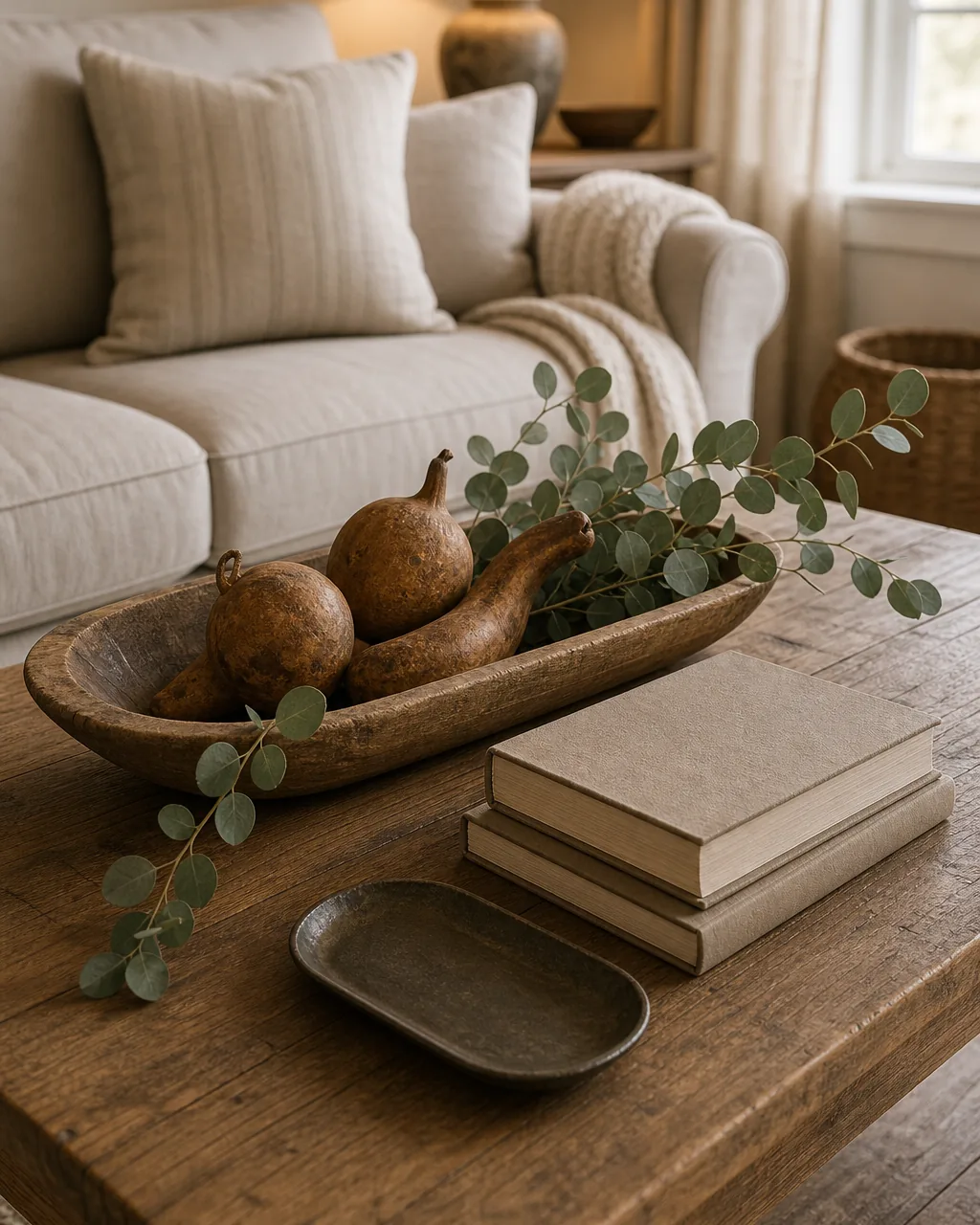
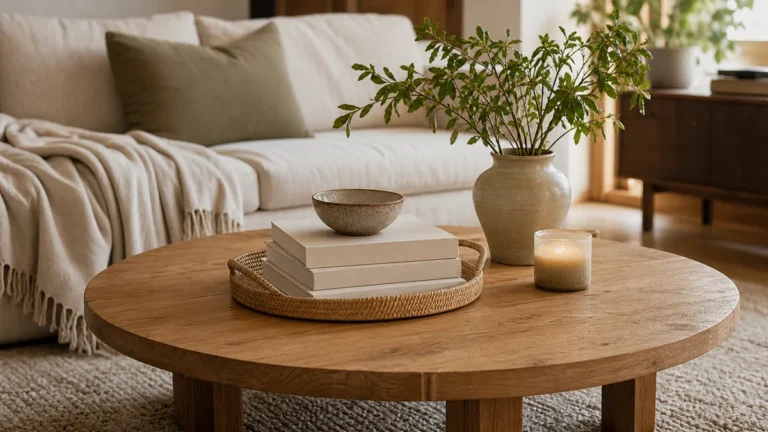
A coffee table styled with a wooden dough bowl is the most farmhouse thing you can do to the center of a room. The dough bowl solves a real problem — it corrals the small stuff that always lands on a coffee table into one intentional vessel.
The long carved bowl reads handmade and rustic, and filled with a few dried gourds, some greenery, or just a trailing eucalyptus stem, it gives the table a low, horizontal anchor that does not block the sightline across the room.
Restraint is everything here. A dough bowl crammed with twelve decorative balls reads as clutter in a nicer container.
Three to five natural objects is the whole recipe — a couple of dried gourds in fall, a few green stems in spring, a cluster of pinecones in winter. Pair the bowl with a short stack of two books and maybe a small tray for the remote, and the coffee table is styled. Everything else that lands there during the week gets cleared back to those three elements during the evening tidy.
- Use one long carved wooden dough bowl as the single anchor object on the coffee table
- Fill it with three to five natural items — dried gourds, greenery, pinecones — never a crammed pile
- Keep the arrangement low and horizontal so it never blocks the view across the seating
- Add only a short stack of two books and a small tray for the remote alongside the bowl
- Swap the bowl’s filling with the season instead of buying new decor — gourds, stems, pinecones
Mix Matte Black Metal and Warm Wood in the Lighting
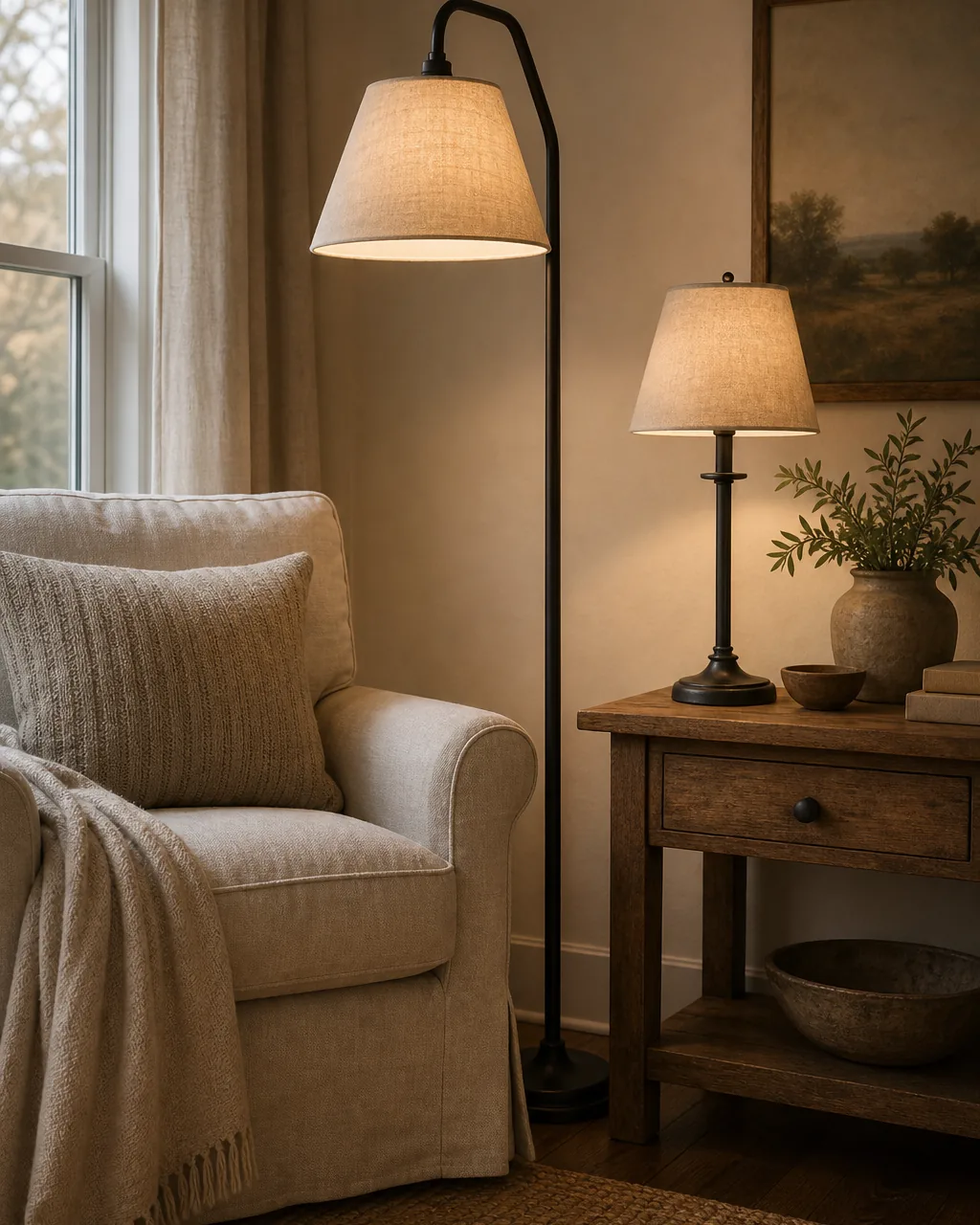
Lighting is where a farmhouse living room either pulls together or reads like a furniture showroom. A deliberate mix of matte black metal and warm wood across the fixtures pulls it into focus.
A matte black floor lamp, a wood-and-black table lamp, and a black metal pendant or a small wood-beaded chandelier give the room a consistent material story that ties the whole space together without everything matching exactly.
Matte black is the farmhouse metal — not brushed nickel, not chrome, not the shiny brass of a glam room.
Just as important is layering the light low. One overhead fixture lighting the whole room from the ceiling is the cold, flat look farmhouse style is reacting against.
Two or three lamps at table and floor height throw warm pools of light at the level people actually sit. A warm bulb around 2700 kelvin keeps the glow honey-colored instead of blue — the room reads cozy at night because the light comes from where you live, not from a single bright box on the ceiling.
- Repeat matte black metal across fixtures — floor lamp, table lamp, pendant — for one material story
- Mix in warm wood elements (lamp bases, beads) so the black never reads industrial-cold
- Layer light low with two or three lamps instead of relying on one overhead fixture
- Use warm bulbs around 2700K so the light reads honey, not blue-white
- Skip shiny metals — brushed nickel and chrome fight the warm rustic palette
Pile a Chunky Knit Throw and Mixed-Texture Cushions on the Sofa
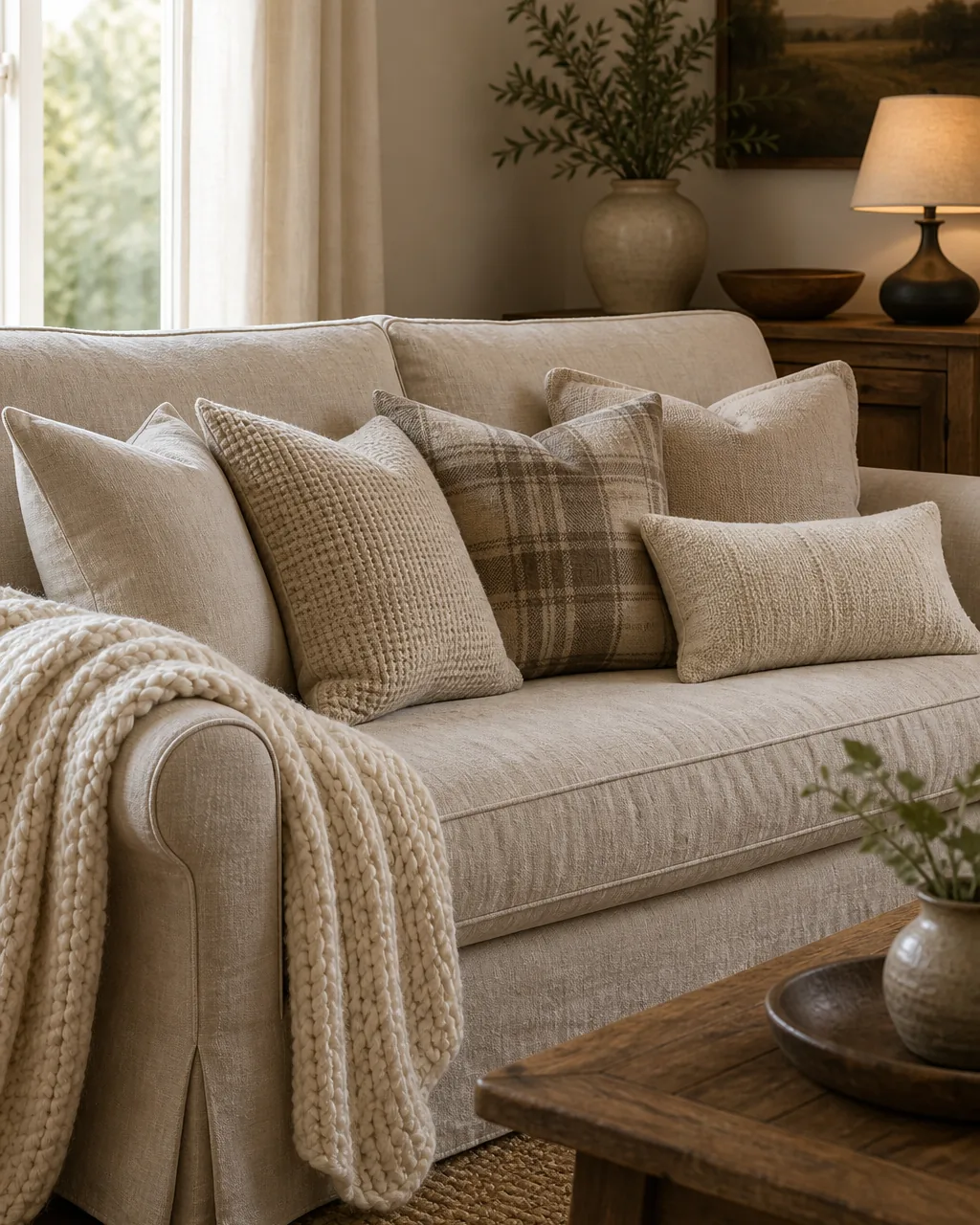
Texture is what makes a neutral farmhouse room feel warm instead of flat, and the cheapest place to build it is the sofa. A chunky knit throw draped over one arm and a small pile of cushions in mixed textures — a smooth linen, a waffle weave, a nubby boucle, one soft plaid — turn a plain slipcovered sofa into something you want to sink into.
The colors stay in the warm neutral family so the variety comes from texture, not from a clash of bright hues.
The arrangement should look relaxed, not staged. Farmhouse is the opposite of two perfectly symmetrical cushions standing at attention.
Three to five cushions of slightly different sizes, leaned and overlapped a little, with the throw casually folded rather than perfectly squared, reads lived-in and inviting.
The mistake is matching everything — a set of four identical cushions reads like a hotel, not a home. Buy covers rather than whole cushions so you can swap textures seasonally and wash them, and stuff them with inserts one size larger than the cover so they look full instead of limp.
- Build the look from texture — linen, waffle, boucle, knit — kept inside one warm neutral palette
- Mix three to five cushions in slightly different sizes, arranged relaxed and overlapped, never symmetrical
- Drape the chunky throw casually over one arm instead of folding it into a perfect square
- Buy covers, not whole cushions, so textures swap seasonally and wash easily
- Size inserts one larger than the cover so cushions look full, not flat and tired
These four rules separate a farmhouse living room that feels genuinely warm and lived-in from one that just looks like a showroom set with a few signs that say gather.
Lean a Vintage Wooden Ladder in the Corner for Blanket Storage
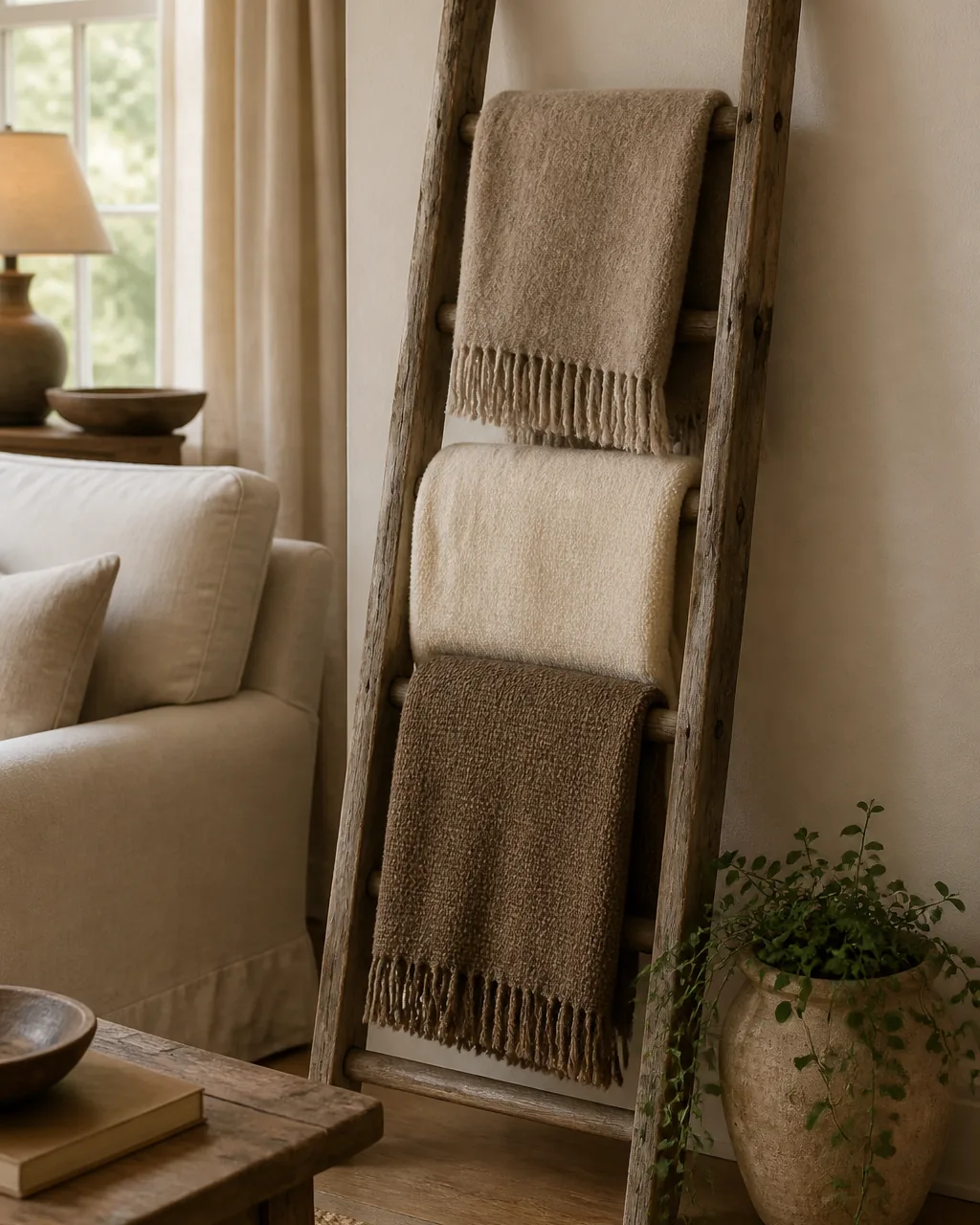
Throw blankets are essential to a cozy farmhouse living room and a problem to store, and a vintage wooden ladder leaned in a corner solves both at once. The blankets you actually use stay out, visible and grabbable, draped over the rungs instead of stuffed in a basket or closet.
The ladder itself — weathered, a little rough, ideally a real old orchard or paint-spattered ladder from a flea market — is a piece of rustic sculpture that fills an awkward corner.
It earns its spot by being storage and decor in the same object, which is the test every piece in a small room should pass.
A real vintage ladder beats a new store-bought blanket ladder by a mile because the wear is genuine — the smooth-worn rungs and faded paint cannot be faked convincingly. Check flea markets, salvage yards, and estate sales, where they run ten to thirty dollars.
Lean it securely against the wall so it cannot slide, drape two to four blankets in warm neutrals over the rungs, and leave the bottom rungs lighter so the piece does not read top-heavy.
- Use a real weathered vintage ladder over a new store-bought one — genuine wear cannot be faked
- Drape two to four blankets you actually use so the ladder is storage, not just decoration
- Keep the blankets in warm neutrals so the ladder reads calm against the wall
- Lean it securely so it cannot slide, and check it is stable if there are kids or pets
- Hunt flea markets and salvage yards — old ladders run ten to thirty dollars and beat retail versions
Add a Woven Bamboo Shade Behind Linen Panels for Texture and Privacy
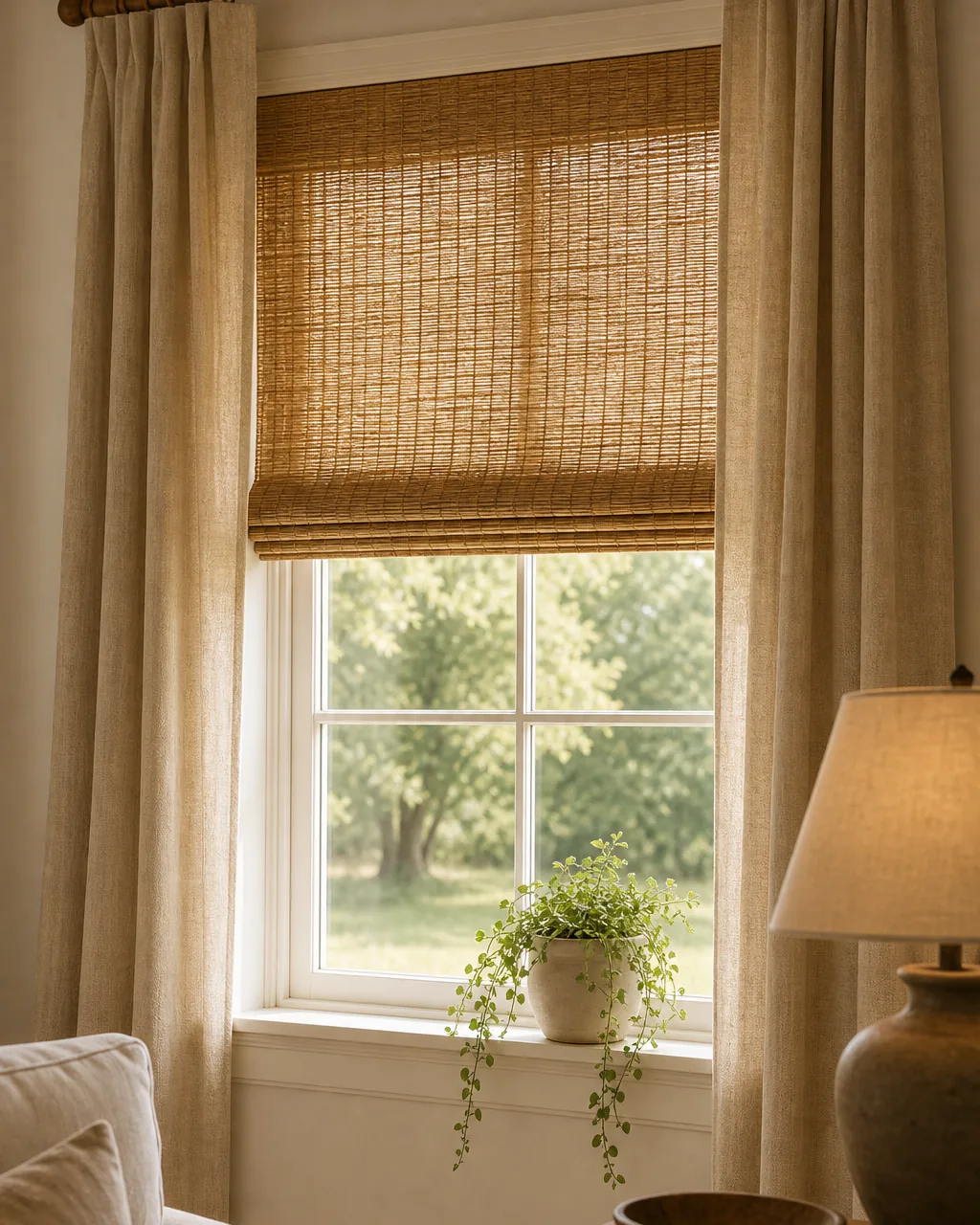
The window is a chance to add natural texture, and a woven bamboo or seagrass shade is the farmhouse move that plain blinds can never make. The woven fiber catches light into a warm pattern, handles privacy and light control on its own, and brings the same organic texture as the jute rug and the worn wood elsewhere in the room.
Simple linen panels flank it as a soft frame, so the window reads layered and warm instead of bare or builder-basic.
Choosing woven over vinyl or aluminum blinds is the whole point. Slatted plastic and metal blinds are exactly the cold, rental-builder look farmhouse style is reacting against.
The layering is straightforward and forgiving. Mount the woven shade inside the window frame as the working layer you actually raise and lower, and hang two stationary linen panels outside the frame on a thin wood rod purely as a decorative edge — they never need to close because the shade does the work.
Add a privacy liner to the shade if the room faces the street, keep the panels in the room’s warm neutral so the woven texture stays the star, and the window finally pulls its weight in the room.
- Mount a woven bamboo or seagrass shade inside the frame as the working privacy-and-light layer
- Flank it with stationary linen panels on a thin wood rod as a soft decorative frame
- Choose natural woven fiber over vinyl or aluminum blinds, which read cold and builder-grade
- Add a privacy liner to the shade if the room faces the street so daylight still filters in
- Keep the panels in the room’s warm neutral so the woven shade stays the texture star
Lean One Oversized Vintage Landscape Instead of a Busy Gallery Wall
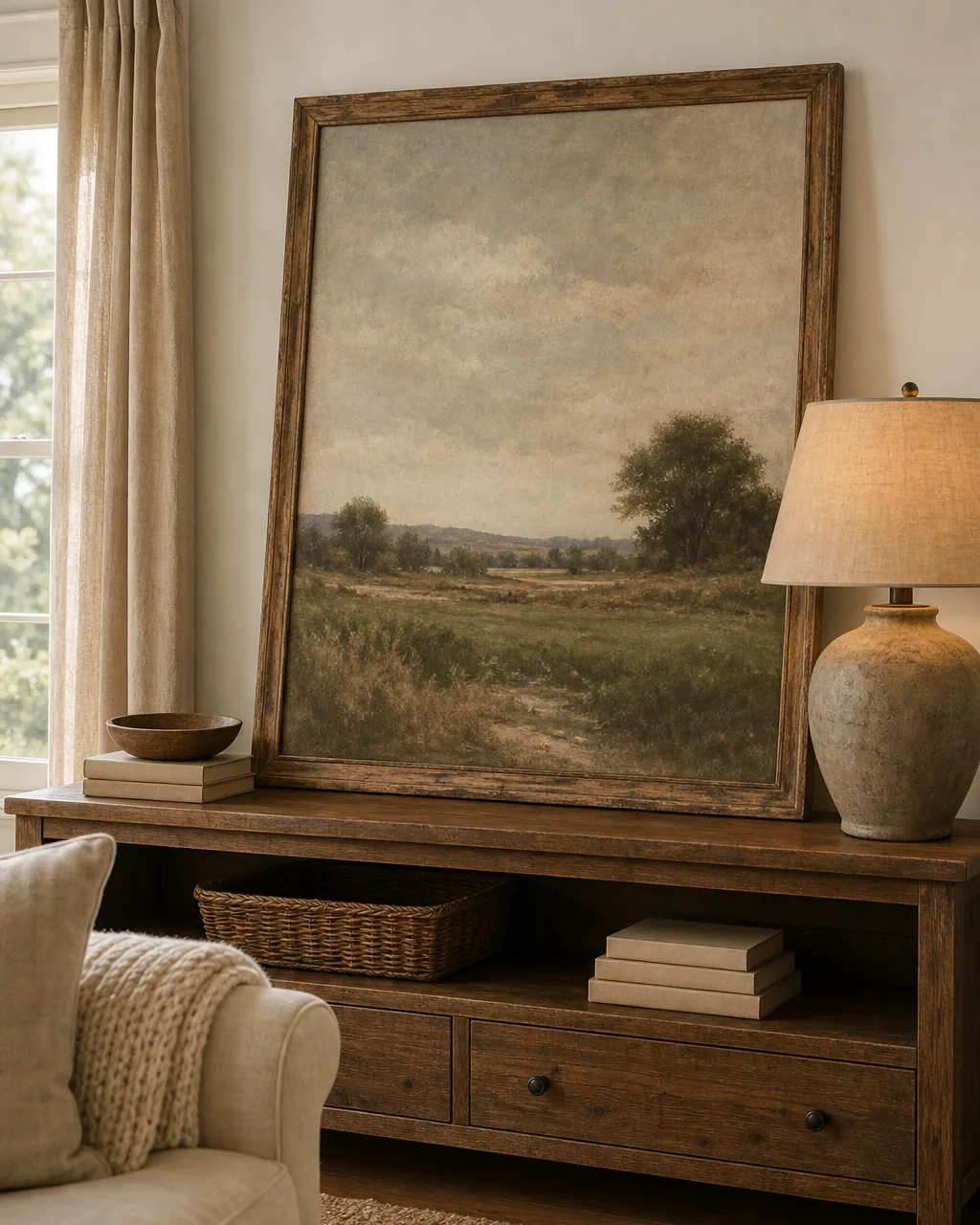
Where a modern room reaches for a gallery wall, a farmhouse room is often calmer and more striking with one oversized piece of art leaned rather than hung.
A single large vintage-style landscape or still life in muted, earthy tones gives the room a quiet focal point without the busy grid of small frames. Leaning it against the wall on the floor or a console reads relaxed and unfussy in a way a perfectly leveled gallery wall never does.
The leaned piece also commits to nothing — no nail holes, easy to swap, easy to move when the room changes.
Thrifted and vintage landscapes are everywhere for cheap, and a slightly faded oil painting of a field, a coast, or a barn carries genuine age that a printed canvas cannot.
Look for muted greens, browns, and warm grays that sit quietly in the palette rather than a bright high-contrast print that grabs the eye. Frame it in simple distressed wood or a plain aged-gold frame, lean it securely behind a console or low shelf so it cannot tip, and let one big piece do the work of twelve small ones.
- Choose one oversized vintage-style landscape or still life over a busy multi-frame gallery wall
- Lean it on the floor or a console instead of hanging — relaxed, swappable, no nail holes
- Look for muted earthy tones that sit quietly in the palette, not a bright high-contrast print
- Frame in distressed wood or plain aged gold to keep the rustic feel
- Secure it behind a console or low shelf so an oversized leaned piece cannot tip over
12 farmhouse living room moves, one warm and lived-in room
- 1Anchor the Room with a Slipcovered Linen Sofa in a Warm NeutralA relaxed slipcovered linen sofa in oatmeal or flax sets the whole tone, recedes so the wood and texture can lead, and comes off to wash when life happens on it. A warm neutral hides marks where bright white reads staged.
- 2Layer a Soft Wool Rug Over a Larger Jute Rug for Grounded TextureA big natural jute rug underneath and a soft wool rug on top give the floor a grounded, textured base plus somewhere comfortable to land. The jute border showing around the soft rug frames the seating and reads intentional.
- 3Hang a Round Antique Mirror Above a Reclaimed Wood MantelA round antique mirror over a reclaimed wood mantel softens the wall full of rectangles and bounces daylight deeper. No fireplace? A barn-wood shelf at mantel height does the same job for forty dollars.
- 4Center the Coffee Table with a Wooden Dough Bowl and Trailing GreeneryA long carved wooden dough bowl filled with three to five natural items — gourds, greenery, pinecones — anchors the coffee table low and horizontal. Restraint is the whole recipe; a crammed bowl is just clutter in a nicer vessel.
- 5Mix Matte Black Metal and Warm Wood in the LightingRepeat matte black metal across the floor lamp, table lamp, and pendant for one material story, mixed with warm wood. Layer the light low with warm bulbs so the room glows honey instead of flat and blue from the ceiling.
- 6Pile a Chunky Knit Throw and Mixed-Texture Cushions on the SofaA chunky knit throw and three to five mixed-texture cushions — linen, waffle, boucle — build warmth from texture inside one neutral palette. Arrange them relaxed and overlapped, never the symmetrical hotel look.
- 7Lean a Vintage Wooden Ladder in the Corner for Blanket StorageA real weathered vintage ladder leaned in a corner keeps the blankets you actually use visible and grabbable while filling an awkward space. Genuine wear beats a new store-bought ladder, and it earns its spot as storage plus sculpture.
- 8Add a Woven Bamboo Shade Behind Linen Panels for Texture and PrivacyA woven bamboo or seagrass shade inside the frame handles privacy and light while adding the natural texture plain blinds never can, with stationary linen panels as a soft frame. Woven fiber over cold vinyl or aluminum.
- 9Lean One Oversized Vintage Landscape Instead of a Busy Gallery WallOne oversized vintage-style landscape in muted earthy tones, leaned on the floor or a console, gives a quiet focal point without a busy grid of small frames. Relaxed, swappable, no nail holes, and a big piece does the work of twelve.
- 10Swap the Coffee Table for a Reclaimed Wood Trunk or CrateA reclaimed wood trunk or stacked crates in place of a coffee table add rustic character plus hidden storage for blankets, games, and remotes. Check the height sits near the sofa seat so it works as a real surface.
- 11Fill the Empty Corner with Tall Dried Branches in a Stoneware CrockA tall arrangement of dried branches or pampas in a large stoneware crock fills the empty corner with height and warmth for almost nothing. Dried over fresh means zero upkeep, and scale matters — go tall and full so it never looks lost.
- 12Hold the Whole Palette to Warm White, Oatmeal, and Soft BlackWarm white walls, oatmeal and cream textiles, warm wood, and soft black in small doses is the entire formula. Lean every neutral warm to avoid cold minimalism, and skip the single saturated accent that breaks the calm.
styledhomenotes.com
Swap the Coffee Table for a Reclaimed Wood Trunk or Crate
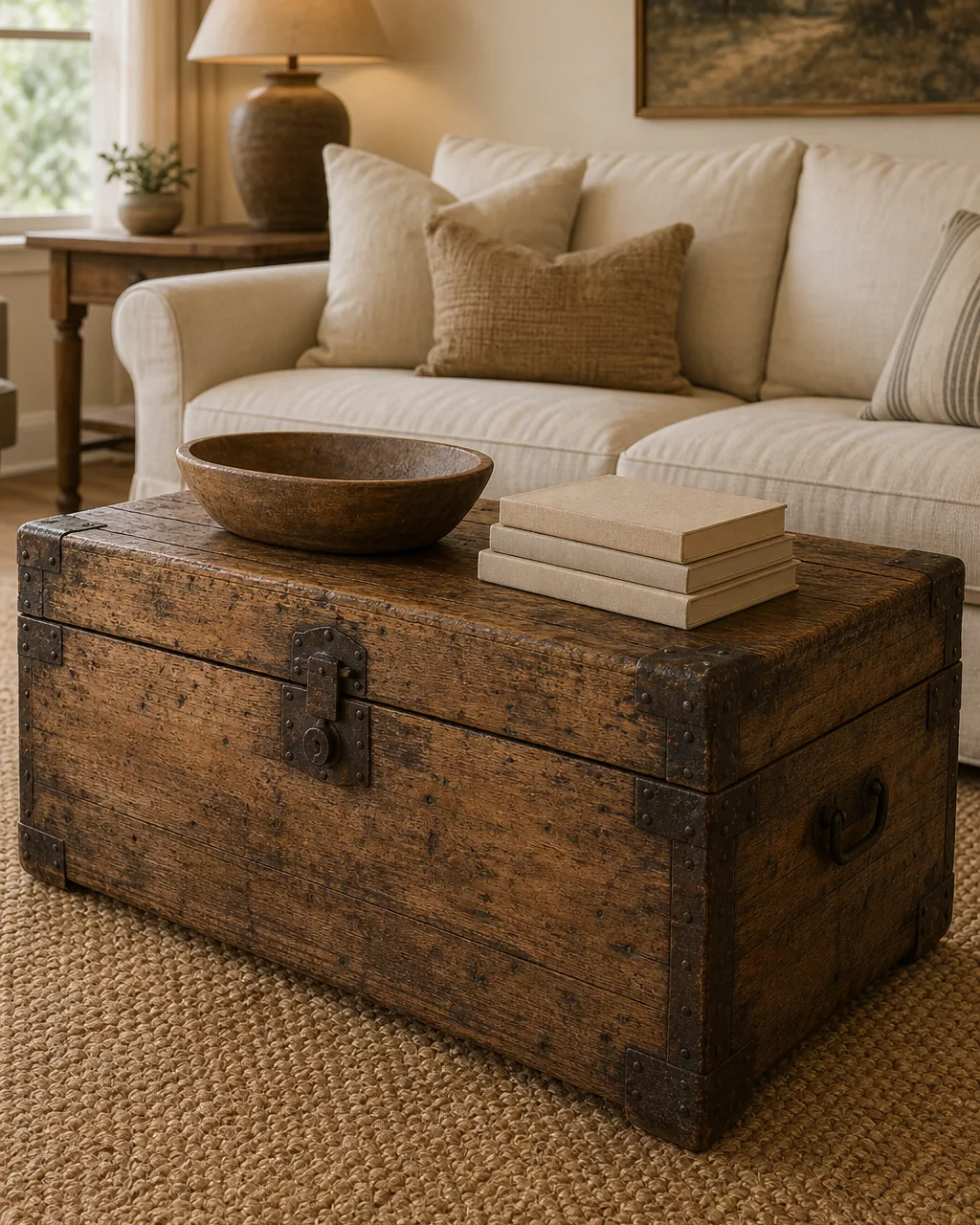
A reclaimed wood trunk or a pair of stacked vintage crates in place of a conventional coffee table adds the two things a farmhouse living room always wants more of — rustic character and hidden storage.
The trunk gives you a surface to style on top and a closed interior for the blankets, board games, and remotes that otherwise pile up, which matters most in a small living room where every piece has to earn its footprint twice over.
The weathered wood and aged iron hardware bring instant age that a new manufactured table cannot.
An old steamer trunk, a military footlocker, or a sturdy wooden crate from a salvage shop runs far less than a new coffee table and carries a story in its dents.
Check the height — a trunk should sit roughly level with the sofa seat, sixteen to eighteen inches, so it works as a real coffee table and not a too-tall block. Add felt pads underneath to protect the floor and the layered rug, and keep the top styling minimal so the trunk’s own texture stays the focus.
- Use a reclaimed wood trunk or stacked crates for rustic character plus hidden storage in one piece
- Store blankets, games, and remotes inside so a small living room stays clear
- Check the height sits near the sofa seat, sixteen to eighteen inches, so it works as a coffee table
- Add felt pads underneath to protect the floor and the layered rug below
- Keep the top styling minimal so the trunk’s weathered texture stays the focus
Fill the Empty Corner with Tall Dried Branches in a Stoneware Crock
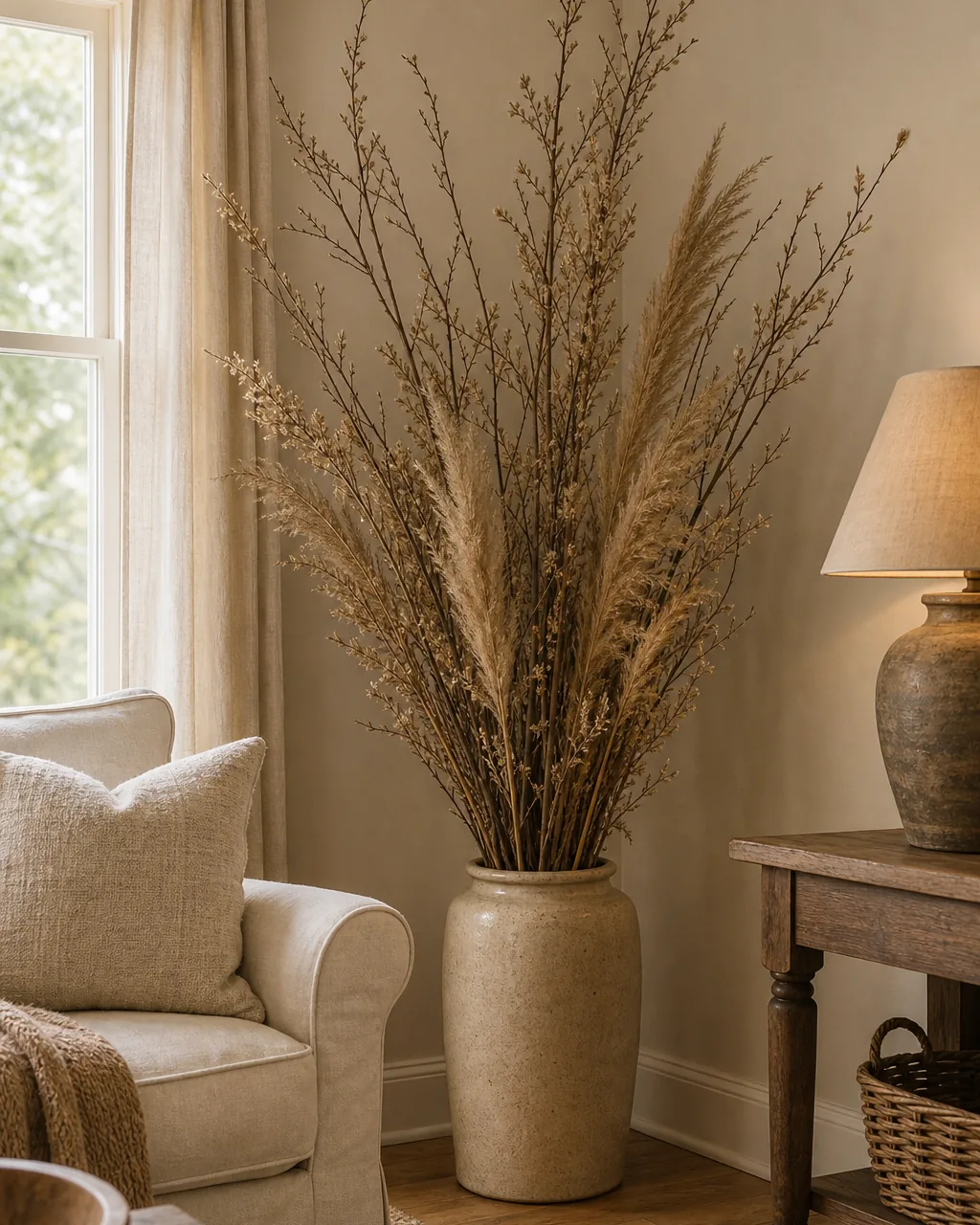
The empty corner is the unfinished edge of most living rooms, and a tall arrangement of dried branches in a large stoneware crock fills it with height and warmth for almost nothing.
Dried pampas, eucalyptus, magnolia, or just bare branches gathered from outside reach up toward the ceiling and draw the eye vertically, which makes the whole room feel taller and the corner feel intentional rather than forgotten.
Dried over fresh is the practical farmhouse choice — no watering, no light needs, no wilting, and the muted tan-and-brown palette sits perfectly in the neutral scheme.
A large crock, a stoneware pitcher, or a galvanized bucket holds the branches and adds its own rustic texture at the base.
Scale matters more than anything: the arrangement should be tall, roughly knee height of crock plus three to four feet of branches, because a small vase of stems in a big corner just looks lost. Gather branches free from a walk, buy a bundle of dried pampas if you want softness, and group an odd number of stems so the silhouette reads natural.
- Fill the empty corner with a tall arrangement to add vertical height and draw the eye up
- Choose dried stems — pampas, eucalyptus, branches — over fresh for zero upkeep and a muted palette
- Use a large stoneware crock, pitcher, or galvanized bucket for rustic texture at the base
- Go tall and full — small stems in a big corner look lost; aim for three to four feet of branches
- Gather branches free from a walk and group an odd number of stems for a natural silhouette
Hold the Whole Palette to Warm White, Oatmeal, and Soft Black
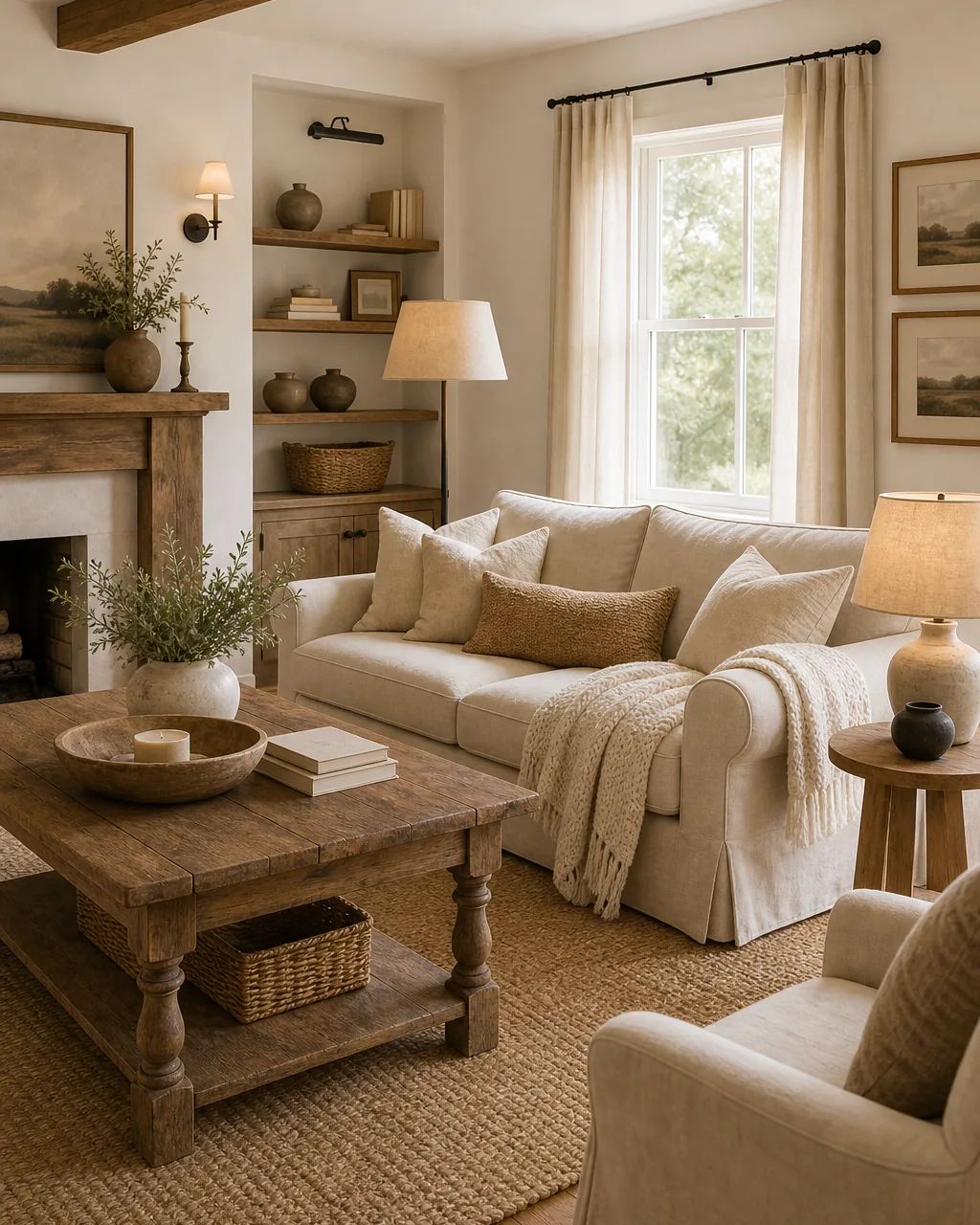
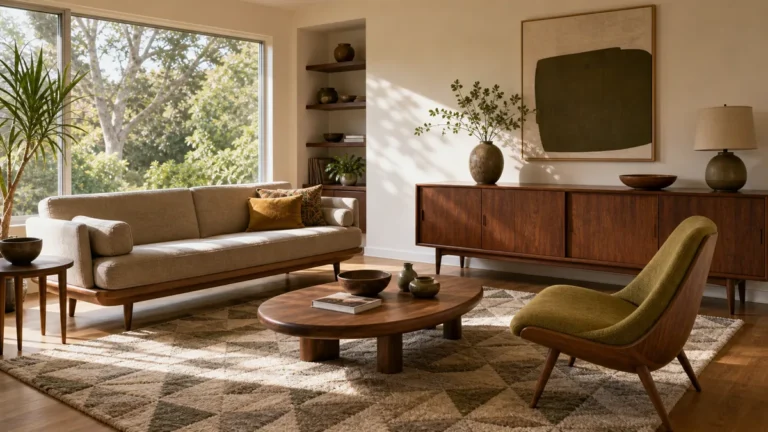
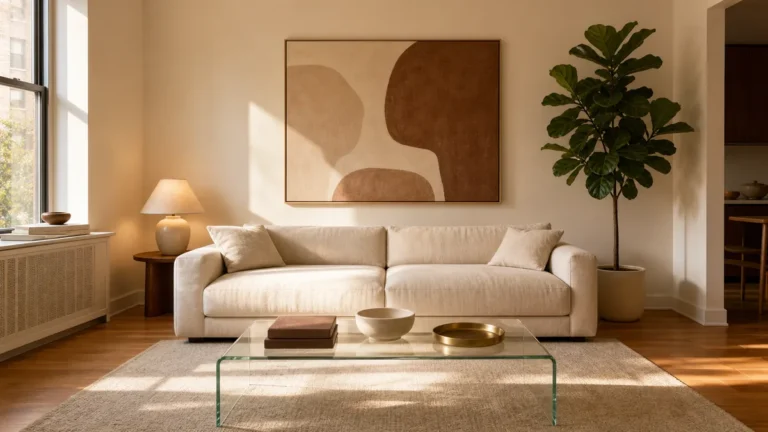
Every idea above only adds up to a calm farmhouse room if the palette stays disciplined, and the discipline is simpler than it sounds: warm white on the walls, oatmeal and cream in the textiles, warm wood tones throughout, and soft black in small doses for contrast. That is the entire farmhouse formula.
The warmth is what separates farmhouse from cold minimalism — every white leans cream, every gray leans greige, every metal is matte black or aged brass rather than chrome.
Restraint in color is what lets all the texture do its job.
When the palette is tight, the layered rugs, the linen, the knit throw, the dried branches, and the worn wood read as richness instead of mess, because nothing competes on color.
The one move that breaks a farmhouse room is a single saturated accent — a bright navy cushion, a red blanket, a teal vase — dropped into the neutral scheme. If you want a touch of color, pull it from nature in muted form: a sage stem, a faded ochre book spine, a dusty terracotta pot. Keep the saturation low and the whole room stays calm.
- Hold to the formula: warm white walls, oatmeal and cream textiles, warm wood, soft black in small doses
- Lean every neutral warm — whites toward cream, grays toward greige — to avoid cold minimalism
- Let texture carry the interest so nothing has to compete on color
- Avoid a single saturated accent — one bright cushion or vase breaks the calm
- Pull any color from nature in muted form: sage, faded ochre, dusty terracotta — low saturation only

Nora writes about small, livable rooms for real apartments. Her own living room runs the farmhouse formula honestly — a washable slipcovered linen sofa, a wool rug layered over jute, a thrifted landscape leaned on the console, a vintage ladder of blankets in the corner, and a palette held to warm white, oatmeal, and soft black. Every idea in this guide gets pressure-tested against a real Tuesday evening with the lamps on, not a catalog photo shoot.
Nora Ellis edits Styled Home Notes. Visit the Nora Ellis author page. More from Nora: modern living room ideas, minimalist living room ideas, living room plant decor ideas.