11 Freezer Organization Ideas That Stop Food Getting Lost in the Back
A freezer fails the same quiet way every time. Bags pile on bags, the back wall swallows whatever sinks toward it, and three months later something rock-hard gets thrown out because no one remembers what it was.
What separates a freezer that earns its keep from one that swallows food is not a bigger freezer. It is eleven decisions about zones, filing, labels, and rhythm — most take an afternoon to set up and run themselves for months.
These eleven moves work for any apartment freezer. The broader logic of running a fridge as a system shows up in our fridge organization ideas sister piece.
From three vertical zones with clear bins to a quarterly defrost reset — these eleven moves are decisions, not inspiration. Jump to the question your freezer is failing at right now.
- 1Build three vertical zones with clear stackable bins (proteins, vegetables, leftovers)
- 2File flat-frozen bags upright like books, not stack them
- 3Flatten soups and sauces in zip bags before freezing for vertical filing
- 4Date and label every bag with masking tape and a sharpie
- 5Magnet a running inventory list to the outside of the door
- 6Run an eat-me-first bin at eye level for FIFO
- 7Group raw proteins on the lowest shelf to catch any drips
- 8Decant ice cubes and ice packs into one tall caddy
- 9Stand tall items like frozen pizzas upright in a wire basket
- 10Dedicate a small bin to backup essentials (butter, bread, yeast)
- 11Defrost once a quarter — empty, wipe, restart the system
Build Three Vertical Zones With Clear Stackable Bins (Proteins, Vegetables, Leftovers)
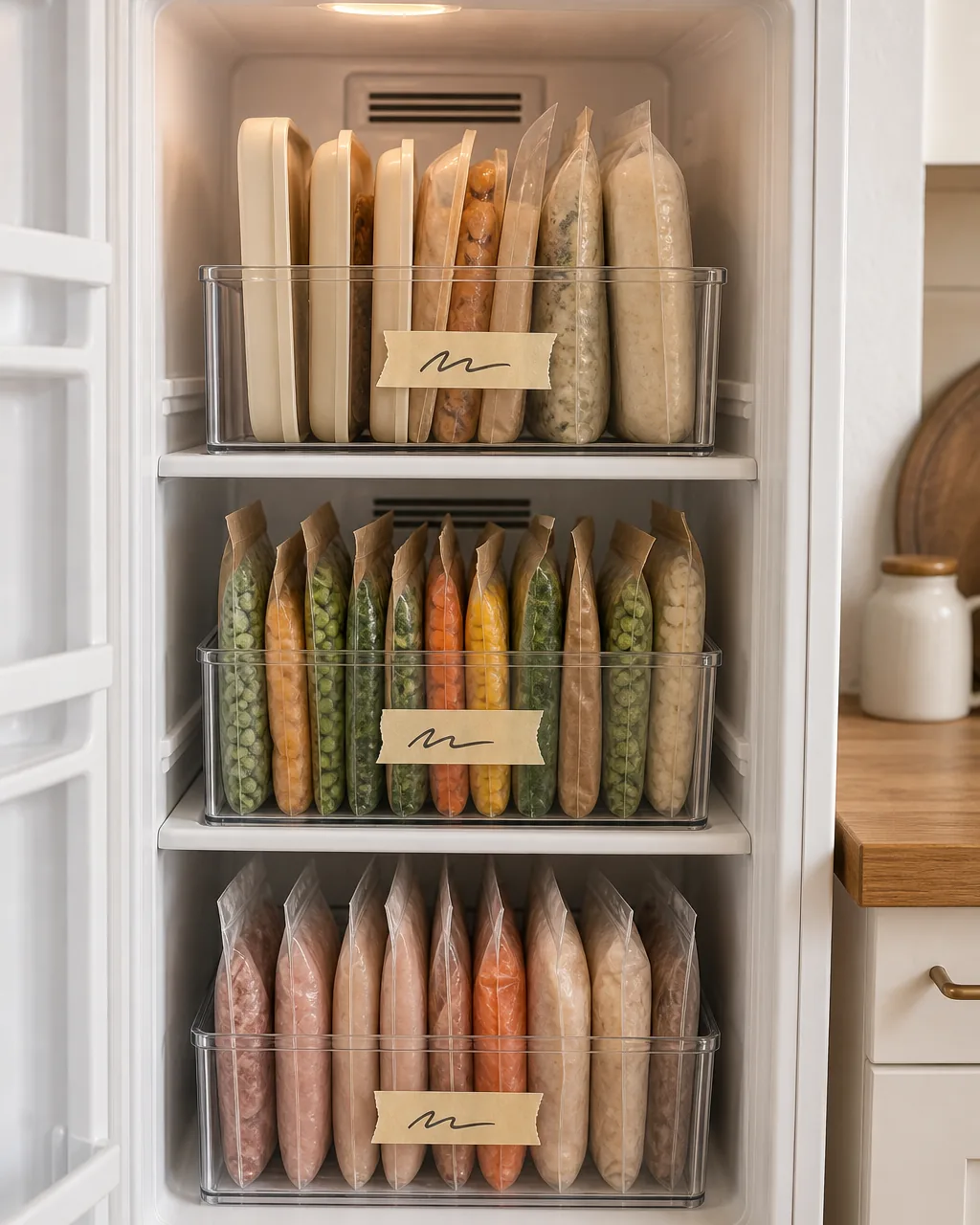
A freezer without zones is where food goes to disappear. You open the door, you see a single dense pile, and the only items that get used are the ones on top — everything underneath drifts to the back, gets buried, then gets tossed at the next defrost.
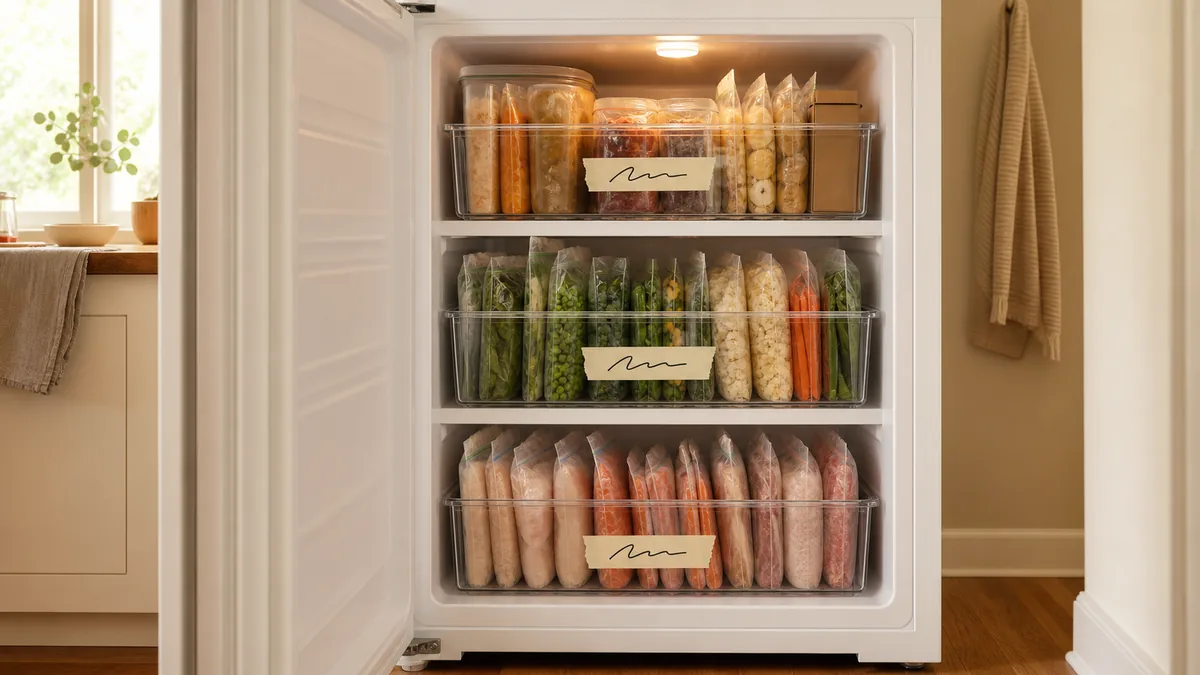
Three clear stackable bins build three vertical zones — proteins on the bottom, vegetables in the middle, leftovers on top — and every bag inside its bin sits upright, fronts out. The freezer goes from one pile to three readable shelves, and putting something away has an obvious right place instead of a vague any-spot.
- Buy three matching clear PET bins sized to your freezer shelf — match the width within an inch so they slot in side by side
- Pick the zone order based on weight, not category — heaviest (proteins) on the bottom, lightest (leftovers) on top so reaching in does not knock things over
- Label the front of each bin once with handwritten masking tape — the bin label, not the bag label, tells you which zone you are in
- Keep one bin half empty as a buffer for the week’s incoming grocery haul — full bins cannot accept new items without a re-shuffle
- Re-pack the bins every two weeks during the regular grocery put-away — small resets prevent quarterly disasters
File Flat-Frozen Bags Upright Like Books, Not Stack Them
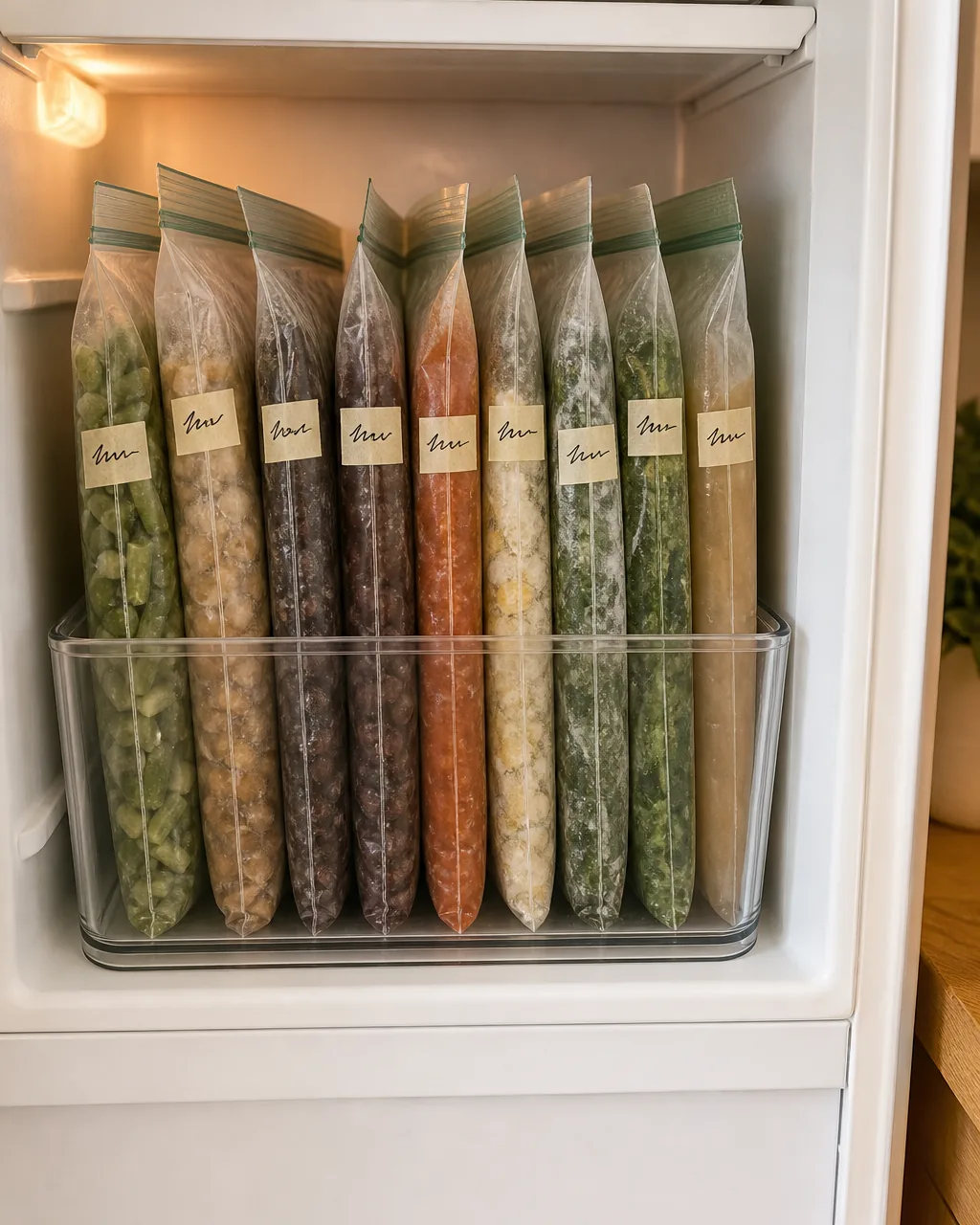
Stacked flat bags are the silent killer of a working freezer. The bag at the bottom of the stack disappears into the back wall, the bag in the middle fuses to the bags above and below, and three months later the whole stack moves as one frozen brick that needs a butter knife to separate.
Filing flat-frozen bags vertically inside a bin — fronts facing forward like books on a shelf — fixes every one of those failures. The bag you want comes out without disturbing the bags around it, every label is visible from above, and nothing fuses to anything else because the contact area is the bag edge, not the bag face.
- Choose a bin tall enough to hold the bag on its long edge — short bins force you back to stacking
- Lay bags flat on a sheet pan to freeze first, then transfer to the upright bin once they are solid slabs
- Sort the bin like a filing cabinet — most-used categories at the front, backup at the back
- Use the bin’s vertical capacity, not the freezer’s horizontal floor — vertical filing fits roughly three times the bags per square foot
- Move the next-up bag to the front each time you cook so the queue stays current
You will not need all eleven at once. Find the situation below that matches your freezer today, and start with those two or three ideas.
Flatten Soups and Sauces in Zip Bags Before Freezing for Vertical Filing
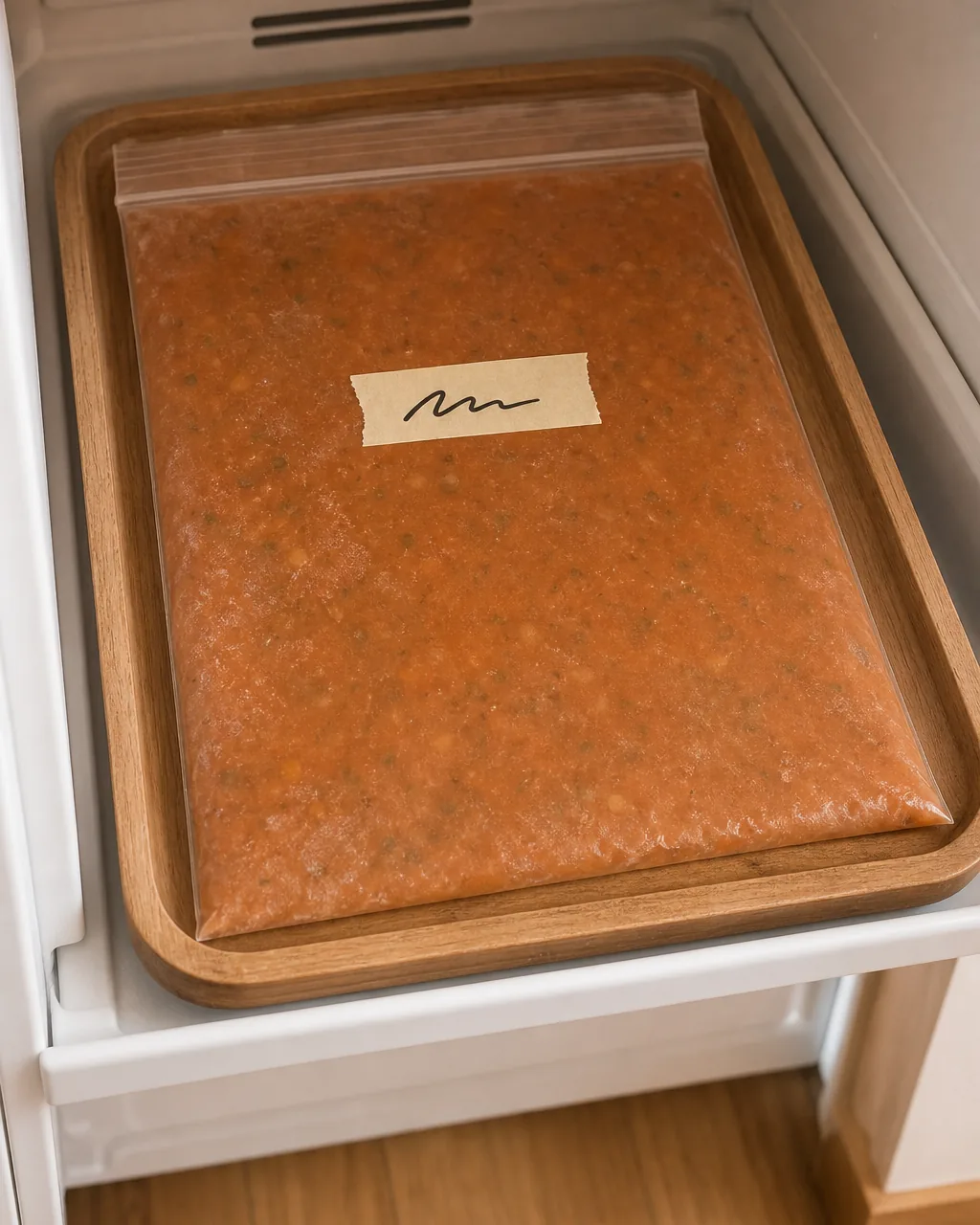
Soups and sauces frozen in tall containers are the reason most freezers are full and unusable at the same time. A round quart container of soup takes up the floor space of three flat bags of the same volume, plus it cannot stand upright in a filing bin, so it ends up wedged on its side in a corner.
Pouring soup or sauce into a zip-top bag and freezing it flat on a sheet pan turns liquid into a quarter-inch slab — and slabs file like books. One household pot of chili that used to occupy a whole shelf now becomes four flat bags that take up the same space as a paperback.
- Pour into the bag while the soup is still warm but not hot — hot fluid weakens the seal
- Lay the bag completely flat on a small sheet pan inside the freezer for the first 12 hours; do not touch it until solid
- Squeeze out the air before sealing — air pockets freeze last and make the slab brittle
- Once solid, transfer the slab to the vertical filing bin alongside the other flat bags
- Defrost a slab in 20 minutes flat in a bowl of cold water — round containers take three hours
Date and Label Every Bag With Masking Tape and a Sharpie
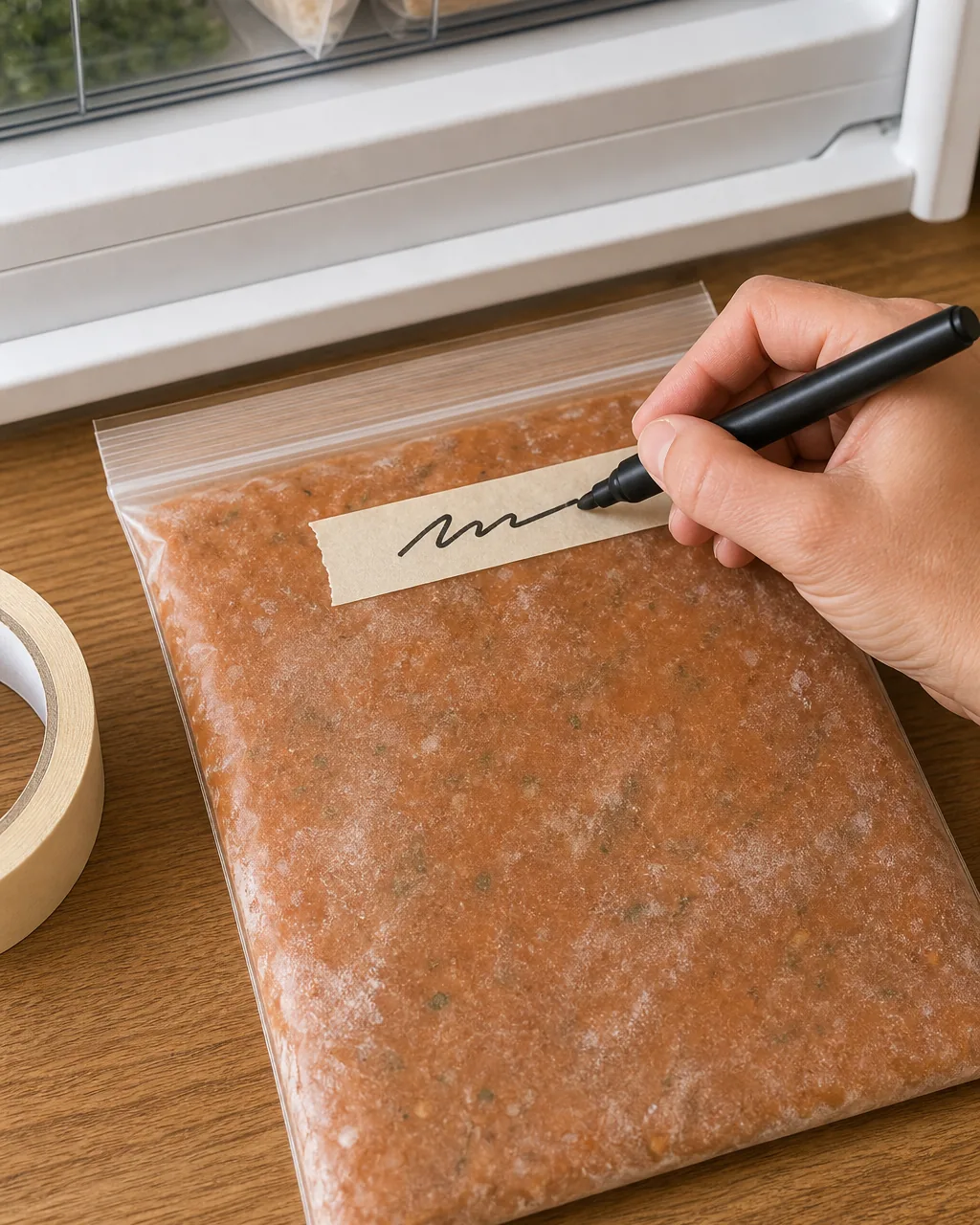
Unlabeled freezer bags are why people throw away food they bought two months ago. The bag goes in confident — “I’ll remember what that is” — and comes out a mystery, opaque with frost, sometime the next winter.
A strip of cream masking tape with two pieces of information — what is inside, and the date it went in — solves the entire mystery problem with a piece of tape and a sharpie. Tape sticks at zero, the sharpie writes through the cold, and the label peels off cleanly when the bag is reused.
- Keep a roll of masking tape and a black permanent marker in a small drawer near the freezer — friction kills consistency
- Write only two things: contents and date — every extra detail you mean to add stops you from labeling at all
- Use the same date format every time so the rotation is obvious — month/day works for most home cooks
- Stick the tape on the top edge of the bag (the part visible when filed) — never on the face
- Re-label any bag you decant or split — half a bag of stock without a label becomes a mystery in three weeks
Magnet a Running Inventory List to the Outside of the Door
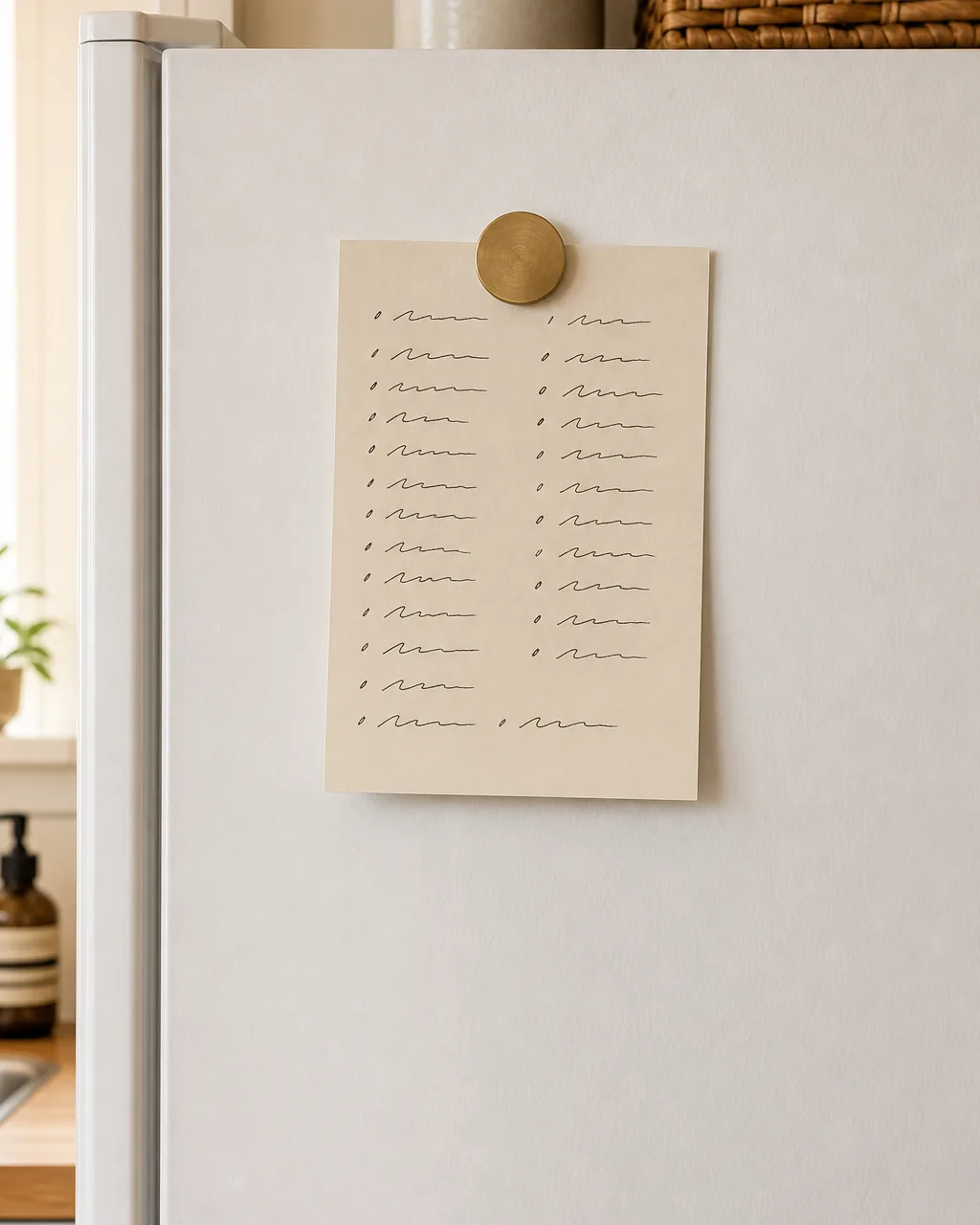
Opening the freezer to figure out whether you have ground turkey is how cold air leaks out and warm air slips in. Every check tax the freezer’s seal and warms the back wall a couple of degrees — and most of the time the answer is still uncertain because the bag is buried.
A small running inventory card stuck to the outside of the freezer door — pencil for additions, an eraser for removals — answers the question without opening the door. Add a tally mark when something goes in, cross it off when something comes out, and the card stays current with about ten seconds of work per week.
- Use a small piece of paper, not a whiteboard — paper is cheap to swap and forces a periodic rewrite
- Group the card the same way the freezer is zoned — proteins, vegetables, leftovers — so a glance maps to a shelf
- Keep a pencil tethered nearby with a piece of string — the marker that walks away is the system that stops working
- Tally marks, not paragraphs — “ground turkey ////” is faster than “four packs ground turkey”
- Rewrite the card from scratch every month — a clean card resets the discipline
These four rules separate a freezer you can actually shop from one that quietly swallows half its contents.
Run an Eat-Me-First Bin at Eye Level for FIFO
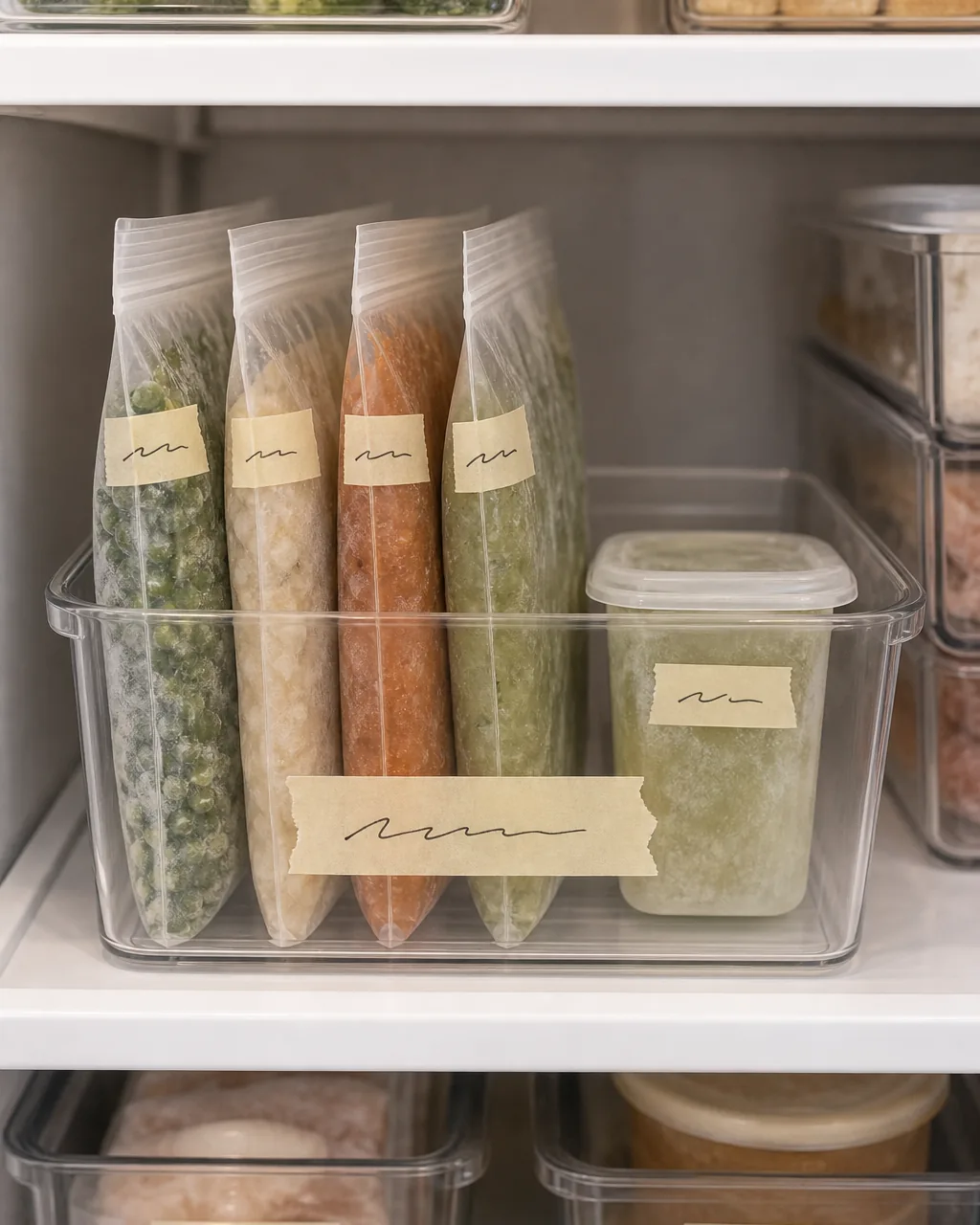
The reason cooked rice from August is still in the freezer in December is that nothing in a household freezer naturally enforces first-in-first-out. New items go on top of old items because that is where there is room, and the old items quietly sink toward the back wall until they get thrown out.
A small “eat me first” bin at eye level — explicitly labeled as such — gives the household one place to look before cooking anything new. Anything close to its date, anything halfway through, anything you intended to use last week goes into that bin, and the next meal pulls from it before pulling from the rest of the freezer.
- Make the bin small on purpose — a big eat-me-first bin defeats itself by holding too much to read
- Position it at adult eye level — the height the household actually looks at first
- Move items into it any time you cook — if you notice “we should eat that,” it goes in the bin that minute, not later
- Establish a household rule — nothing new goes on the dinner menu until the bin is checked
- Empty the bin completely once a week — if items in it never get eaten, the meal plan needs to change, not the bin
Group Raw Proteins on the Lowest Shelf to Catch Any Drips
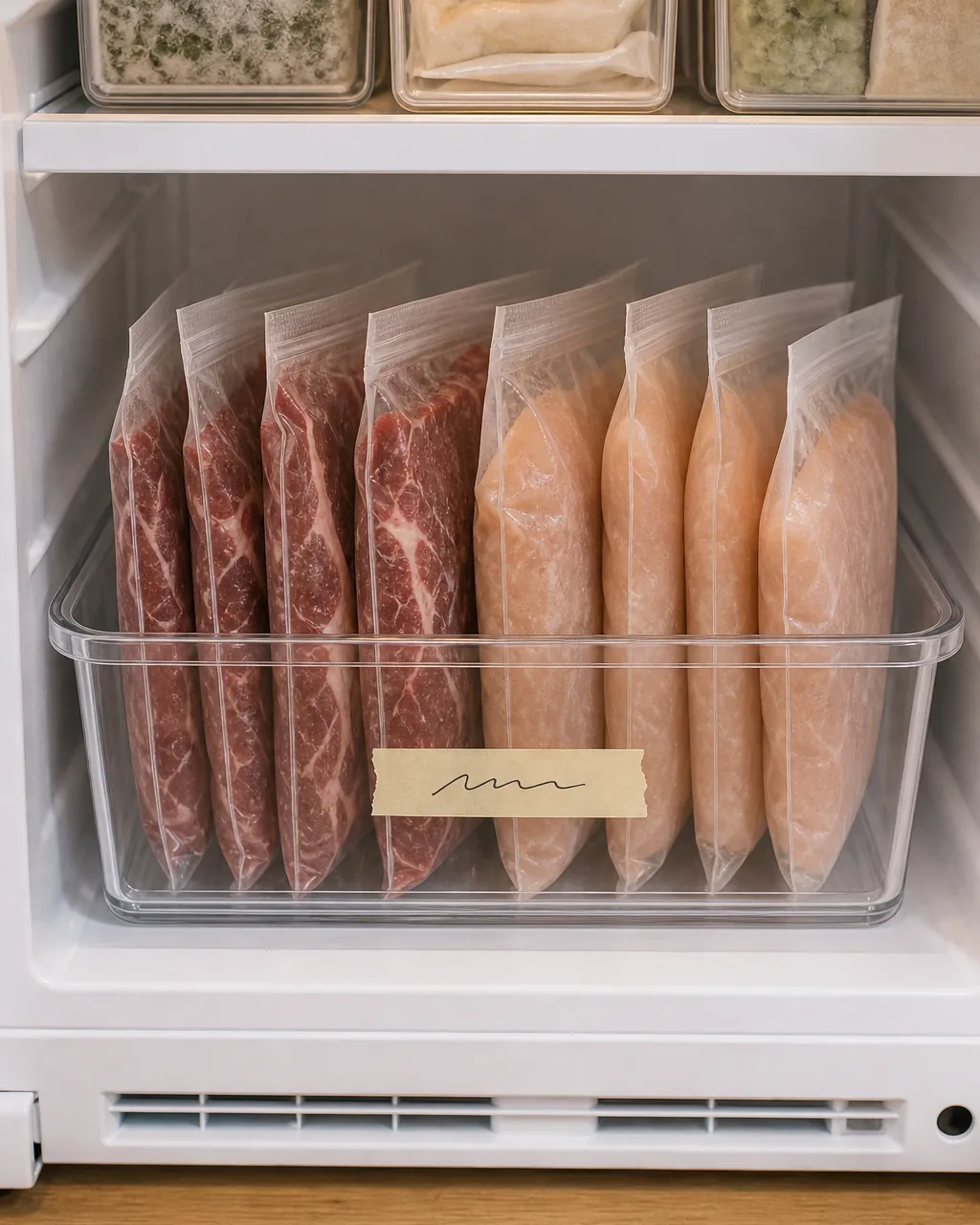
Raw proteins on a high freezer shelf are how a power outage becomes a kitchen contamination incident. A bag thaws, leaks down through the bin below, and suddenly the frozen vegetables underneath need to be thrown out even though they never thawed.
Grouping all raw proteins into one dedicated bin on the lowest freezer shelf solves two problems with one move. Any drip during a thaw is contained inside the protein bin and below every other bin, and the household always knows where to look for chicken or fish without rifling through three zones.
- Use a slightly deeper bin for the protein zone — taller side walls catch more drip
- Line the bottom of the bin with a thin cotton towel or paper towel — a fast absorber buys time during a power blip
- Wash the protein bin once a month with warm soapy water — it is the bin that needs it most
- Keep raw beef, chicken, and fish in separate sub-bags inside the bin — cross-contamination is a same-bin problem, not a same-bin solution
- Pull the bin out as a unit when meal-planning instead of pulling individual bags — one motion, see everything, no door-open dwell
Decant Ice Cubes and Ice Packs Into One Tall Caddy
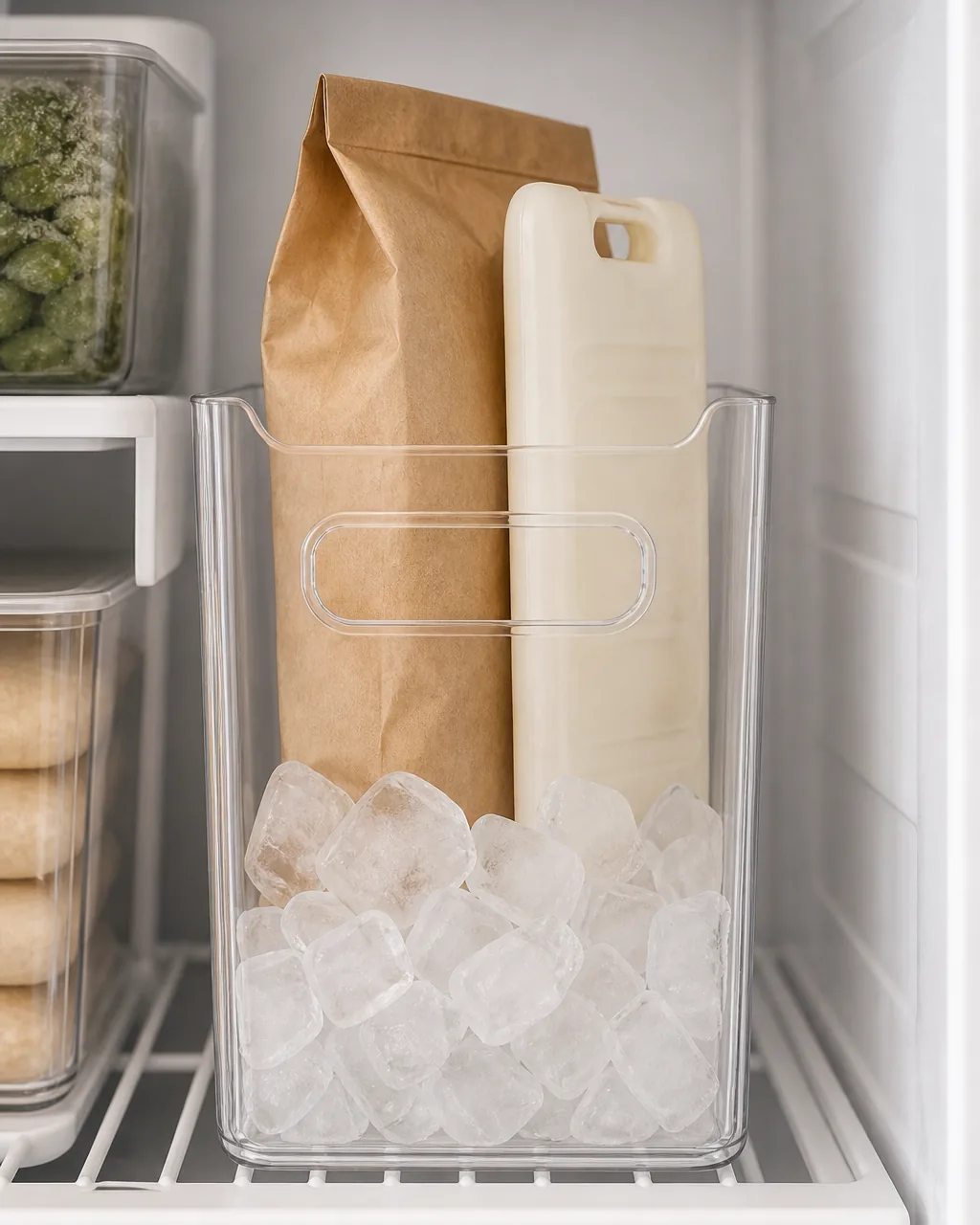
Loose ice cubes, a bagged ice block, and three reusable cold packs scattered around the floor of the freezer eat more space than they have any right to. They roll, they slide, they wedge in front of bins, and they make the freezer feel full before any food has gone in.
One tall clear caddy gathers every cold thing into a single vertical column — ice cubes at the bottom, bagged ice in the middle, gel packs standing on edge. The footprint shrinks by roughly half, and you can lift the whole caddy in one motion to grab a pack for a cooler instead of digging.
- Choose a caddy tall and narrow, not short and wide — narrow caddies hide nothing
- Stand gel packs vertically on their long edge — laid flat they ride too much shelf
- Decant cubes from any bagged ice you buy immediately into the caddy — the bag rips, the cubes roll
- Empty and dry the caddy once a quarter — frost build-up in the caddy makes it stick to the shelf
- Keep one slim cold pack on the door for kid scrapes and headaches — fast access stays out of the caddy
11 freezer organization moves, one system that runs as a vertical archive instead of a frozen pile
- 1Build three vertical zones with clear stackable bins (proteins, vegetables, leftovers)Three matching clear PET bins turn a single dense pile into three readable zones — proteins low, vegetables middle, leftovers high — so every bag has a defined right place to go back to.
- 2File flat-frozen bags upright like books, not stack themFiling flat bags vertically inside a bin makes every label readable from above and prevents the back-of-stack disappearance and the fused frozen brick problem.
- 3Flatten soups and sauces in zip bags before freezing for vertical filingA pot of soup poured into zip bags and frozen flat on a sheet pan becomes thin slabs that file like books and defrost in twenty minutes in cold water.
- 4Date and label every bag with masking tape and a sharpieA strip of cream masking tape with two pieces of information — contents and date — stops the unlabeled-mystery-bag problem and survives the freezer’s cold without lifting.
- 5Magnet a running inventory list to the outside of the doorA small handwritten card stuck to the front of the freezer door tracks what is inside without opening it, saving cold air and decision time at every check.
- 6Run an eat-me-first bin at eye level for FIFOA small dedicated bin at eye level holds items close to their date so the household pulls from it before pulling from the rest of the freezer, enforcing FIFO without effort.
- 7Group raw proteins on the lowest shelf to catch any dripsAll raw proteins live in one dedicated bin on the lowest shelf so any thaw drip is contained inside the bin and below every other zone, preventing cross-contamination.
- 8Decant ice cubes and ice packs into one tall caddyOne tall narrow caddy gathers every cold thing — loose cubes, bagged ice, gel packs — into a single vertical column and shrinks the cold-pack footprint by roughly half.
- 9Stand tall items like frozen pizzas upright in a wire basketA short wire basket stands pizzas, sheet-pan dinners, and other flat tall items on edge like records so every item is readable at a glance.
- 10Dedicate a small bin to backup essentials (butter, bread, yeast)A small dedicated bin holds the freezer’s backup pantry items — butter, bread, yeast, a stash of nuts — so the “I thought we had one” failure mode never happens.
- 11Defrost once a quarter — empty, wipe, restart the systemHalf an hour, four times a year, to pull everything out, wipe the interior, and put the bins back the way the system was designed keeps the whole archive from drifting back into a pile.
styledhomenotes.com
Stand Tall Items Like Frozen Pizzas Upright in a Wire Basket
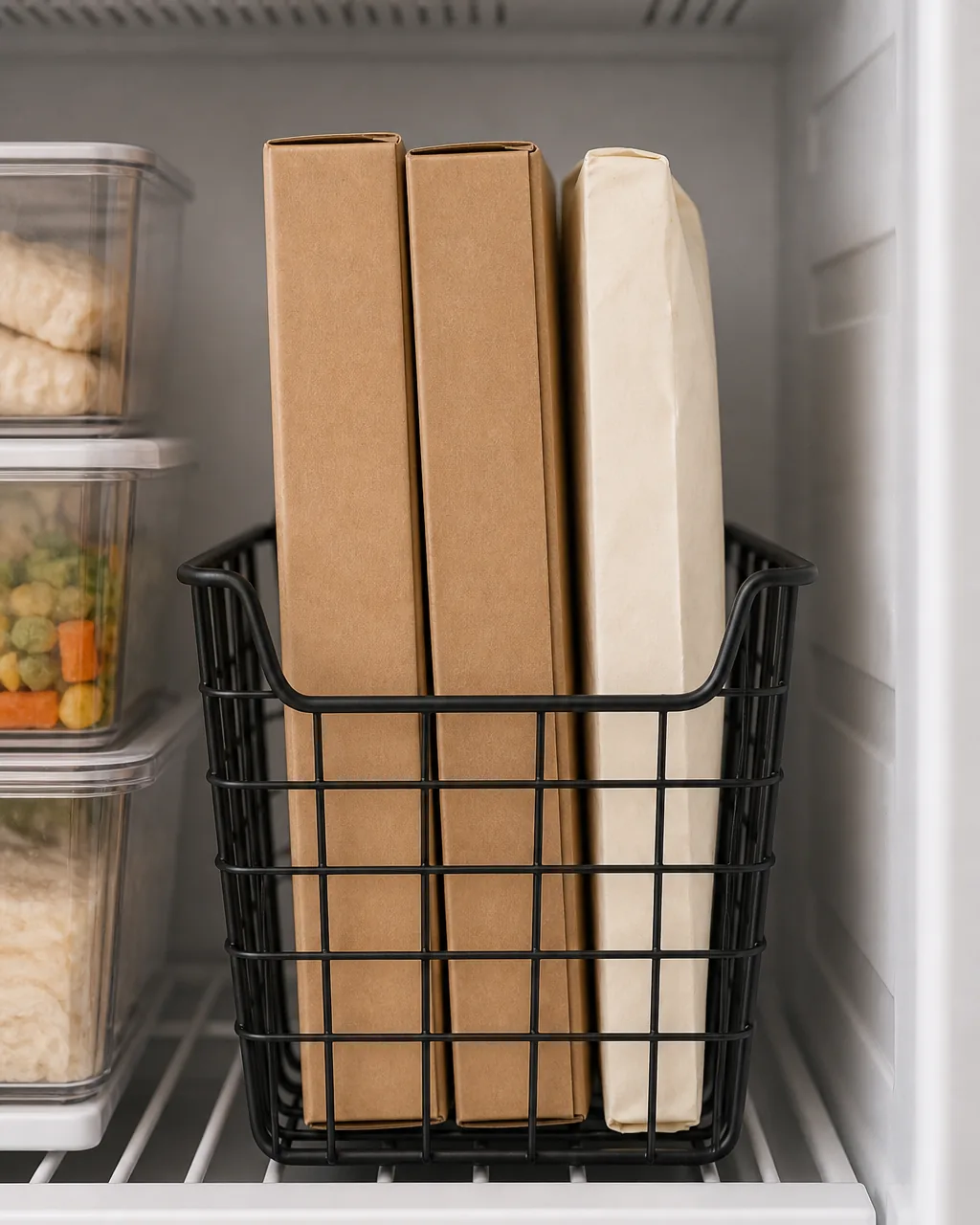
Flat frozen items — pizzas, sheet pan dinners, hash brown slabs, baking sheets of par-baked cookies — are the worst freezer citizens lying flat. They take up half a shelf, they require lifting half the bins above them to see what is below, and they hide behind each other in a stack.
A short matte-black wire basket on one shelf standing flat items on edge — like records in a record crate — fixes the visibility problem with one piece of hardware. The wire walls hold each item upright, the open top makes them readable at a glance, and the basket itself slots into the freezer’s existing footprint without modification.
- Pick a basket with vertical wire ribs at least four inches tall — shorter walls let pizzas tip
- Reserve the basket only for flat large items — small bags fall through the wire
- Position the basket so its open end faces the door — sliding items out from the side defeats the system
- Keep the basket about three-quarters full — fully packed makes pulling one item hard
- Stand items in reverse-rotation order — newest at the back, oldest at the front, so the front always gets used first
Dedicate a Small Bin to Backup Essentials (Butter, Bread, Yeast)
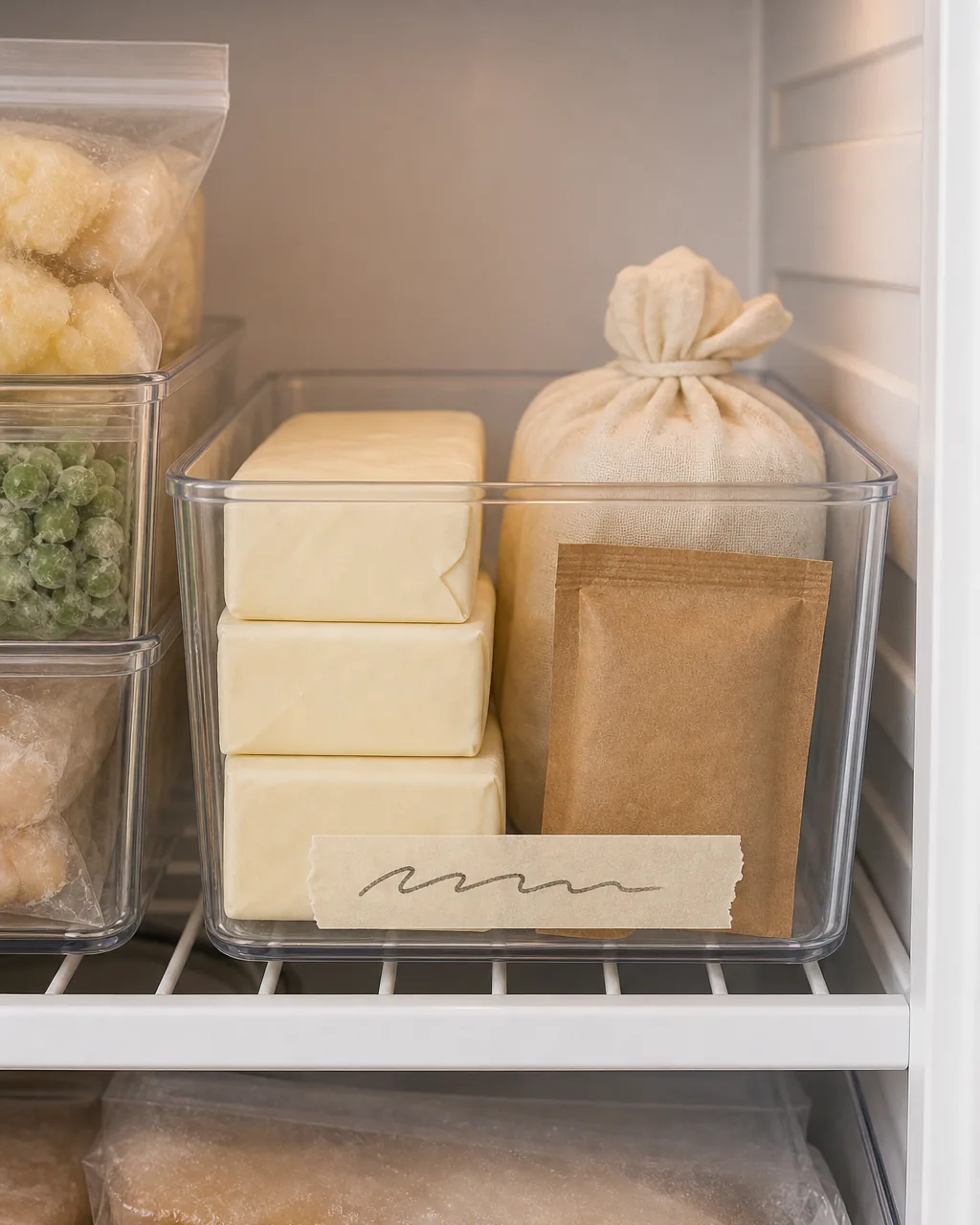
The freezer’s other quiet job is to be a small backup pantry. Spare butter, a frozen loaf of bread, a packet of yeast, a stash of nuts — items that go rancid at room temperature but live for months in the cold — get scattered across the freezer and forgotten until they would have been useful last Tuesday.
A small dedicated bin for backup essentials puts every “I know we had one” item in one place. The bin is small on purpose — three sticks of butter, a small bread loaf, a yeast packet, maybe a half-cup of nuts — and the rule is the same as a pantry restock: open it, see what is low, write it on the grocery list.
- Cap the bin at five categories — bigger and it stops being a backup, it becomes a second freezer
- Position the bin next to the eat-me-first bin at eye level — backups belong at the same height as decisions
- Label the bin “backups” and not by content — the contents will shift over time
- Pair the bin with a small pantry-side mirror — when bread runs out in the pantry, the bin gets checked before grocery day
- Top off after every big bake — the day you finish a loaf of bread is the day to thaw the frozen backup, not the day you run out
Defrost Once a Quarter — Empty, Wipe, Restart the System
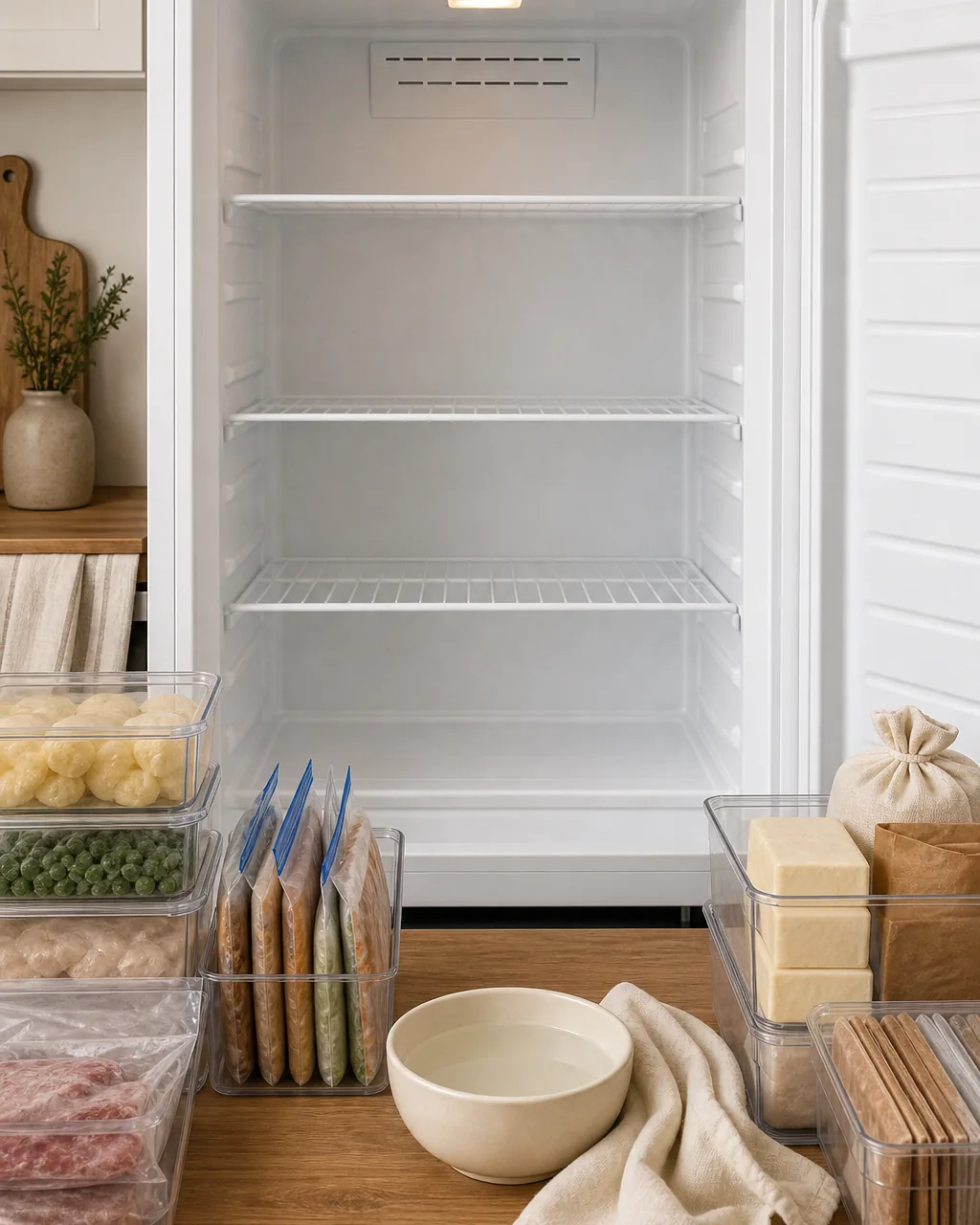
The cleverest freezer organization system in the world drifts after three months. Bags slip out of bins, labels fall off, ice cubes escape the caddy, and a mystery item lands on the floor under the lowest bin. Without a reset, the system slowly degrades back into the original pile.
A scheduled quarterly defrost — half an hour, four times a year — pulls everything out, wipes the interior, sorts the bins, and puts everything back the way the system was designed.
The labor is small, the result is a freezer that looks the way it did on day one, and the bonus is finding the bag of stock you forgot about while there is still time to use it.
The same hands-on calm shows up in the pantry shelf organization ideas for dry storage and the baking supplies organization ideas for kitchen working pantries.
- Schedule the defrost on the calendar — first Saturday of every quarter is a low-friction default
- Move the contents to a cooler with ice packs before starting — twenty minutes out keeps everything safely cold
- Wipe interior walls and shelves with a cream cloth and warm water — no harsh chemicals, the freezer will smell like them
- Toss anything past its date or unlabeled — the quarterly reset is the moment to be unsentimental
- Restart the system bin by bin, in the same zone order — proteins low, vegetables middle, leftovers high — so the rhythm continues

Nora writes about small, livable systems for real apartments. Her freezer runs three vertical zones in clear bins, an eat-me-first bin at eye level, masking-tape labels on every bag, and a quarterly defrost on the first Saturday of every season — which is why every move in this guide gets pressure-tested against a real freezer, a real grocery cadence, and a household that actually has to live with whatever the system asks of them on a Tuesday night.
Nora Ellis edits Styled Home Notes. Visit the Nora Ellis author page. More from Nora: fridge organization ideas, pantry shelf organization ideas, baking supplies organization ideas.