12 Small Apartment Bedroom Ideas That Sleep Big in a Tight Footprint
A small apartment bedroom fails the same way every time. The bed pushed flat against a wall, the dresser hogging a full bedroom wall, cords tangled at the nightstand, and cool-gray bedding picked “to look modern” — the room reads cramped and the eye never rests.
What separates a small bedroom that sleeps big from one that just feels tight is not square footage or budget. It is twelve square-footage decisions — floating the bed, moving the dresser, hanging one art piece, choosing warm linens — most of them take an afternoon.
These moves work whether your bedroom is a true second room or carved out of a single-room footprint like in our studio apartment ideas guide.
From floating the bed off all three walls and moving the dresser into the closet to a two-week three-surface edit — these twelve moves are square-footage decisions, not styling tricks. Jump to the problem your bedroom is failing at right now.
- 1Float the bed off all three walls so you can make it from both sides
- 2Pick one slim nightstand if a side wall touches, two if both sides clear 18 inches
- 3Hang one large piece of art above the bed instead of a crowded gallery
- 4Hold sheets, pillow stack, throw, and curtain in one tonal warm-neutral family
- 5Stack linen curtain panels onto the wall so the bedroom window reads taller
- 6Use built-in under-bed drawers, never plastic bins you have to lift the mattress for
- 7Move the dresser into the closet — give the bedroom a wall back
- 8Mount a slim picture ledge above the bed instead of a bulky headboard
- 9Switch to wall-mounted reading lights so the nightstand stays clear
- 10Lean one tall mirror in a corner to bounce light and stretch the floor
- 11Keep the linens warm, not cool — small rooms read calmer in cream and oat than gray
- 12Edit three surfaces every two weeks — nightstand, dresser top, trunk top
Float the Bed Off All Three Walls So You Can Make It From Both Sides
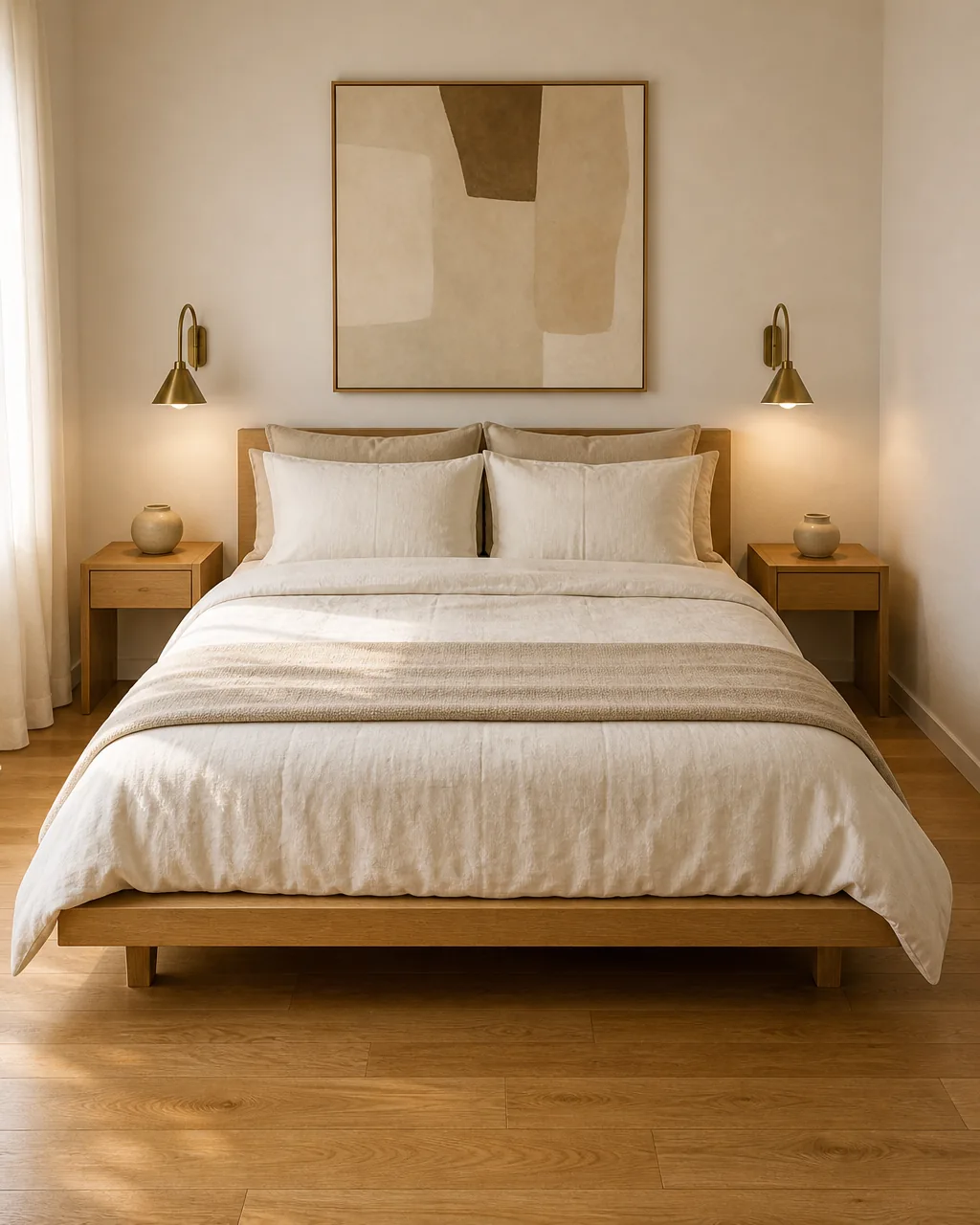
The default move in a small apartment bedroom is to push the bed flat against a side wall to “save space,” but the trade is brutal: one whole side of the mattress becomes a wall-against ledge, you climb over your partner to get out, and making the bed becomes a 10-minute wrestling match with the fitted sheet. The room reads as smaller, not bigger, because the bed visually grafts onto the wall.
Floating the bed several inches off all three walls — back, head wall, and both side walls — costs almost no square footage and buys back two real things.
You can walk both sides of the bed and make it from both sides in 90 seconds, and the room reads as a bedroom designed around a bed instead of a bed jammed into whatever space was left. The walk-around clearance does not need to be wide; six to ten inches on the sides and twelve at the foot is enough.
- Pull the head of the bed at least six inches off the back wall so a fitted sheet can wrap the top corner without you flipping the mattress
- Leave six to ten inches on each side wall so you can walk and tuck the sheets without climbing onto the mattress
- Keep at least twelve inches at the foot of the bed so a tall slim dresser or a low bench can sit opposite without scraping
- Use a low platform bed frame rather than a tall four-poster — low frames waste less vertical air in a small bedroom and read calmer
- Center the bed under the art instead of centering on the wall — eye-line symmetry reads more intentional than wall-edge symmetry
Pick One Slim Nightstand If a Side Wall Touches, Two If Both Sides Clear 18 Inches
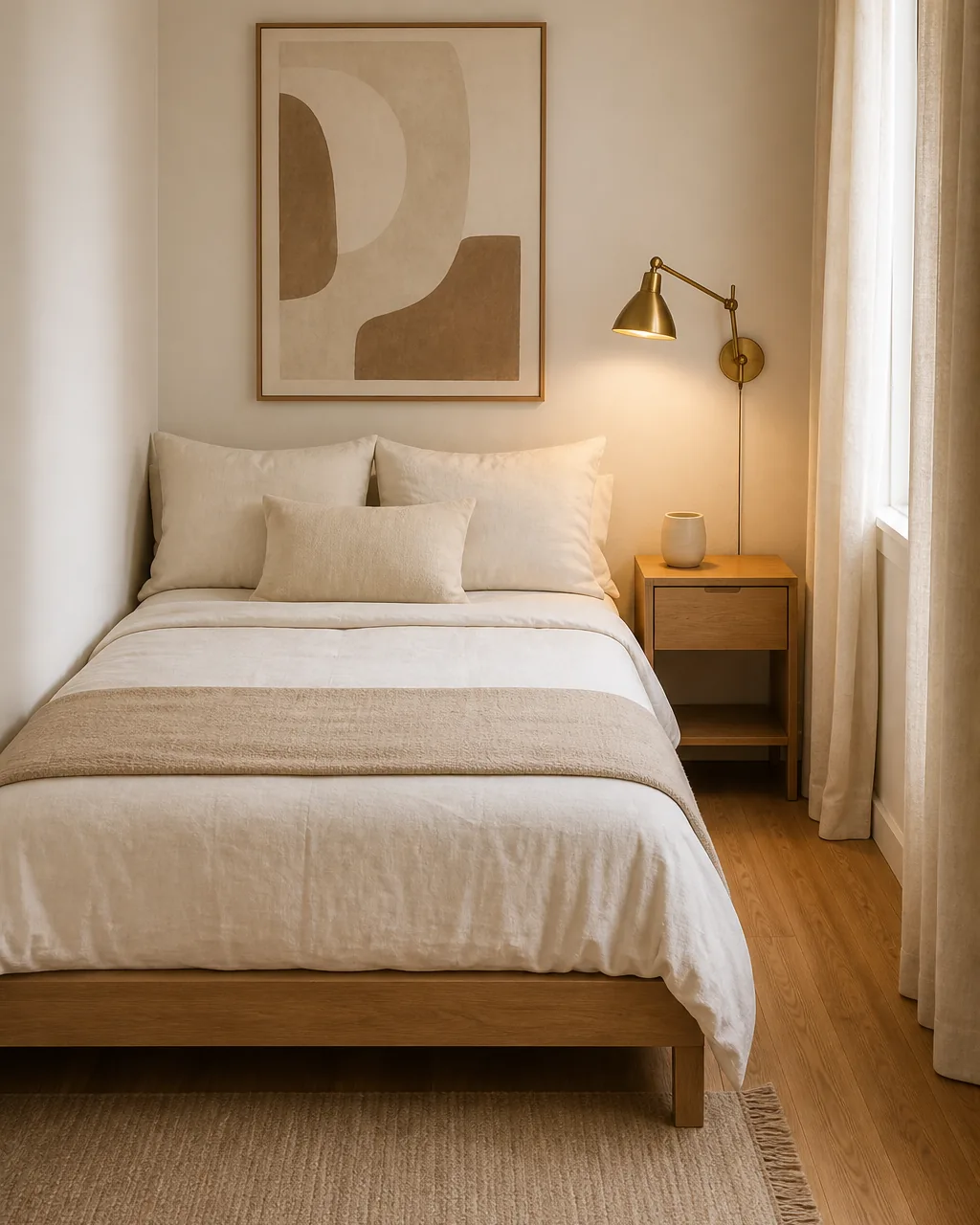
Two matched nightstands are not a bedroom rule, they are a Pinterest assumption. In a small apartment bedroom where one side of the bed touches a wall — common in galley-shaped bedrooms — forcing a second nightstand onto the touching side makes the wall feel crowded and the nightstand functionally useless because nothing fits between the lamp and the wall corner.
The decision is binary and unsentimental. If you have at least eighteen inches of clear floor on both sides of the bed, you can fit two slim 14-to-16-inch nightstands and the symmetry reads calm.
If one side is flush against a wall, you skip that side entirely and put one slim nightstand only on the free side — the asymmetry reads intentional, not unfinished, because the wall itself becomes the “other side.” Trying to split the difference with a shallow shelf on the touching side reads as an apology and adds visual noise.
- Measure floor clearance on both sides of the bed before buying any nightstand — eighteen inches is the minimum for one to read as a nightstand and not a shelf
- Pick nightstands no wider than the wall clearance on that side minus one inch — overhanging nightstands always look wrong
- Skip the touching side entirely if the bed is flush against a wall — one nightstand reads more intentional than one and a half
- Choose a single drawer plus open shelf rather than two drawers — closed storage hides what you actually use nightly
- Match nightstand height to the top of the mattress within two inches — taller reads bulky, shorter reads childlike
Hang One Large Piece of Art Above the Bed Instead of a Crowded Gallery
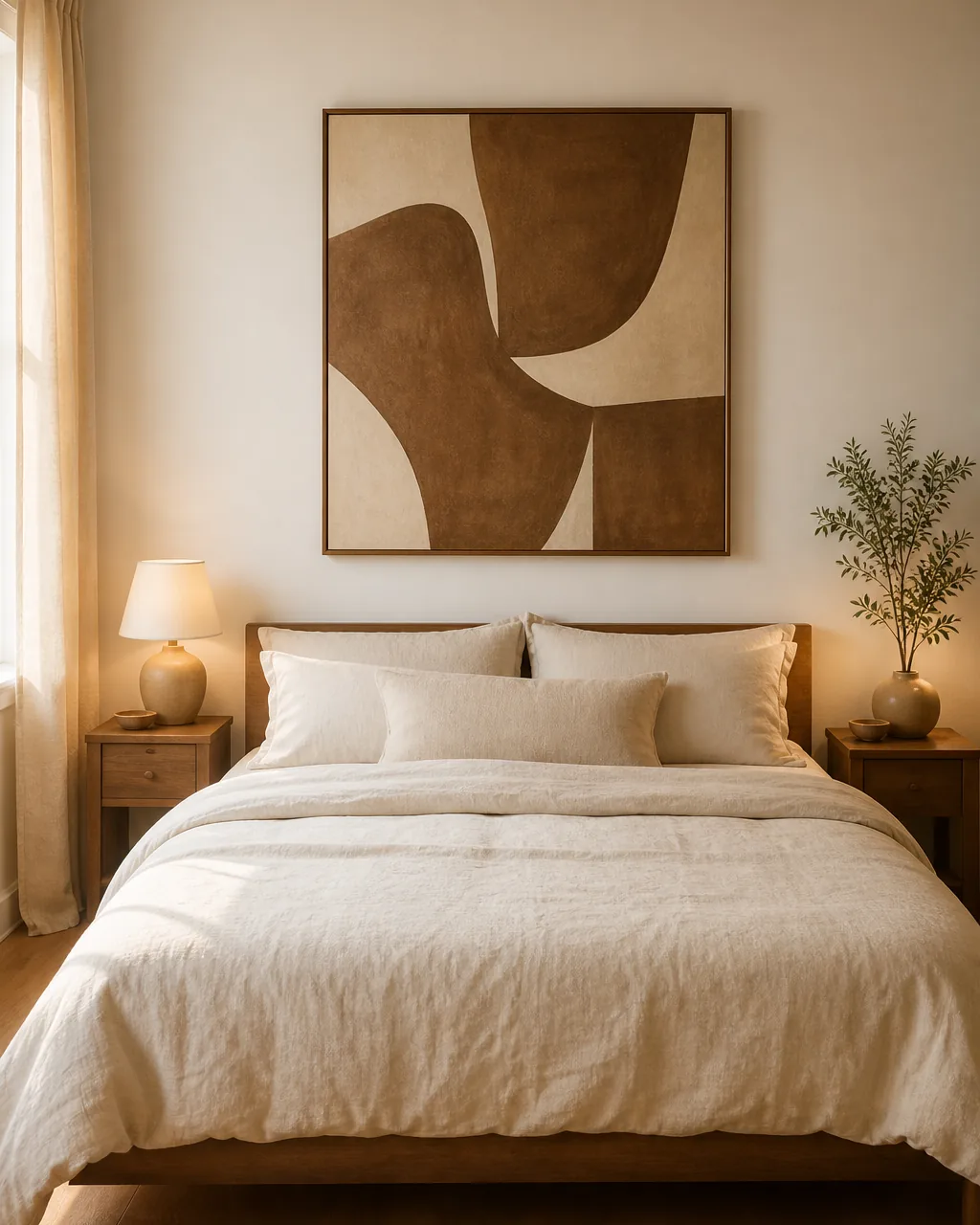
A gallery wall above a small apartment bed is the single fastest way to make the room read busy. Six to nine smaller frames create six to nine focal points directly in your eye-line as you fall asleep and wake up, and the wall reads as a curated collection rather than a bedroom backdrop.
One large piece of abstract or quietly representational art hung centered above the bed — sized to about two-thirds the width of the mattress — replaces the cluster with a single calm focal point.
The wall reads as composed instead of decorated, and the bed beneath it gets visually anchored to the wall above. The bedroom is the one room where the eye should have nowhere to drift while it is trying to power down, and a single piece of art is the cheapest way to enforce that.
- Size the piece to roughly two-thirds the width of the bed — a queen bed wants an art piece around forty inches wide minimum
- Hang the center of the art eight to ten inches above the headboard or picture-ledge — bedrooms read better with art slightly lower than the 57-inch living-room rule
- Pick abstract warm shapes or quiet landscape over busy detail — the bedroom rewards images you do not have to look at
- Choose one frame style (or no frame) — a single slim warm-oak frame or a bare canvas, never a mix of black and brass on the same wall
- Resist adding a second piece beside it — if you want change, swap the large piece, do not start a cluster above the bed
You will not need all twelve at once. Find the situation below that matches your bedroom today, and start with those two or three ideas.
Hold Sheets, Pillow Stack, Throw, and Curtain in One Tonal Warm-Neutral Family
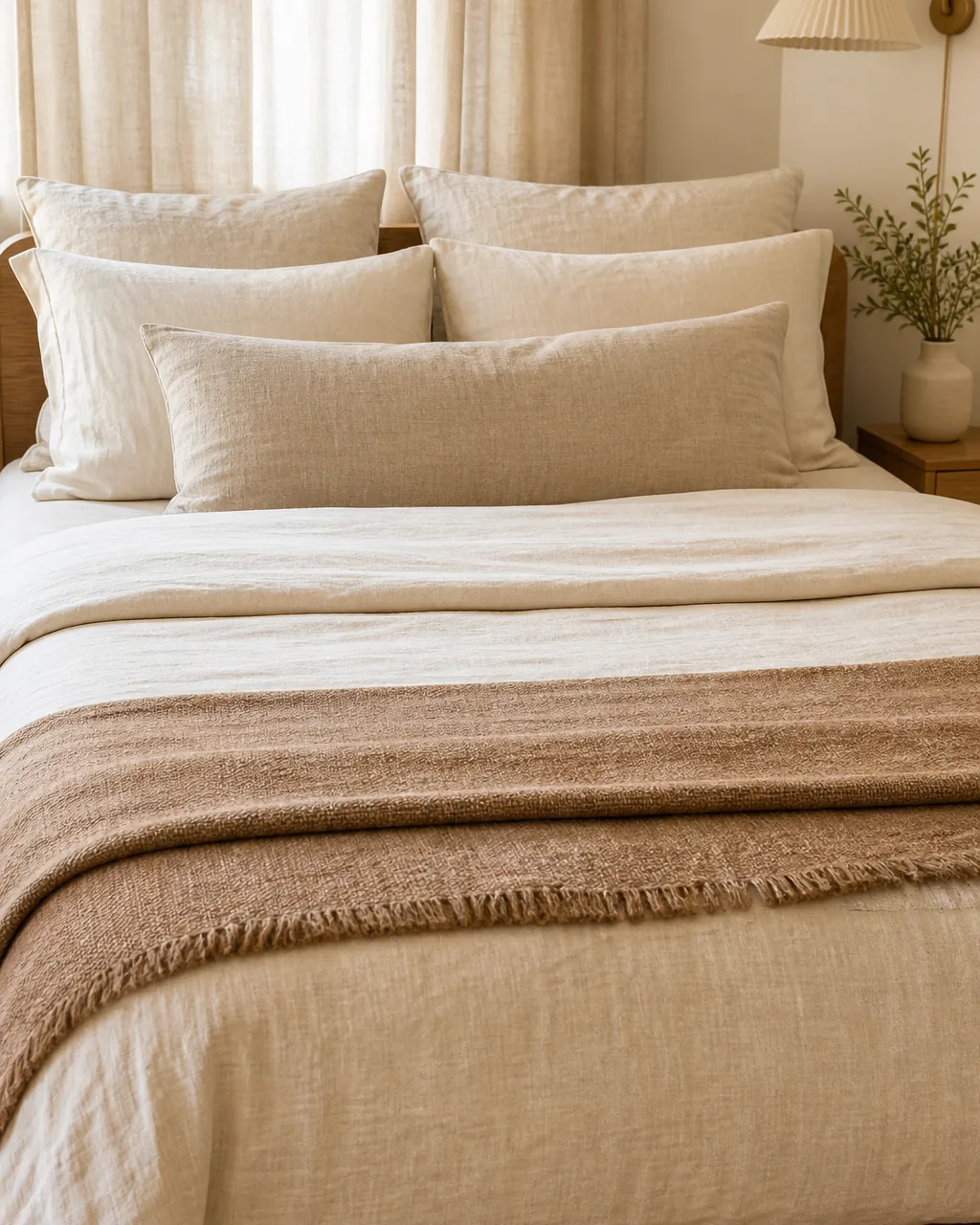
Most small bedrooms that feel busy are not actually too small — they are too multi-colored. A gray fitted sheet, a navy duvet, a terracotta throw, and white curtains mean four distinct color decisions are stacked on a single piece of furniture, and the eye reads “lots of things” instead of “a bed.”
Holding every textile in one tonal warm-neutral family — cream, oat, and a single warm cocoa accent on the throw — is the move that does the most work for the smallest effort.
Pillow, fitted sheet, flat sheet, duvet, throw, and curtain all share temperature, and the bed reads as a single calm anchor instead of a cluttered surface. The bedroom feels bigger because the eye has fewer color decisions to process, and warmer because every textile shares the same undertone.
- Pick two warm neutrals and one warm accent — cream + oat + a single cocoa kraft throw is a reliable default
- Hold the curtain in the same family — a cool gray curtain breaks the tonal palette in one glance even if the bedding is perfect
- Pillow stack tops out at four pillows total — two sleeping pillows and two decorative, all in the warm-neutral family
- Skip patterned bedding entirely in a small bedroom — the pattern reads as more clutter at the scale of a queen bed
- Test the palette in flat morning daylight, not lamp light — lamp light warms anything; daylight reveals the cool undertones lying
Stack Linen Curtain Panels Onto the Wall So the Bedroom Window Reads Taller
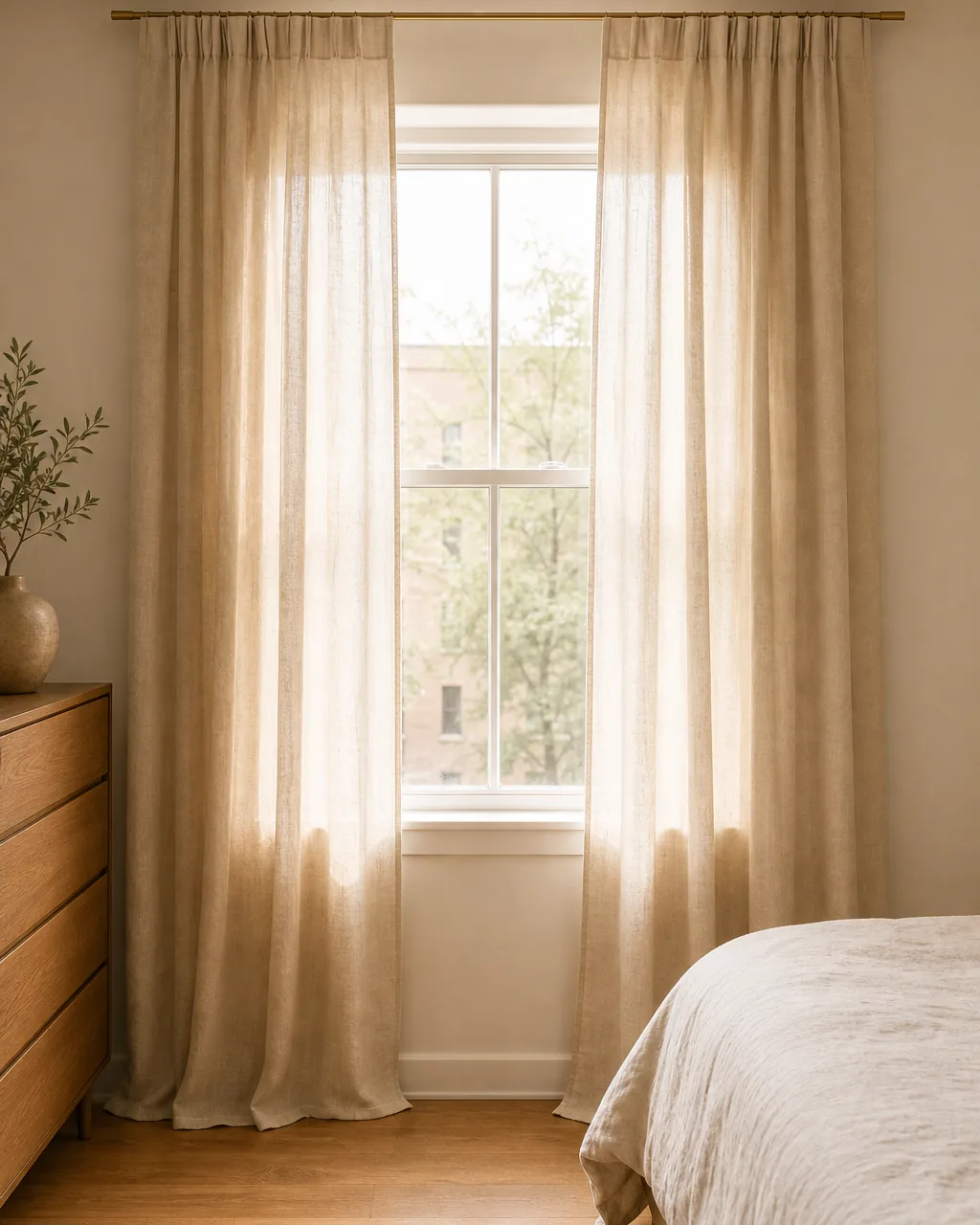
The default rental curtain hang — rod mounted just above the window frame, panels barely wider than the glass — visually shrinks the wall around the window and makes a small bedroom feel boxed in. The window becomes the ceiling, and the wall above and beside it reads as wasted.
Hanging the curtain rod almost all the way at the ceiling and extending the rod four to eight inches wider than the window opening on each side does two things at once. The wall reads taller because the eye now travels all the way down from the ceiling.
The window reads wider because the panels stack onto the wall, not the glass, when they are open. The room gains visual height and width without anyone moving an inch of furniture.
- Mount the rod within an inch of the ceiling — gap closes the “boxed window” feeling that low rods create
- Extend the rod four to eight inches past each side of the window opening — panels then stack onto wall, not glass, when open
- Hang panels long enough to brush the floor — short rental curtains visually amputate the wall
- Pick a cream linen panel over blackout if light is not the issue — linen diffuses morning light and warms the room
- Use a slim matte rod, not a decorative finial — finials read fussy at small-bedroom scale
Use Built-In Under-Bed Drawers, Never Plastic Bins You Have to Lift the Mattress For
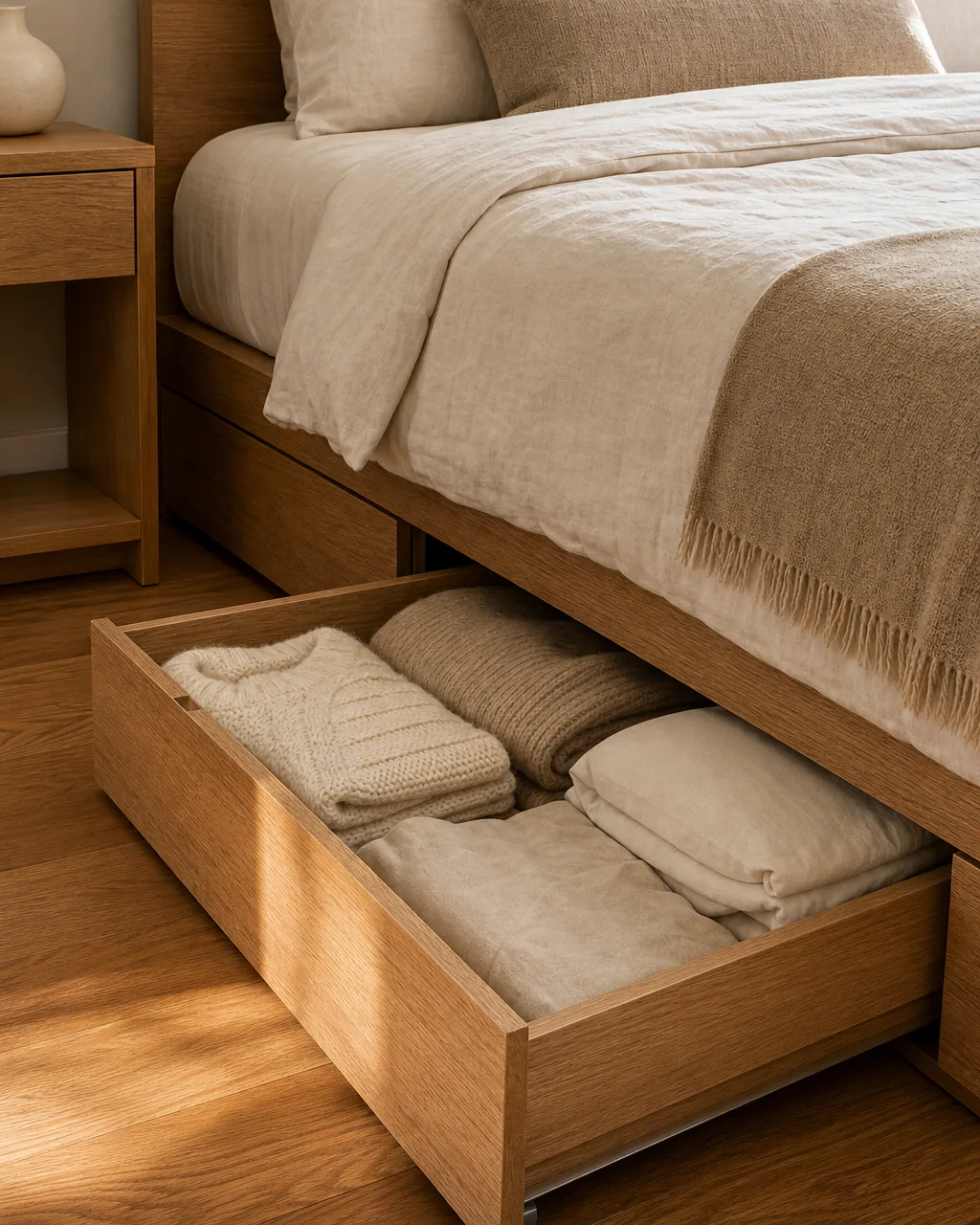
Under-bed storage in a small apartment bedroom is usually the difference between a calm closet and an overflowing one.
But the default move — sliding stackable plastic bins under the bed — fails twice: you have to lift the mattress or crawl under the frame to reach them, so the bins fill once in October and never get touched again, and the bins themselves read as visual chaos any time the bed is unmade.
Switching to a bed frame with built-in long flat drawers on rollers is the fix that makes the storage actually get used.
You pull a drawer the way you pull a dresser drawer — standing, with one hand, in three seconds — so off-season bedding, sweaters, and the second pillow set rotate normally instead of becoming dead inventory. The drawers also read as cabinetry rather than clutter, so the bed looks intentional even when the room is mid-cleanup.
- Pick a platform bed with at least two long drawers per side — short drawers waste the central footprint
- Limit the drawers to soft goods (sweaters, off-season bedding) — anything hard or sharp scratches the floor when the drawer rolls
- Label the inside of each drawer, not the outside — outside labels read as commercial signage in a bedroom
- Empty and re-sort the drawers twice a year on the season change — same cadence as switching the duvet
- If the bed has no built-ins, pick canvas storage cubes that match the bedding palette rather than clear or colored plastic bins
These four rules separate a small apartment bedroom that sleeps big and reads calm from one that feels like a furniture jam — or quietly fills with clutter you stopped seeing.
Move the Dresser Into the Closet — Give the Bedroom a Wall Back
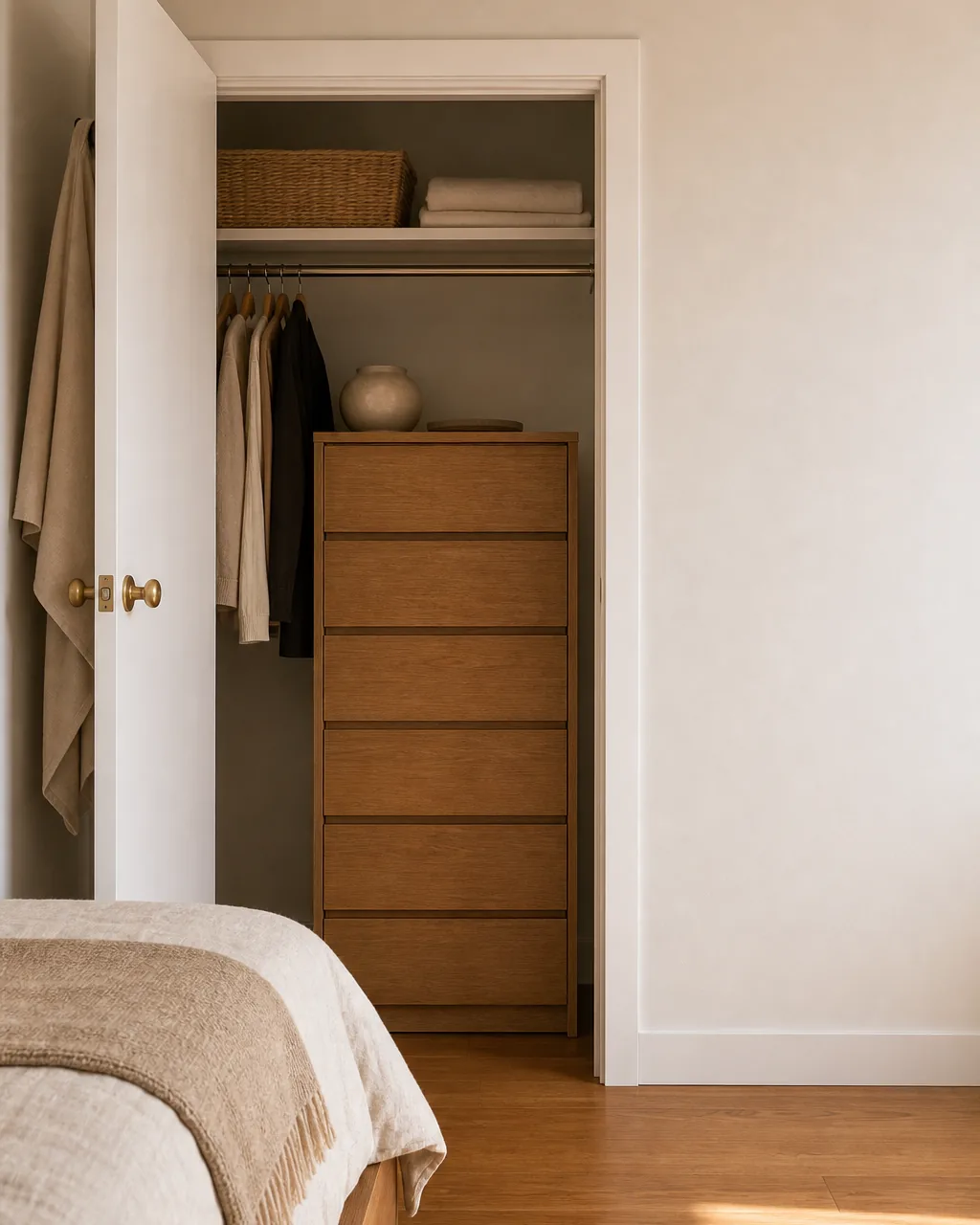
A standard dresser eats roughly six linear feet of bedroom wall and one of only three available walls in a small apartment bedroom. That wall is then unavailable for art, a reading nook, a second nightstand, or just calm empty space — and the dresser itself, which is functional rather than beautiful, becomes a visual focal point you did not want.
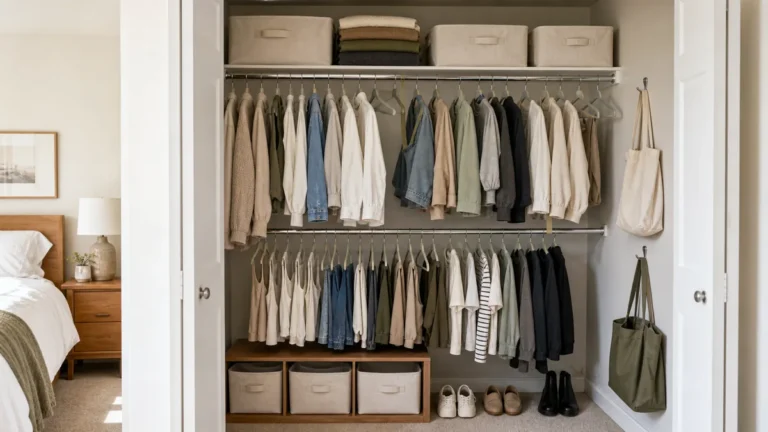
Pulling the dresser out of the bedroom proper and tucking a tall slim six-drawer dresser inside the closet footprint instead is the move that buys back the most square footage in the smallest physical reshuffle.
The clothing storage is still right there, the closet door closes over it, and you get a full bedroom wall back for something quieter. Pair this with the one-bedroom apartment ideas playbook on cross-room zoning if your apartment is one bedroom carrying both wardrobes.
- Measure the closet interior before shopping for a dresser — most closets fit a 15-inch-deep dresser that no bedroom would consider buying
- Pick a tall narrow six-drawer over a wide three-drawer — vertical drawers use the closet’s height instead of robbing its width
- Hang shorter items (shirts, jackets) above the dresser inside the closet — long hanging stays on the dresser-free side
- Skip closet doors that swing into the bedroom — they steal the wall you just bought back
- If the closet has no room, mount a slim 12-inch-deep wall-hung dresser instead of a freestanding 18-inch-deep one
Mount a Slim Picture Ledge Above the Bed Instead of a Bulky Headboard
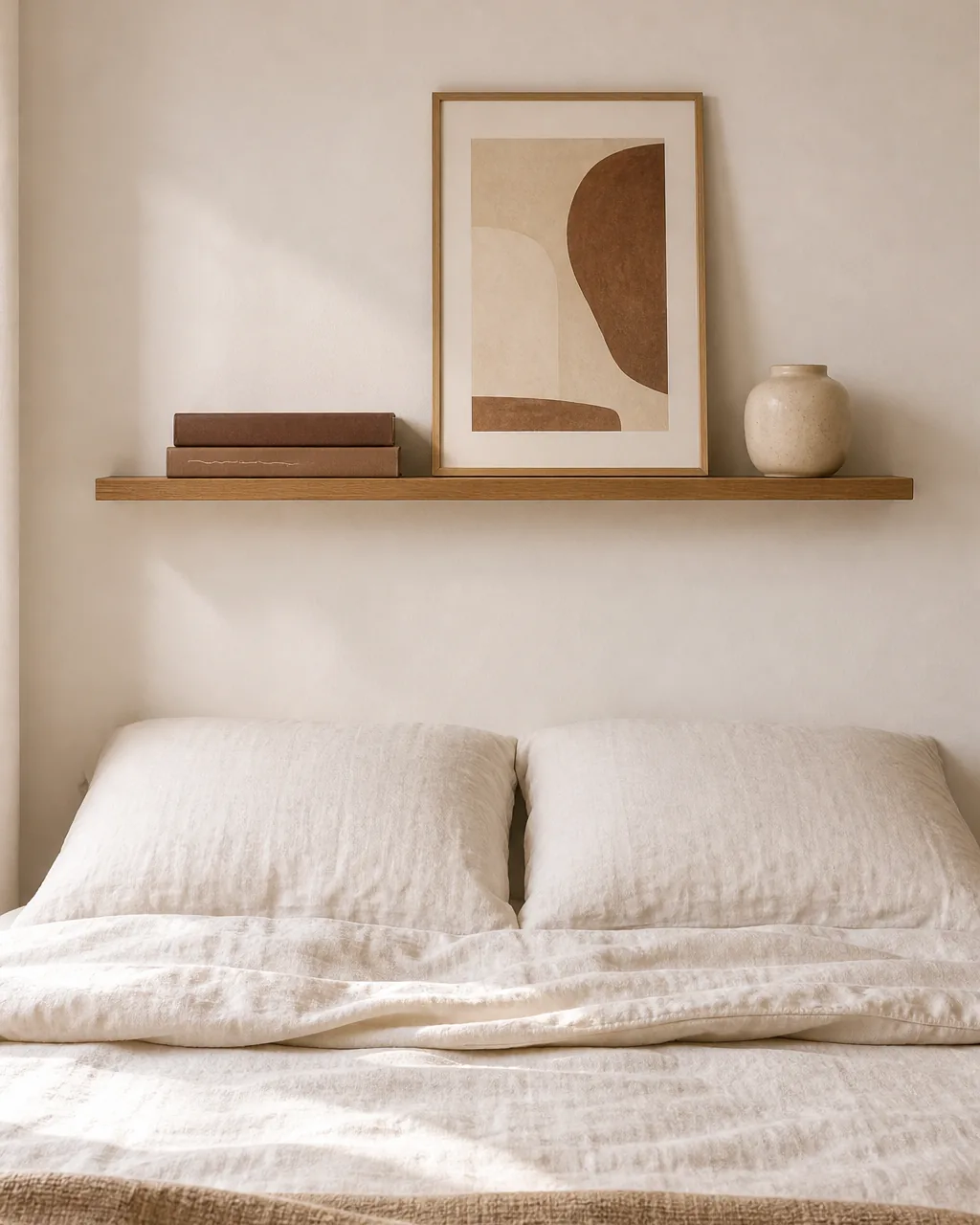
A traditional padded or four-foot tall wooden headboard adds eight to ten inches of furniture depth to the wall above the bed, eats the visual height the curtain just bought back, and is the single most expensive piece of bedroom furniture most people buy to look at sleeping.
Mounting a slim warm-oak picture ledge across the head of the bed at picture-frame height does the same job for one tenth of the bulk.
Two stacked books, a small framed art piece leaned against the wall, and one small ceramic vessel read as a thoughtful styled wall — and the bed below reads as a bed, not as a furniture set. The wall itself becomes the headboard, and the ledge lets you swap the small art piece without committing to a permanent purchase.
- Mount the ledge so the bottom of the ledge sits about 24 to 30 inches above the mattress — anchored to the head, not the ceiling
- Make the ledge as wide as the bed itself, not wider — the bed’s outline defines the headboard zone
- Style the ledge with three objects of varying heights — one leaning frame, one stack of two books, one small vessel
- Use a matte warm-oak or warm-cream ledge — chrome or black industrial reads as office shelving over a bed
- If the wall is rental and you cannot drill, lean a single tall art piece directly against the wall behind the bed at the floor — same effect, no hardware
Switch to Wall-Mounted Reading Lights So the Nightstand Stays Clear
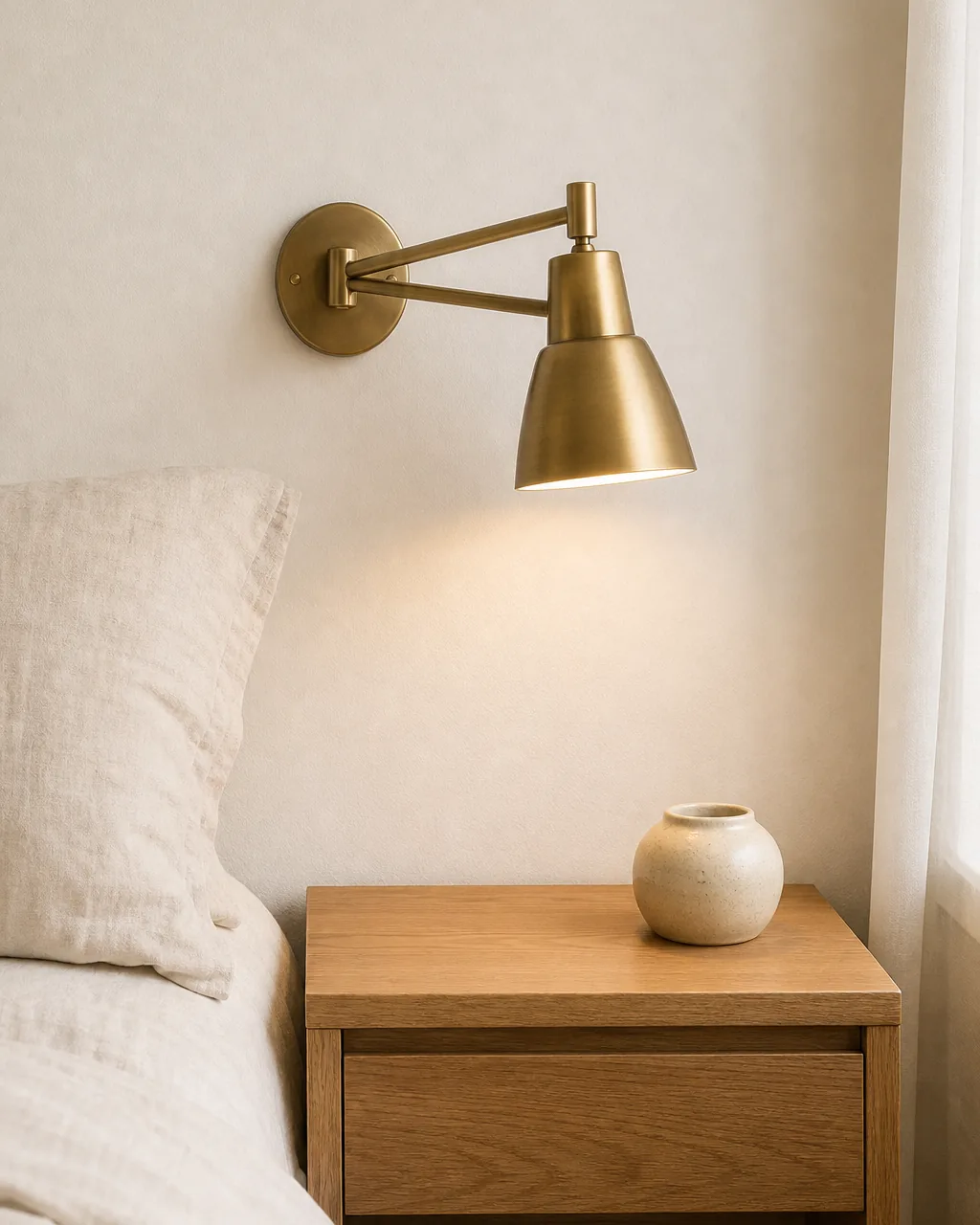
A table lamp on a small-apartment nightstand eats half the surface and most of the usable space. The base takes up six to eight inches, the lamp arm takes up another four, and what is left holds a phone and nothing else — which is why nightstand clutter migrates fast in a small bedroom.
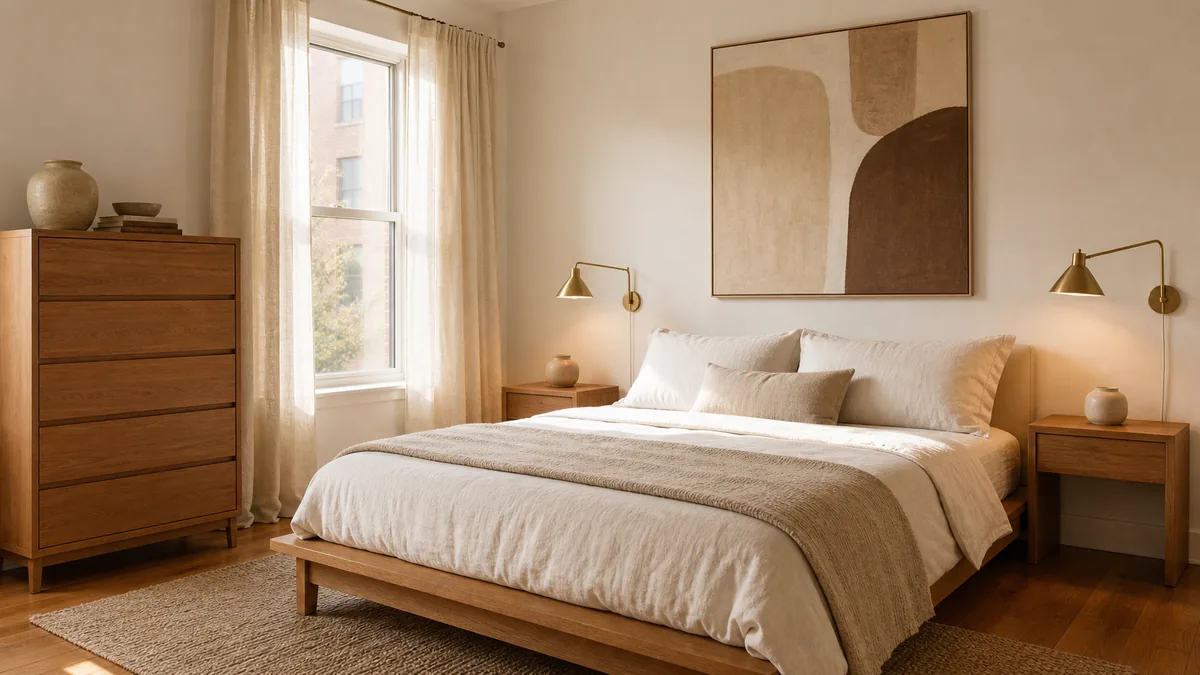
Wall-mounting a swing-arm reading light directly above the nightstand pulls the lamp off the nightstand entirely and frees the surface for a glass of water, a book, and your morning alarm without anything stacking.
The swing arm folds flush against the wall when not in use, the light pivots to angle exactly onto the book or the pillow, and the nightstand reads as a calm clear plane rather than a furniture cluster.
- Mount the light about 24 inches above the top of the mattress — high enough to read by, low enough that the swing reaches the pillow
- Pick a swing-arm with a matte warm brass or matte black finish — chrome reads dental-office in a bedroom
- Wire the light hardwired or use an in-wall cable channel — visible cords down the wall undo the visual calm
- Choose a 2700 K warm bulb, never a 4000 K cool white — bedroom lamp light should match candlelight, not office light
- Add a small wall switch beside the bed, not just on the lamp head — fumbling for the lamp switch breaks sleep more than the light itself
12 small-apartment-bedroom moves, one system that sleeps big in a tight footprint
- 1Float the bed off all three walls so you can make it from both sidesFloating the bed several inches off all three walls lets you make the bed from both sides and reads the room as designed around a bed, not as a bed crammed in.
- 2Pick one slim nightstand if a side wall touches, two if both sides clear 18 inchesIf one side of the bed touches a wall, one slim nightstand on the free side reads more intentional than two crowded ones — symmetry is not the rule, breathing room is.
- 3Hang one large piece of art above the bed instead of a crowded galleryOne large abstract piece of art above the bed replaces a busy gallery cluster and gives your eye a single calm focal point exactly where it lands as you fall asleep.
- 4Hold sheets, pillow stack, throw, and curtain in one tonal warm-neutral familySheet, pillow stack, throw, and curtain all in cream and oat with one warm cocoa accent — one tonal family is what makes the bed read as one calm anchor instead of seven things.
- 5Stack linen curtain panels onto the wall so the bedroom window reads tallerMount the curtain rod almost to the ceiling and stack the linen panels onto the wall past the window — the wall reads taller and the window reads wider for free.
- 6Use built-in under-bed drawers, never plastic bins you have to lift the mattress forA bed frame with built-in long flat drawers on rollers turns under-bed storage into a usable dresser — and you actually rotate the off-season bedding instead of forgetting about it.
- 7Move the dresser into the closet — give the bedroom a wall backA tall slim six-drawer dresser tucked inside the closet footprint frees a full bedroom wall for art, breathing room, or just calm empty space — biggest single square-footage win.
- 8Mount a slim picture ledge above the bed instead of a bulky headboardA slim picture ledge above the bed with two books, one leaning art piece, and one ceramic vessel replaces a bulky headboard at one tenth the depth — and you can swap the art weekly.
- 9Switch to wall-mounted reading lights so the nightstand stays clearWall-mounted swing-arm reading lights pull the lamp off the nightstand entirely and free the surface for the things you actually use every night — book, water, glasses.
- 10Lean one tall mirror in a corner to bounce light and stretch the floorA tall full-length mirror leaned in one corner bounces window light back across the room and visually doubles the floor depth — the cheapest small-bedroom expansion you can do.
- 11Keep the linens warm, not cool — small rooms read calmer in cream and oat than grayCream and oat warm linens, not cool gray, keep a small bedroom reading calm and restful instead of dental-office bright — same brightness, very different temperature.
- 12Edit three surfaces every two weeks — nightstand, dresser top, trunk topEdit three surfaces (nightstand, dresser top, trunk top) every other Sunday for ten minutes — the bedroom holds its calm permanently because the drift gets caught while it is still small.
styledhomenotes.com
Lean One Tall Mirror in a Corner to Bounce Light and Stretch the Floor
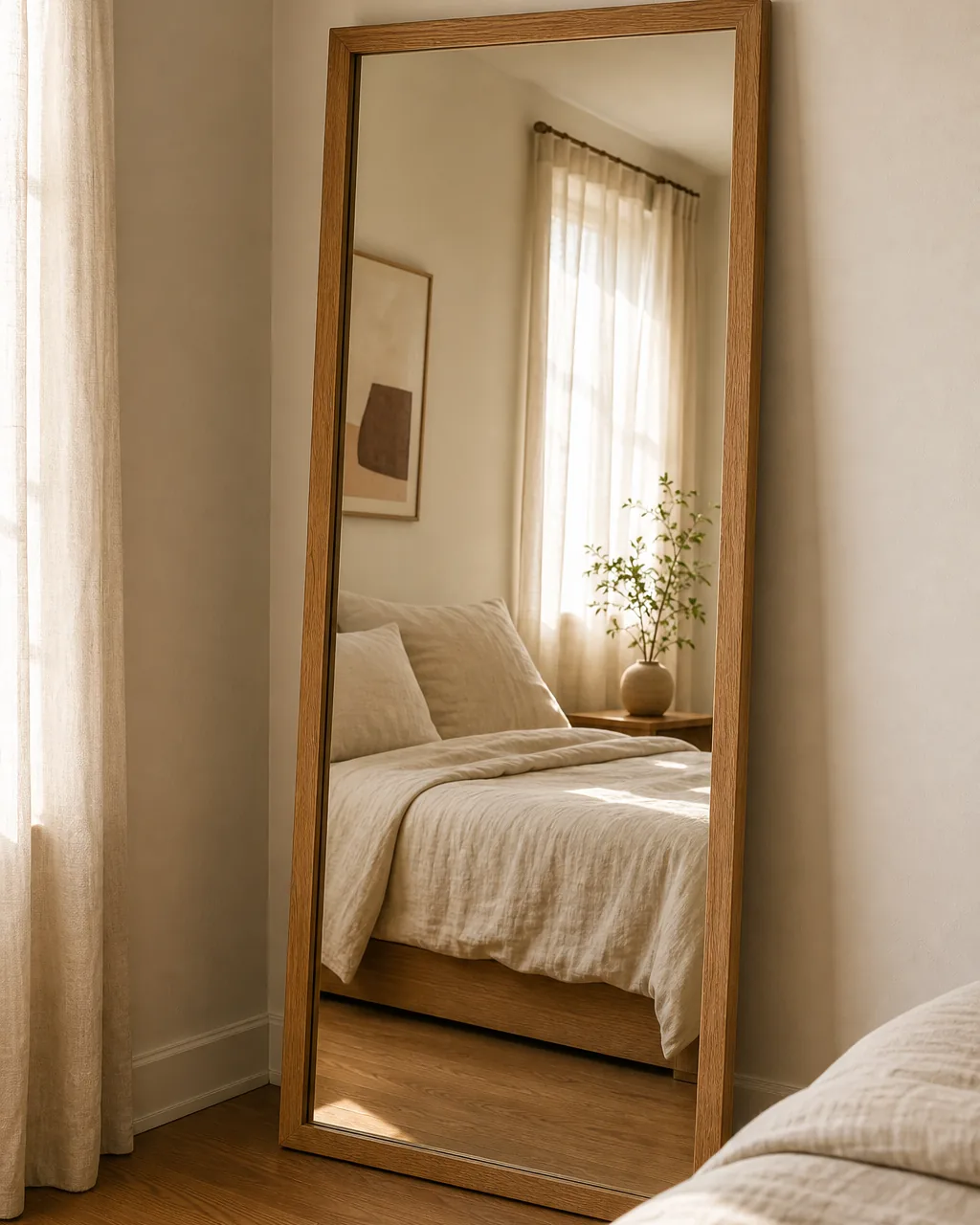
A small apartment bedroom usually has exactly one window, often on the same wall as the bed, and most of the room sits in the soft half-dark for half the day. Adding a second light source feels like the answer; the better move is bouncing the light you already have.
Leaning a tall full-length mirror — six feet plus, warm-oak or warm-brass frame — against one corner wall does two things at once. It catches the window light and bounces it back across the floor and ceiling, making the room read brighter without adding fixtures.
And the reflection visually doubles the depth of the floor itself, so the bedroom reads as a longer room than it is. The leaning angle, not a flush mount, is what creates the depth illusion.
- Lean the mirror against the wall closest to perpendicular to the window — that geometry catches and throws the most light
- Pick a leaning mirror at least six feet tall — anything shorter reads as a dressing mirror, not an architectural move
- Frame in warm-oak or matte warm-brass, not chrome — chrome frames break the warm palette in one glance
- Anchor the bottom edge to the wall with a hidden bracket — leaning mirrors that actually fall are a real injury risk
- Keep the floor in front of the mirror clear — clutter in the reflection doubles the clutter visually
Keep the Linens Warm, Not Cool — Small Rooms Read Calmer in Cream and Oat Than Gray

A persistent small-apartment-bedroom myth is that cool gray or stark white bedding makes a small room “feel bigger and more modern.” It does the opposite. Cool tones read as dental-office light at the bedroom scale; they amplify the slightly fluorescent overhead and they make a small room feel both clinical and cramped.
Switching the bedding to warm cream and oat — same brightness on the value scale, very different temperature — keeps the room reading as bright but lands the brightness on warm rather than cool.
The bedroom suddenly reads as calm and restful in the same square footage, because every visible surface (sheet, duvet, throw, curtain) carries the same warm undertone as the wall and floor instead of fighting them. This single swap quietly does more for a small bedroom than any furniture change.
- Pick cream, oat, or warm white sheets — read the sample in flat daylight to confirm the undertone is warm
- Skip cool gray duvets entirely in a small bedroom — gray duvets photograph well but live worse
- Pair warm-cream sheets with one warm-cocoa accent — the contrast adds depth without breaking the warm palette
- Check the curtain temperature too — a cool curtain undoes warm sheets in two seconds
- Wash new linen on a warm gentle cycle and line-dry once before judging the color — linen lightens warmer once washed
Edit Three Surfaces Every Two Weeks — Nightstand, Dresser Top, Trunk Top
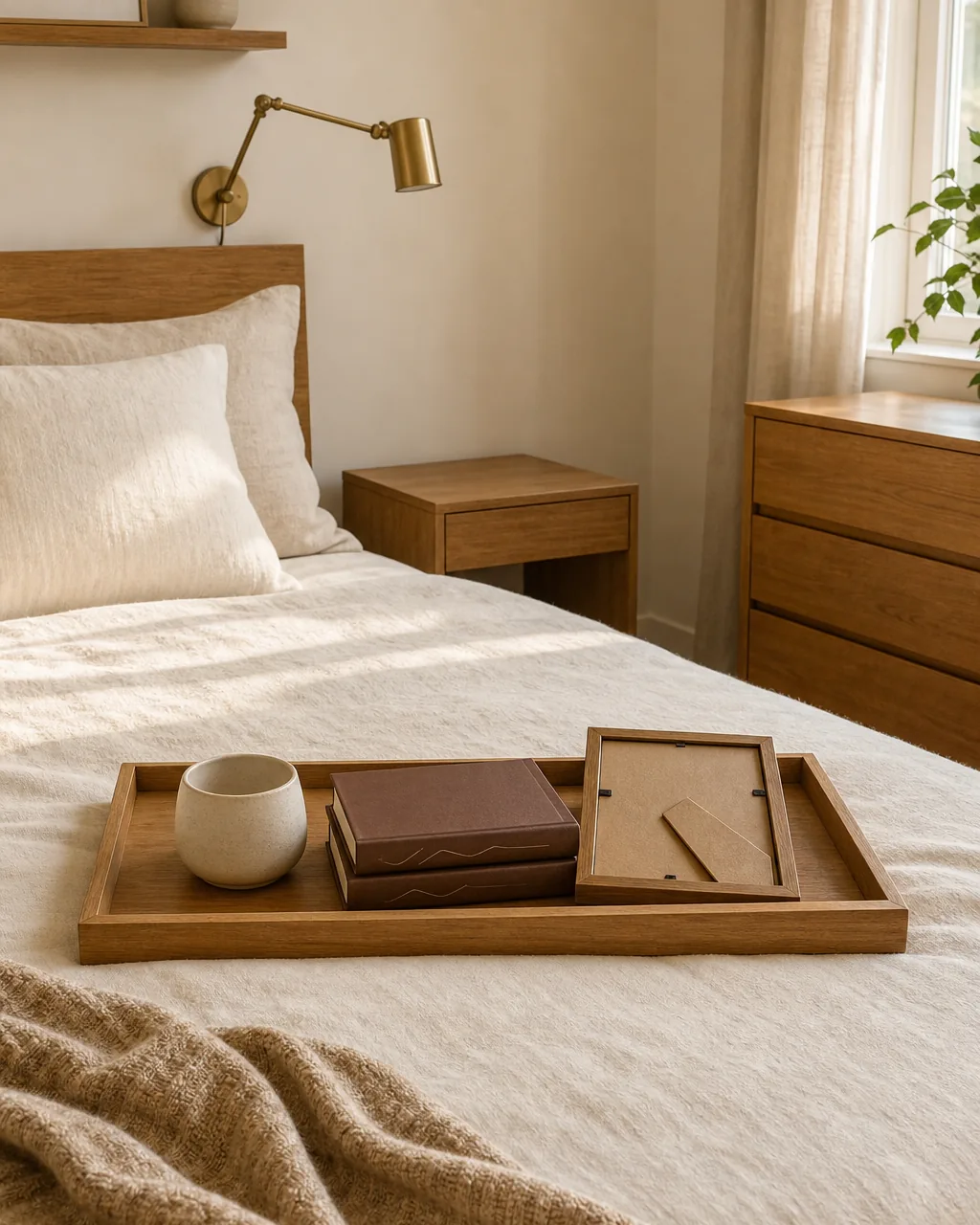
Every small apartment bedroom drifts back toward clutter on the same predictable timeline. The nightstand collects three nights of receipts, the dresser top gathers a stack of clean folded laundry that never quite gets put away, the trunk at the foot of the bed becomes a holding pen for jackets and books. By week three, the calm bedroom reads cluttered again, and nobody knows when it happened.
A two-week three-surface edit catches the drift before it becomes a project. Twice a month — same day every other Sunday morning, ten minutes — you clear exactly three surfaces (nightstand, dresser top, trunk top) and re-decide what gets to live there.
Nothing complicated, nothing aspirational, just a small recurring reset that turns clutter into a problem of two days instead of two months. The bedroom holds its calm permanently because drift is being arrested early, not periodically swept under a project.
- Pick one ten-minute slot every other week — Sunday morning before coffee works because nobody is using the room
- Touch only three surfaces — nightstand, dresser top, trunk top — to keep the edit small enough that you always do it
- Use a small warm-oak tray on the bed to collect everything coming off the three surfaces — sort the tray into “stays / put away / donate”
- Resist the urge to deep clean — the goal is editing visible surfaces, not flipping the mattress
- Pair this with the same cadence in the rest of the apartment, like the room-by-room rhythm in our small apartment living room ideas guide

Nora writes about small, livable systems for real apartments. Her own small-apartment bedroom floats a low platform bed off all three walls, runs one slim nightstand on the only free side, and keeps the dresser tucked inside the closet so one bedroom wall stays intentionally bare — which is why every move in this guide gets pressure-tested against a real bedroom you actually walk through on a Tuesday morning, not a furniture-showroom hero shot.
Nora Ellis edits Styled Home Notes. Visit the Nora Ellis author page. More from Nora: studio apartment ideas, one bedroom apartment ideas, small apartment living room ideas.