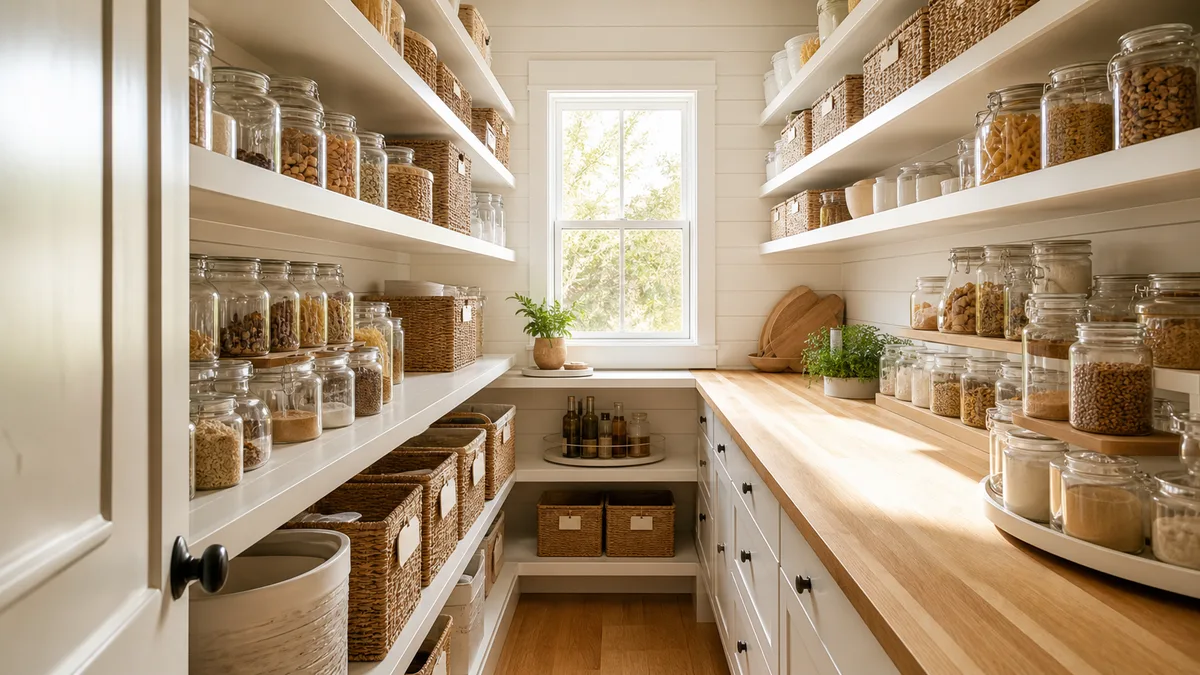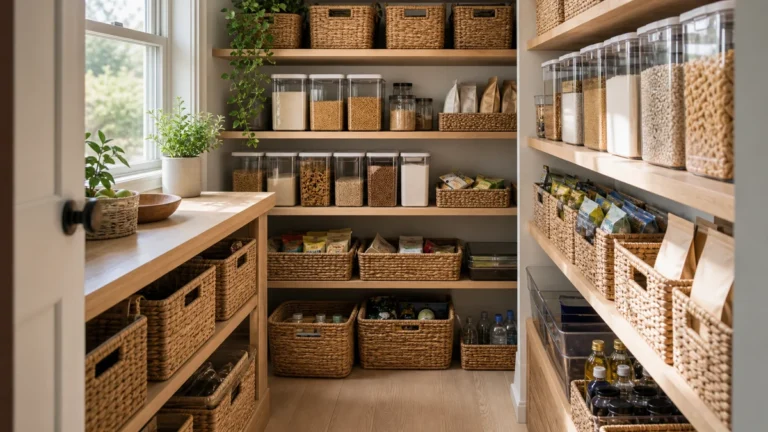
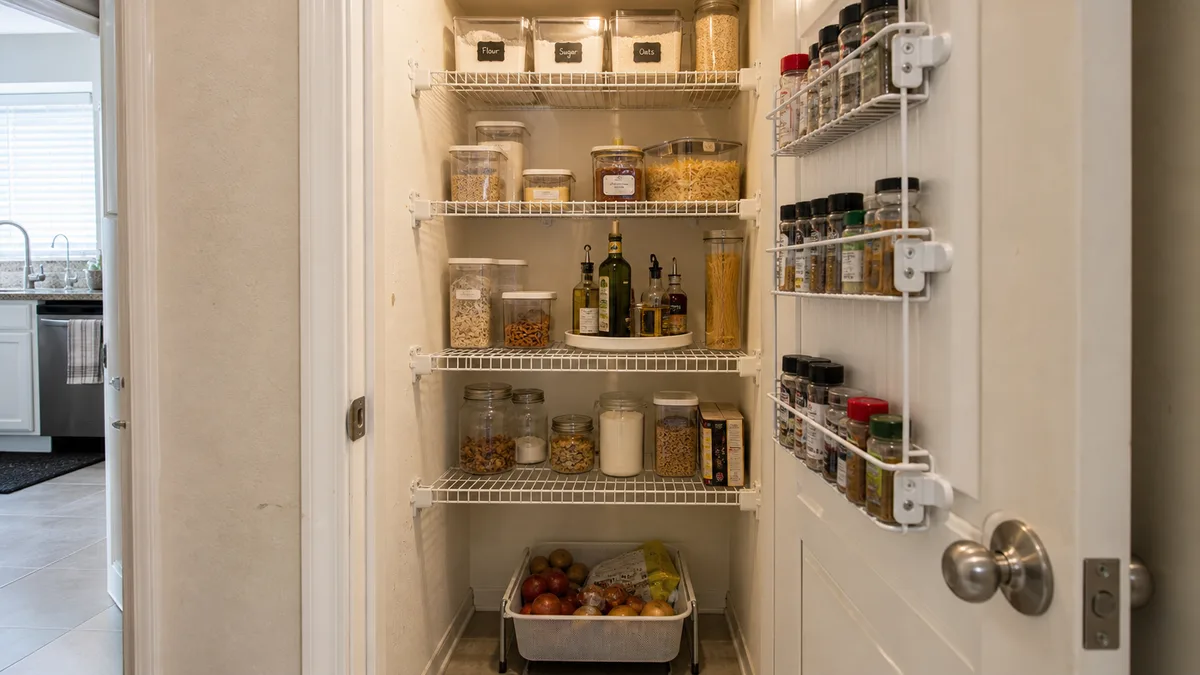
A narrow single pantry closet with warm oak shelving, an over-the-door wire rack holding canisters and kraft-wrapped jars, and stacked clear bins, glass jars, and woven baskets filling every shelf from floor to ceiling

12 Small Pantry Organization Ideas That Turn a Tiny Closet Into Real Storage

Most pantry advice assumes a wall of deep shelving to work with. If yours is a repurposed coat closet or a shallow cabinet barely two feet wide, categorizing bins and labels won’t fix the real problem: not enough square footage.

The fix isn’t more containers. It’s finding capacity that’s already there but unused — the back of the door, the air between shelves, the wall above the top shelf, the floor corner nobody uses. Every idea below claims one of those hidden inches.

Work through them in order or pick the two or three that match your closet’s actual shape. Either way, you’ll free up real storage without knocking out a single wall.

Jump to the small-pantry move
12 small pantry moves that claim every hidden inch of a tiny closet

From an over-the-door wire rack to a floor basket for bulky bags, these twelve moves find capacity in the door, the walls, and the floor of a pantry too small for standard shelving advice. Jump to the problem you are solving right now.

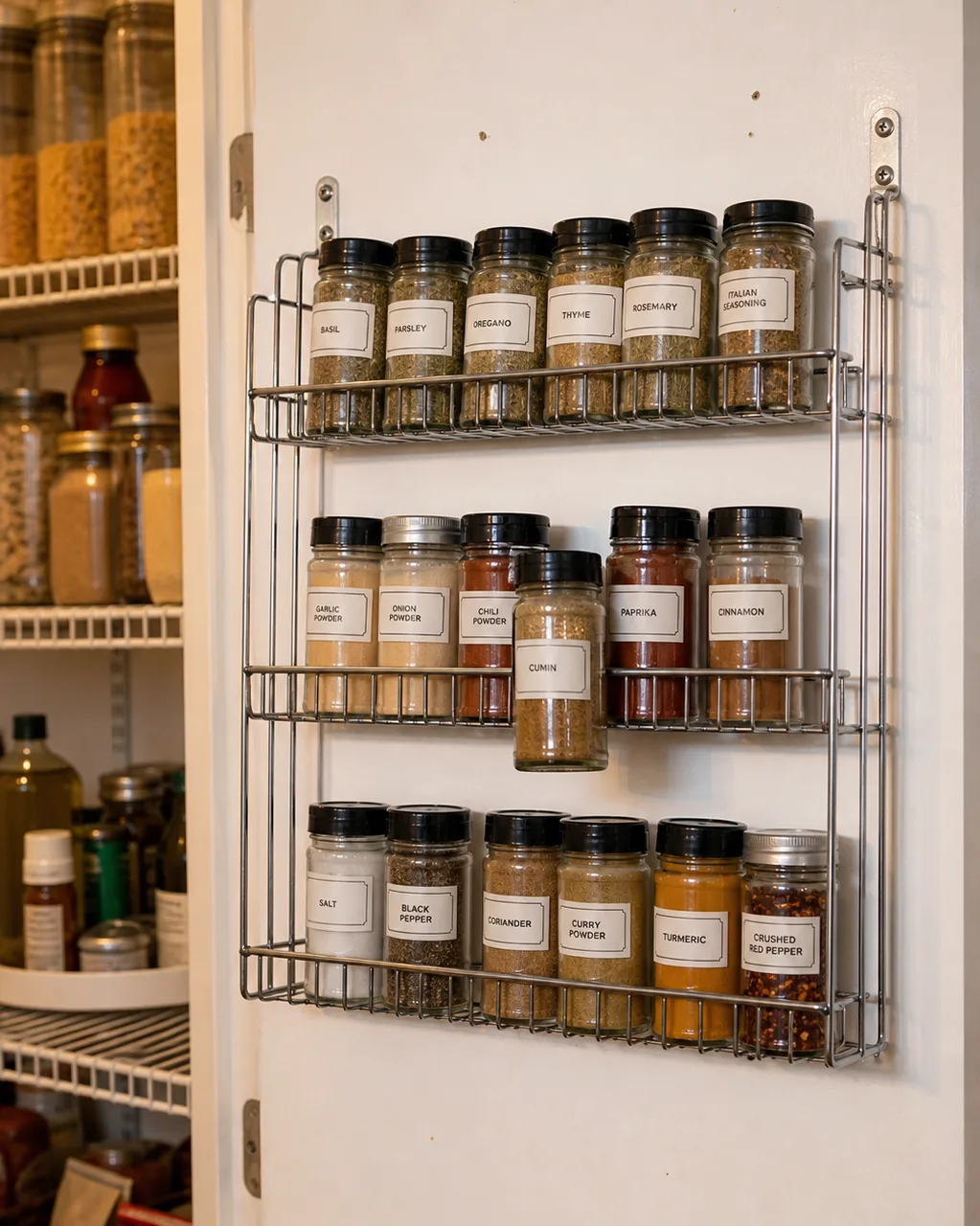
Over-the-Door Wire Rack for Cans and Spices

A tiered bronze wire rack mounted on the back of a pantry door, holding rows of spice jars, kraft-wrapped canisters, and canned goods, with more open shelving visible through the doorway

The back of the door is the single biggest piece of unused real estate in a small pantry, and most people never touch it. An over-the-door wire rack turns that flat surface into six or seven narrow shelves without stealing an inch of depth from the shelving behind it.

Because the rack hangs on the door itself, it moves with the door when it opens — nothing about the main shelves has to shift or shrink to make room for it. That’s what makes it the highest-leverage idea on this list: it’s pure added capacity, not a swap.

Measure the door’s swing clearance before buying. A rack that’s too deep will hit the shelving unit when the door closes, which defeats the entire point.

  • Choose a rack that mounts over the top of the door, not one that requires drilling into the door itself
  • Reserve the rack for lightweight, frequently grabbed items like spice jars and canned goods
  • Group items by tier so the most-used ones land at eye level
  • Check swing clearance against the depth of your shelving before buying
  • Skip anything heavier than a full canister — over-the-door hardware has a real weight limit

A Second Half-Shelf Riser to Double One Shelf’s Capacity

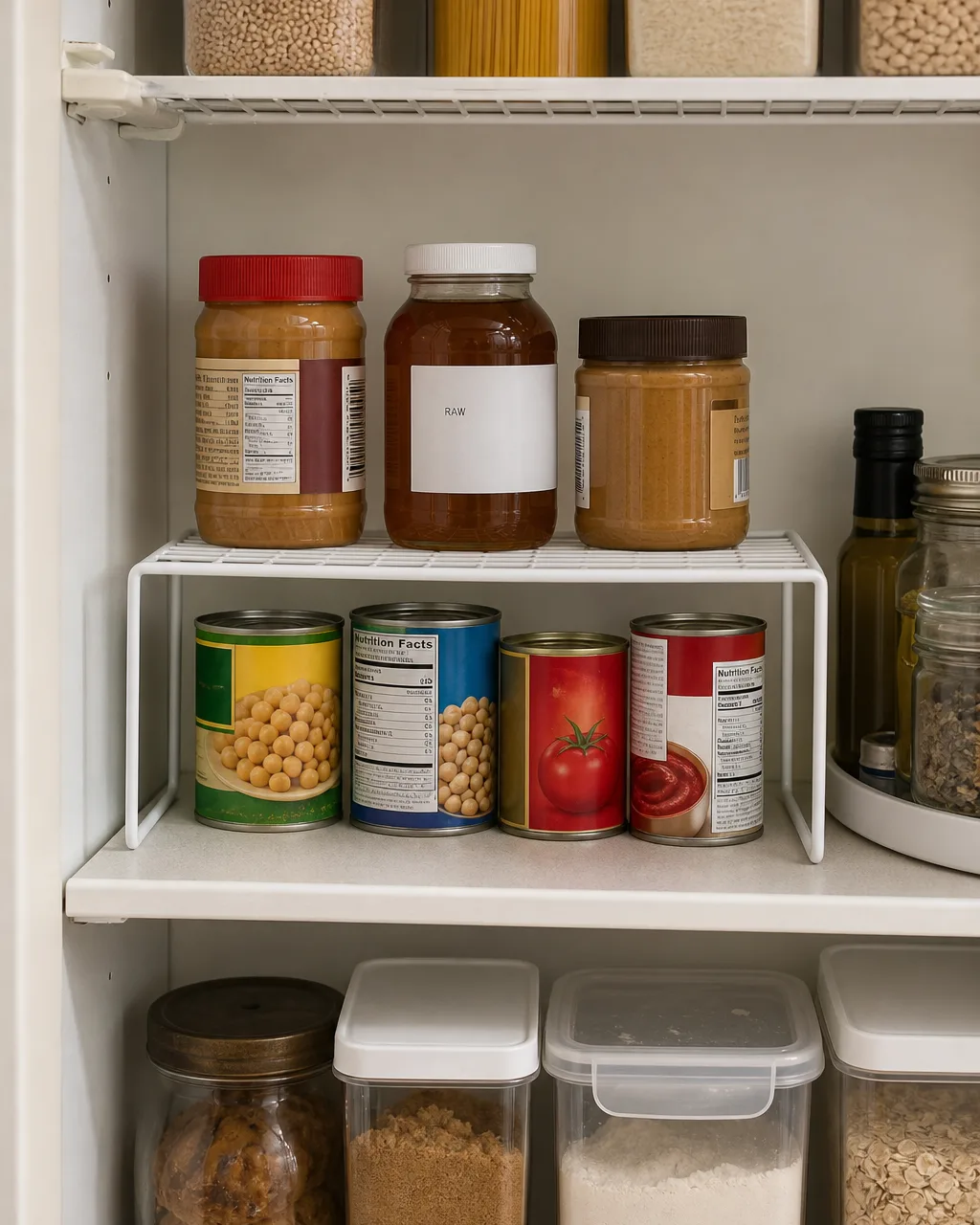
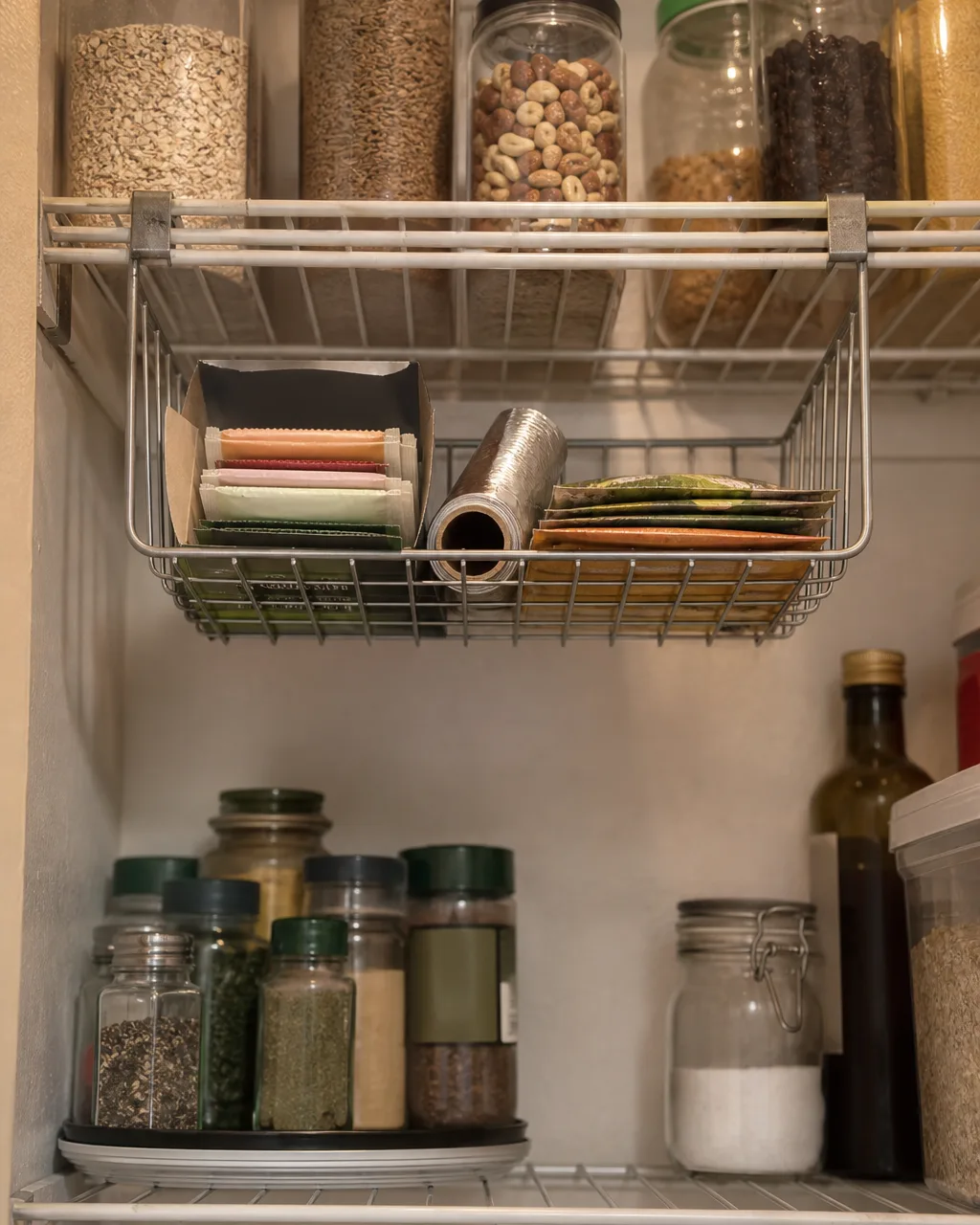
A close-up of a wooden pantry shelf with a bronze wire half-shelf riser added above stacked spice jars and kraft boxes, with canned goods lined up underneath the riser

Most shelves in a small pantry have a foot or more of dead air above whatever’s sitting on them, because shelf spacing is built for the tallest item that might ever go there — not the short jars and cans that actually live there most days. A half-shelf riser claims that gap.

It sits directly on top of your existing shelf, over the shorter items, and gives you a second surface for anything else that fits in the reduced height above. One shelf effectively becomes two without moving a single fixed shelf pin.

This works best on shelves holding a mix of heights — tall canisters on one side, short jars on the other. Put the riser over the short side, and the gap you were losing to empty air becomes a whole extra row.

  • Measure the clear height above your shortest items before ordering a riser
  • Use the riser for lighter items — jars and small boxes, not stacked cans
  • Pair it with the shelf’s tallest items sitting beside it, not underneath it
  • Leave a finger’s width of clearance so items slide in and out without scraping
  • Add risers to more than one shelf if the gap repeats

Stackable Clear Bins Sized to the Shelf Depth

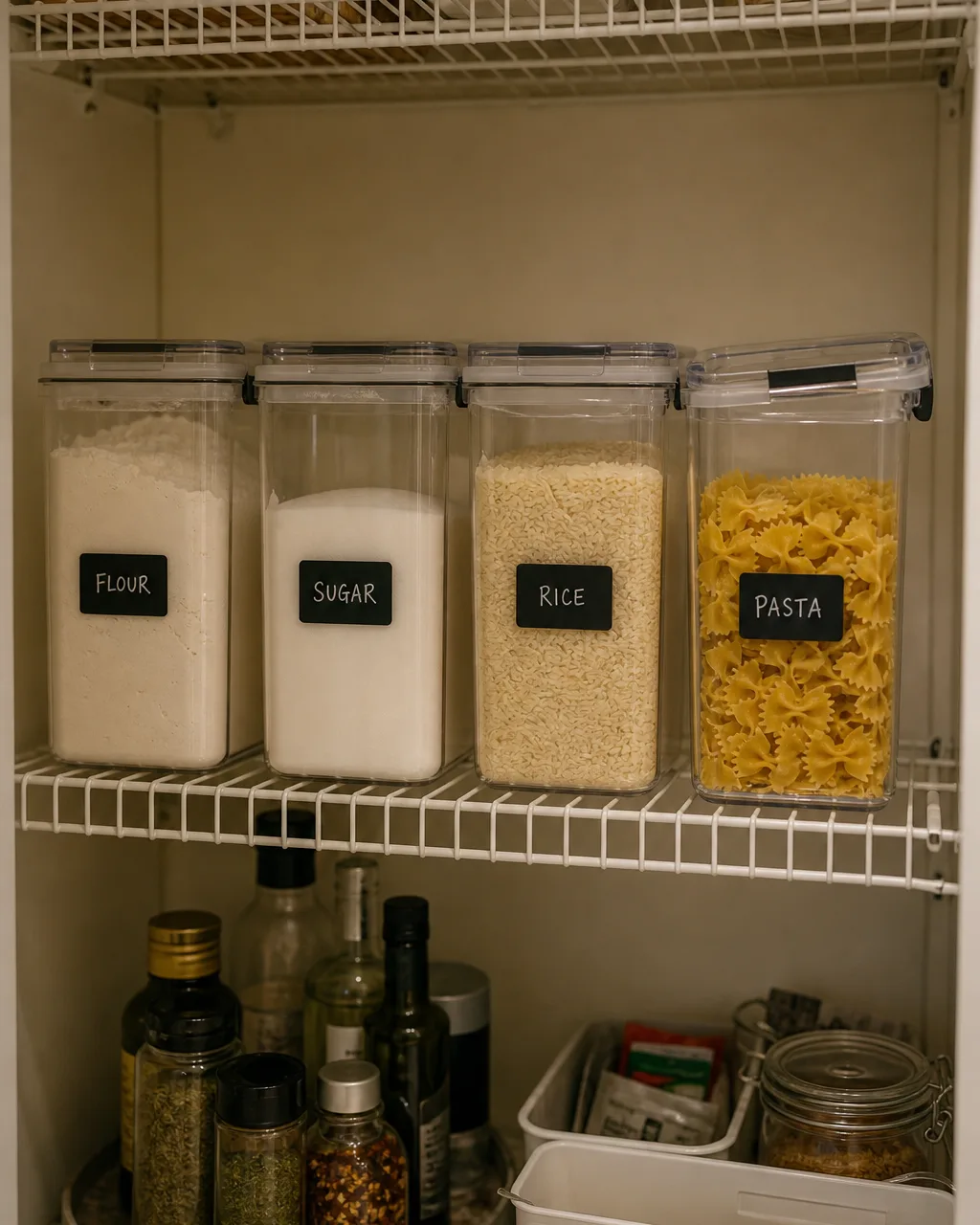
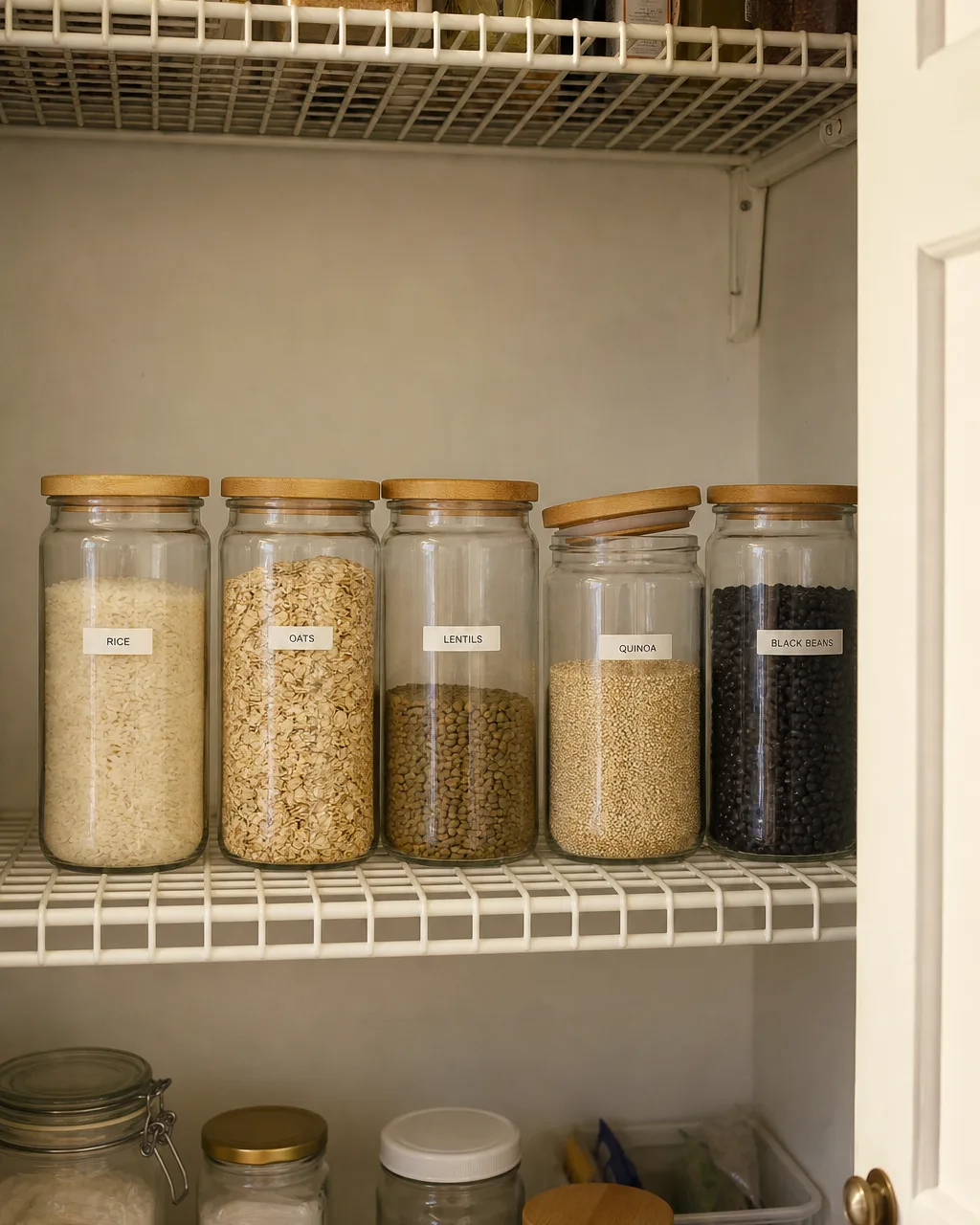
Twelve identical clear stackable bins filled with rice, oats, pasta, and beans, stacked two-wide and six-high to fill a narrow pantry shelf section completely

A shallow shelf wastes space in a way deep shelves don’t: standard bins are sized for average pantry depth, so on a narrow shelf they either hang over the edge or leave several inches of unused space at the back. Bins measured to your shelf’s actual depth close that gap.

Stackability matters just as much as depth here. Because these bins are sized to sit flush against the shelf’s back wall, they stack cleanly on top of each other without wobbling — turning one shallow shelf into two full layers of storage.

Measure before you buy anything. A bin that’s an inch too deep will stick out past the shelf edge every time, which is the exact problem this idea is meant to solve.

  • Measure shelf depth at its shallowest point, not the average
  • Buy one bin size for the whole shelf so stacks sit flush and even
  • Reserve the bottom layer for heavier bulk items like rice and beans
  • Use the top layer for anything you reach for daily
  • Confirm bins are airtight if they’ll hold opened dry goods
Where to start
Pick the small-pantry move that matches what your closet is fighting right now

You will not need all twelve at once. Find the situation below that matches your pantry today, and start with those two or three ideas.

If the shelves are packed but the door is bareAdd an over-the-door wire rack and a door-back pocket organizer — both claim the door’s flat back without touching a single shelf.
If there’s dead air above short jars and cansUse a half-shelf riser and switch to uniform airtight containers — both turn wasted height between shelves into real storage.
If one corner or gap is basically unusableTry a lazy Susan in the blind corner or a rolling cart wedged beside the fridge — both turn an awkward dead spot into a working shelf.
If big bags and flat trays won’t fit anywhereStand trays up with a tension rod and give bulky bags a floor basket — both solve for the awkward shapes that ruin a shelf.

A Slim Rolling Cart Wedged Into the Gap Beside the Fridge

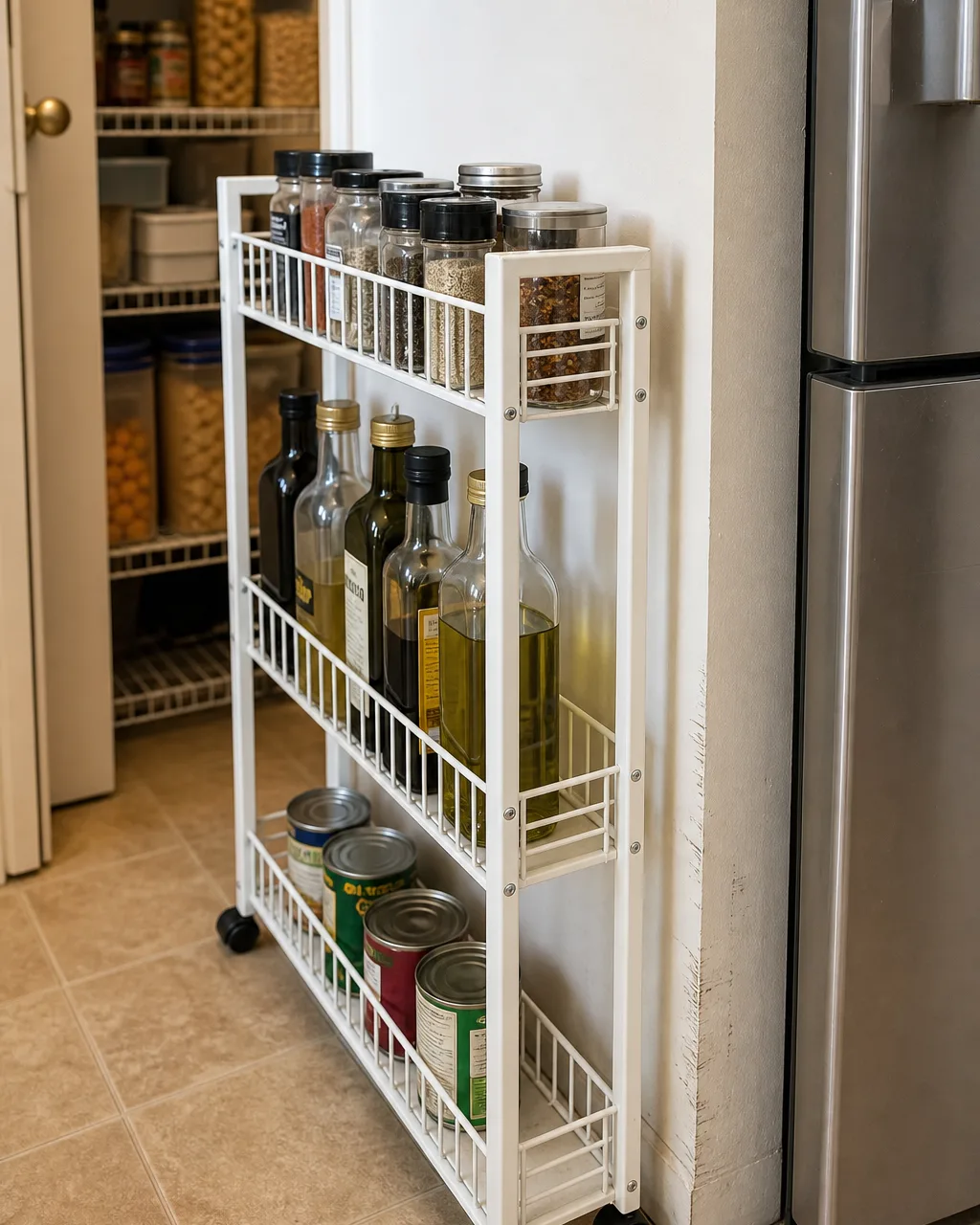
A narrow three-tier metal rolling cart wedged into a slim gap beside a refrigerator, holding canned goods, jars, and kraft paper bags of grains, tucked into a corner near a countertop

Nearly every kitchen has one: the six-to-eight-inch gap between the fridge and the nearest wall or cabinet, too narrow for anything standard but too wide to just ignore. A slim rolling cart is one of the only pieces of storage built specifically for that dimension.

Because it’s on wheels, it does something fixed shelving can’t — it rolls out for full access to every tier, then tucks back into the gap when you’re done. That gap effectively becomes an extra column of pantry storage that didn’t exist before.

Measure the gap’s narrowest point, including any wall trim or appliance handles that stick out, before choosing a cart. A quarter-inch of overhang is enough to keep it from sliding in cleanly.

  • Measure the gap’s narrowest point, not just the open floor width
  • Choose a cart with locking or textured wheels so it doesn’t drift
  • Load heavier items on the bottom tier to keep the cart stable
  • Use it for overflow bulk goods that don’t fit inside the main shelving
  • Leave a little clearance so the cart rolls out without scraping the fridge

Tension Rod to Stand Cutting Boards and Trays on Their Side

A white tension rod mounted vertically between two pantry shelves, holding baking sheets and wooden cutting boards upright on their side, next to jars of rice and salt on the shelf

Flat items like baking sheets and cutting boards are some of the worst offenders in a small pantry — laid flat, they eat an entire shelf and bury whatever’s underneath them. Standing them on their side instead solves both problems at once.

A tension rod mounted vertically between two shelves creates a narrow divider that keeps those flat items upright without needing a dedicated slot organizer. Everything behind the rod stays visible and reachable, instead of buried under a stack of trays.

This only works if the rod’s spring tension is tight enough to hold its position under repeated use — a rod that slips will let the trays lean and eventually topple.

  • Confirm the rod’s spring tension is rated for repeated daily use, not just display
  • Mount it close to the shelf’s side wall so items don’t tip out into the aisle
  • Group trays and boards by size so the tallest anchors one end
  • Leave the shelf space in front of the rod open for other items
  • Recheck tension every few months — springs loosen with use

Door-Back Pocket Organizer for Snack Packets

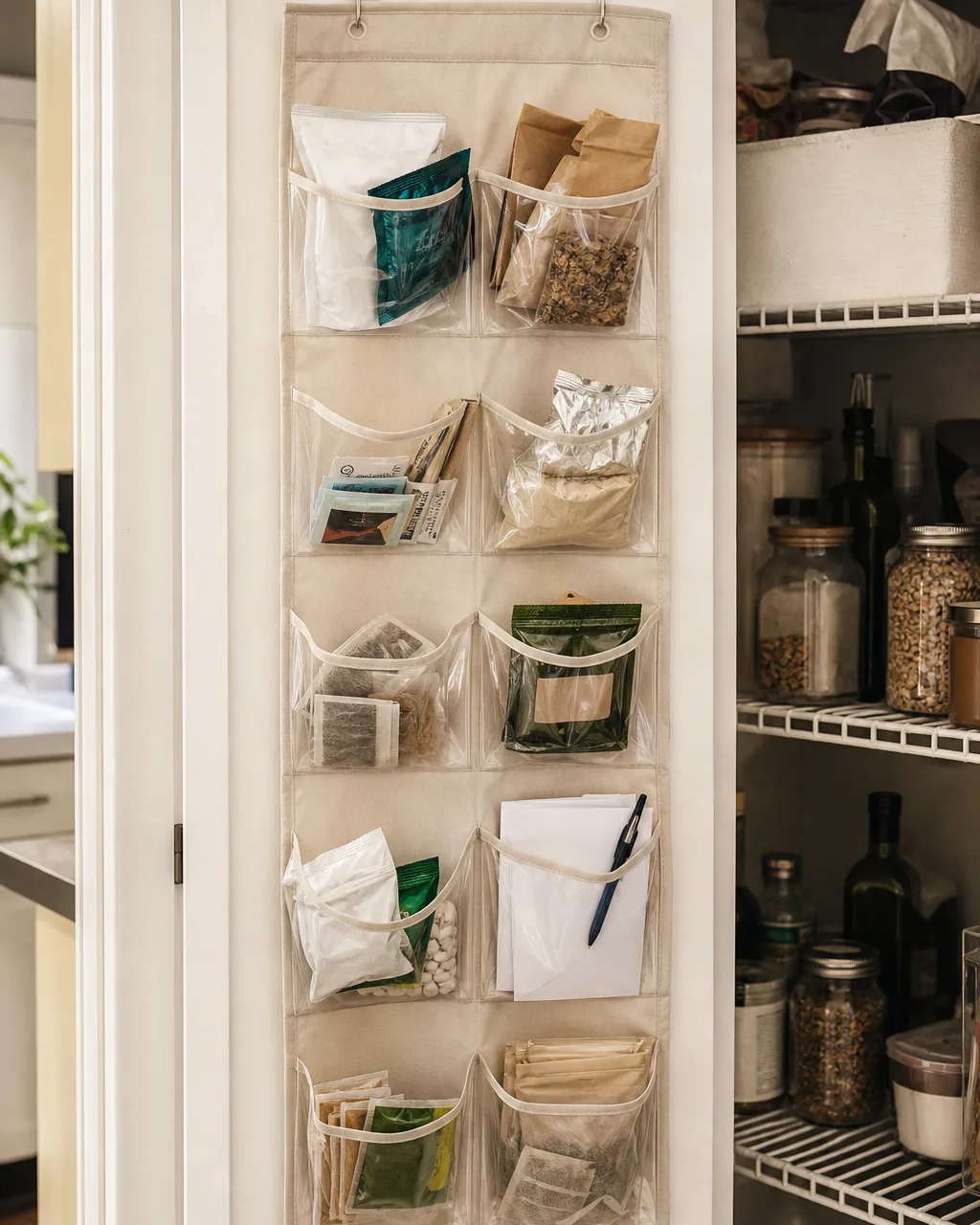
A canvas over-the-door pocket organizer with eight fabric pockets holding folded kraft paper bags and cream snack pouches, mounted on a pantry door with a brass doorknob and shelving visible behind it

Small, loose items like snack packets and granola bars are the hardest things to store efficiently on a shelf — they slide, they get shoved to the back, and they take up disproportionate space for how little they weigh. A fabric pocket organizer on the door solves that by giving each packet its own slot.

Unlike the wire rack from idea one, this uses soft fabric pockets instead of rigid tiers, which makes it better suited to loose, irregularly shaped packets that would slip through wire gaps. The two door-mounted systems can coexist on the same door if there’s room, each handling a different category.

Keep this one lightweight. Fabric pockets sag under weight over time, so it’s built for packets and pouches, not cans or jars.

  • Reserve this organizer strictly for lightweight packaged snacks
  • Assign each pocket to one category so refilling doesn’t require searching
  • Mount it low enough that kids can reach their own snacks if that’s a household priority
  • Check the door doesn’t hit the main shelving when it closes with the organizer loaded
  • Empty and reset pockets when packets run low, rather than letting them overstuff
Four rules that keep a small pantry working instead of just crammed
If a rule breaks, the pantry slides back toward buried shelves, dead corners, and bags nobody can fit anywhere

These four rules separate a tiny pantry that genuinely holds more from one that just has more stuff wedged into the same footprint.

Claim the door before you touch the shelvesThe back of the door is the single biggest piece of unused space in a small pantry. A wire rack or a pocket organizer adds a whole tier of storage without shrinking the shelving that’s already there.
Close the gaps between what’s already storedRisers, depth-matched bins, and uniform containers exist to remove the wasted air around your food, not to add more of it. If a shelf still has an inch of dead space above or beside something, it hasn’t been claimed yet.
Give oversized and odd-shaped items their own spotFlat trays, bulk bags, and blind corners break standard shelving logic. Standing items on edge, using a floor basket, or adding a rotating tray solves the shape problem instead of forcing it onto a shelf that was never built for it.
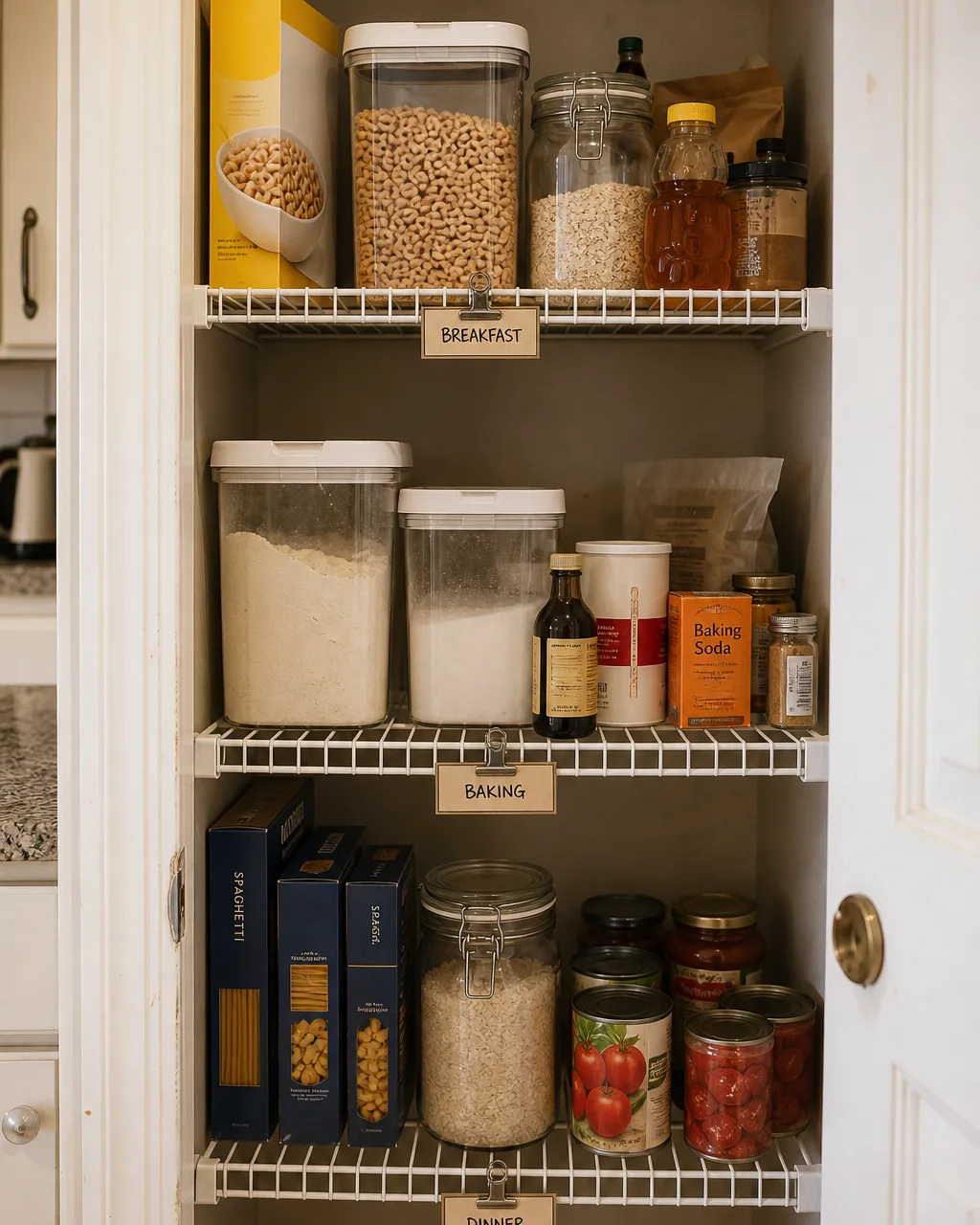
Label the shelf, not just the containerA tight pantry gets reorganized often as bins and bags compete for the same narrow footprint. A label on the shelf edge keeps the system intact no matter which specific container is sitting there this week.

Lazy Susan in the One Blind Corner

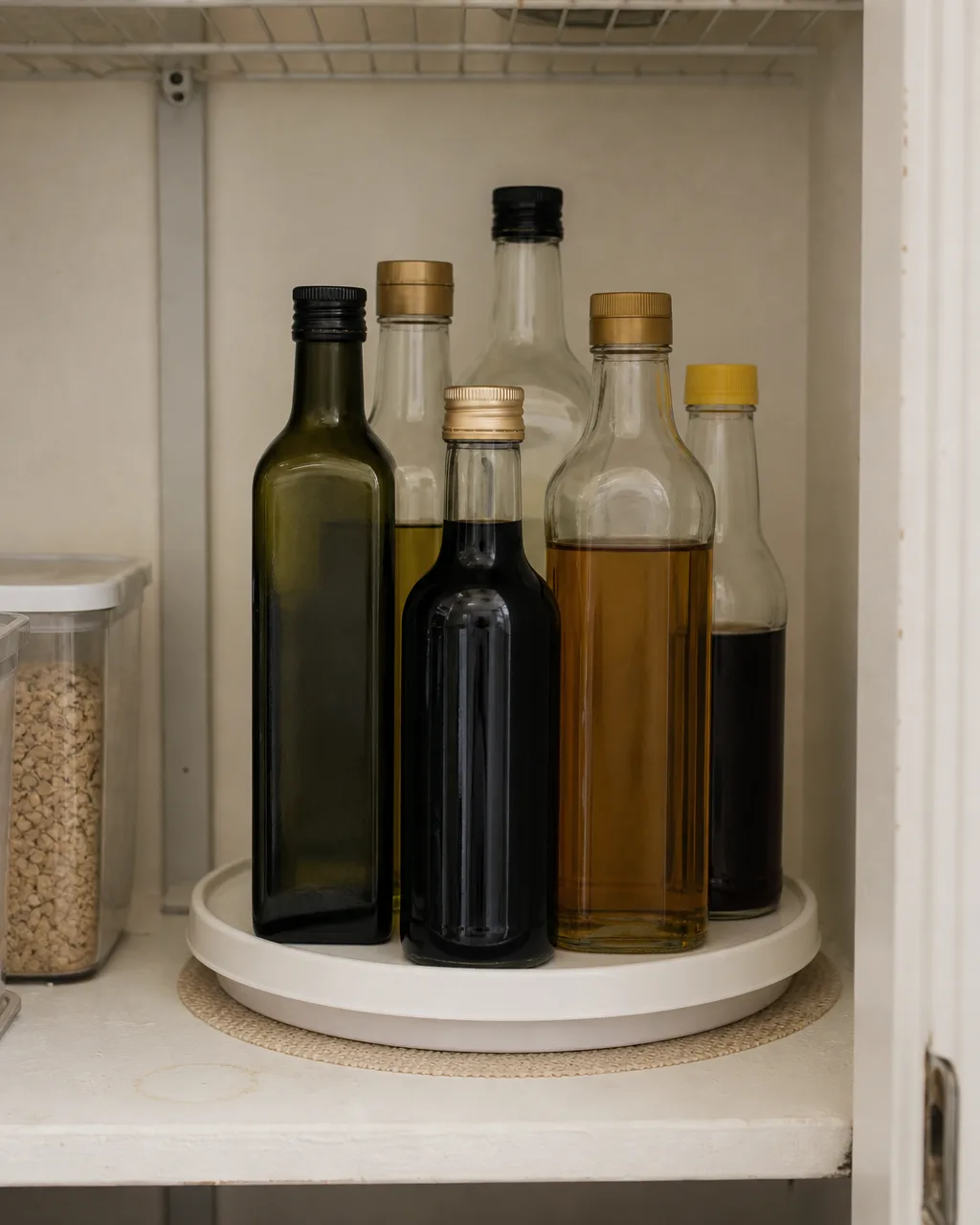
A white round lazy Susan turntable on a pantry shelf loaded with condiment bottles and jars with kraft-paper wrapped labels, positioned in a shelf corner with a woven basket above and glass jars of grains below

Even a pantry too small to have real “corners” usually has one spot where two shelf sections meet at an angle, or where the back wall creates a blind pocket you can’t see into without pulling everything out. That single dead corner is exactly where a lazy Susan earns its keep.

A rotating tray means nothing in that blind spot ever gets permanently lost behind something else — a quarter-turn brings whatever’s at the back around to the front. In a pantry with only one problem corner, one tray is often all it takes to fix the whole shelf.

Size the tray to the corner itself, not the full shelf. An oversized lazy Susan will catch on the shelf above it or block items on either side as it spins.

  • Measure the actual blind corner, not the full shelf width
  • Reserve the tray for bottles and jars that are easy to spot and grab mid-spin
  • Leave enough clearance above for the tray to turn without hitting anything
  • Group similar items together on the tray so one turn finds the whole category
  • Avoid overloading one side, which can make the tray spin unevenly

Wall-Mounted Basket Rail Above the Shelf Line

A dark metal rail mounted on the wall above a pantry's top shelf, holding three hanging woven baskets filled with kraft paper bags of grains, with shelves of glass jars and canisters visible below

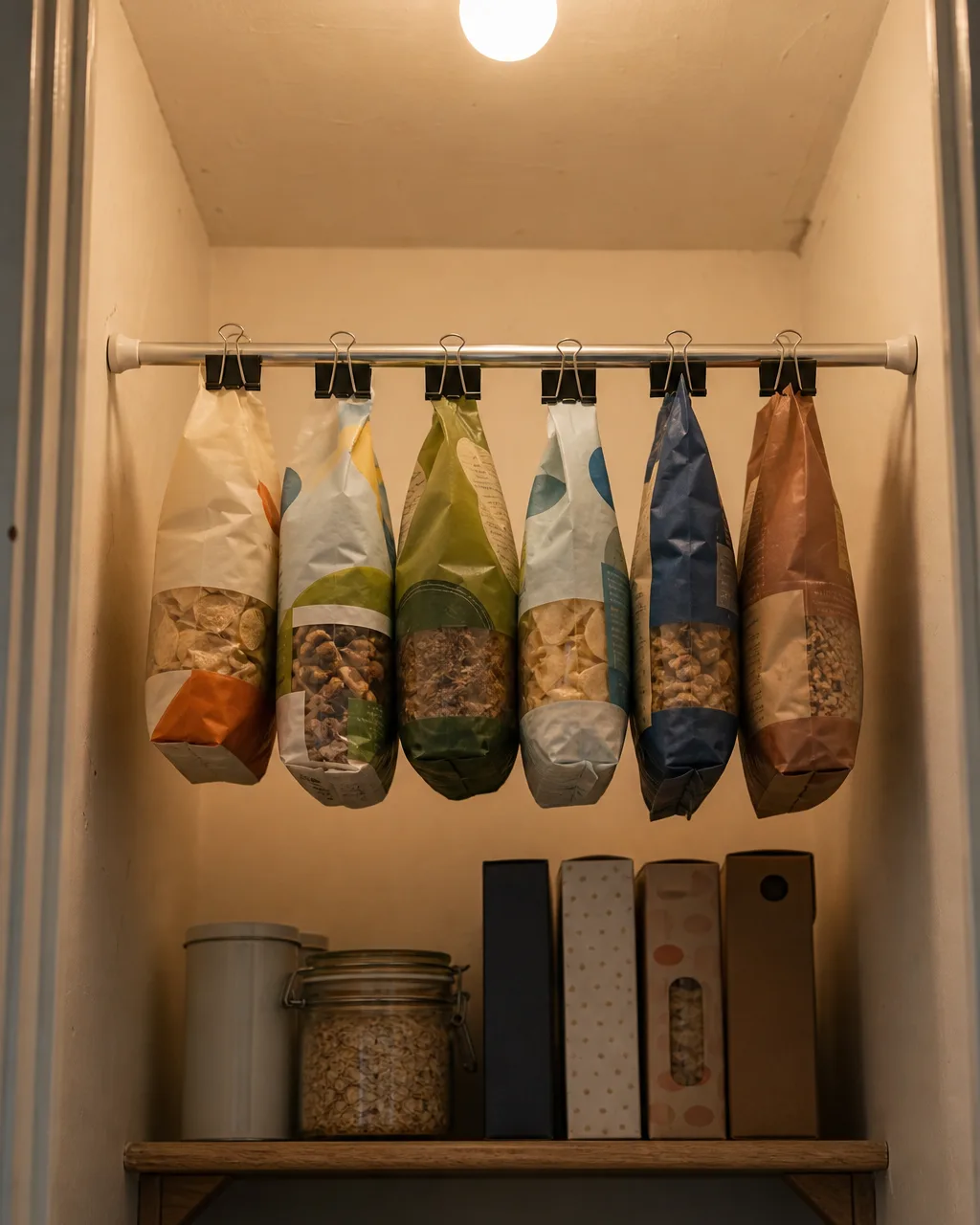
Once the shelving unit itself is full, most people assume the pantry is at capacity. But the wall above the top shelf — the strip between the last shelf and the ceiling — is almost always empty, and it’s tall enough to hang a full basket.

A rail mounted just above the shelf line lets hanging baskets use that vertical gap without competing for the same footprint as anything on the shelves. It’s the one idea on this list that adds a genuinely new tier rather than reworking an existing one.

Because these baskets hang rather than sit, they’re best for bulkier, lighter goods — bagged grains, dry pasta — rather than anything dense enough to strain the rail’s mounting hardware.

  • Confirm the rail’s weight rating before loading baskets with bulk bags
  • Mount it high enough that baskets clear the top shelf’s contents
  • Reserve hanging baskets for lighter bagged goods, not canned items
  • Space baskets evenly so the rail’s load stays balanced
  • Check ceiling clearance so baskets don’t scrape overhead trim

Uniform Airtight Containers That Stack to the Ceiling

Twelve identical clear airtight containers filled with pasta, rice, beans, and grains, stacked in a tight two-by-six grid that fills a narrow pantry shelf section from top to bottom

Mismatched bags and boxes waste space in two ways at once: irregular shapes leave gaps between them, and floppy packaging can’t be stacked without collapsing. Switching bulk dry goods to one uniform container size solves both problems in a single move.

Because every container shares the same footprint, they interlock into a tight grid with almost no wasted air between them — which is what lets a narrow shelf hold twice as much as it did with the original packaging still inside. This is the idea that turns “full” shelves into shelves with real reserve capacity.

Buy one size for the whole shelf, not a mix. Even slightly different container widths break the stacking pattern and bring back the gaps you’re trying to eliminate.

  • Standardize on one container size and shape for the entire shelf
  • Decant bulk goods immediately after buying, before the original bag takes up shelf space
  • Stack heavier grains on the bottom rows to keep the tower stable
  • Leave the top row for whatever you restock most often
  • Confirm lids seal fully before stacking anything on top
Save this for later

12 small pantry moves, one tiny closet that finally holds everything

  1. 1Over-the-Door Wire Rack for Cans and SpicesA tiered rack on the back of the door turns unused flat space into six or seven narrow shelves without stealing any depth from the shelving behind it.
  2. 2A Second Half-Shelf Riser to Double One Shelf’s CapacityA riser sits over your shortest items and claims the dead air above them, turning one shelf into two without moving a single shelf pin.
  3. 3Stackable Clear Bins Sized to the Shelf DepthBins measured to your shelf’s actual depth stack flush against the back wall instead of overhanging the edge, doubling a shallow shelf’s real capacity.
  4. 4A Slim Rolling Cart Wedged Into the Gap Beside the FridgeA narrow cart fitted to the gap beside the fridge rolls out for full access and tucks back in, turning a wasted sliver of floor into an extra column of storage.
  5. 5Tension Rod to Stand Cutting Boards and Trays on Their SideA tension rod mounted between two shelves keeps flat trays and boards upright, so they stop burying whatever’s stored underneath them.
  6. 6Door-Back Pocket Organizer for Snack PacketsA fabric pocket organizer gives each loose snack packet its own slot instead of letting them slide and pile up at the back of a shelf.
  7. 7Lazy Susan in the One Blind CornerA rotating tray sized to your one dead corner means nothing back there gets permanently lost — a quarter-turn brings it right to the front.
  8. 8Wall-Mounted Basket Rail Above the Shelf LineA rail mounted just above the top shelf hangs baskets in the empty strip of wall between the last shelf and the ceiling, adding a genuinely new tier.
  9. 9Uniform Airtight Containers That Stack to the CeilingOne matching container size interlocks into a tight grid with almost no wasted air between pieces, turning a full shelf into one with real reserve capacity.
  10. 10A Fold-Down Step Stool Stored Flat Against the Back WallA slim folding stool hung flat on a single wall hook stores in a sliver of otherwise-dead space and is ready the instant the top shelf needs reaching.
  11. 11Label the Shelf Edge, Not the Bin, So Anyone Can Refill ItA label on the shelf edge stays accurate even when the bin sitting there changes, so anyone restocking knows exactly where a category belongs.
  12. 12A Floor Basket for Bulky Bags That Refuse to ShelveA single basket at the base of the pantry gives oversized bags a dedicated home instead of letting them get wedged wherever they happen to fit.

styledhomenotes.com

A Fold-Down Step Stool Stored Flat Against the Back Wall

A slim green folding step stool hung flat against the back wall of a narrow pantry alcove on a wall hook, with shelving of jars and woven baskets visible on either side

Once you’ve claimed the wall space above the top shelf and stacked containers to the ceiling, reaching the top row becomes its own problem. A step stool solves that, but a bulky one just eats floor space you don’t have.

A slim folding stool that hangs flat against a back wall on a single hook solves both issues at once — it stores in a sliver of space that isn’t usable for anything else, and it’s ready the instant you need the top shelf.

This depends on having a stretch of otherwise-dead wall to hang it on, which is common in a narrow pantry’s back corner. If your layout doesn’t have that spare wall, a stool that tucks flat against a side wall works just as well.

  • Choose a stool rated to fold fully flat, not just partially collapsed
  • Mount the hook at a height where the stool clears the floor completely
  • Reserve this spot for wall space with no other storage use
  • Check the stool’s folded depth against your available wall clearance
  • Pick a stool color that reads as intentional, not like leftover equipment

Label the Shelf Edge, Not the Bin, So Anyone Can Refill It

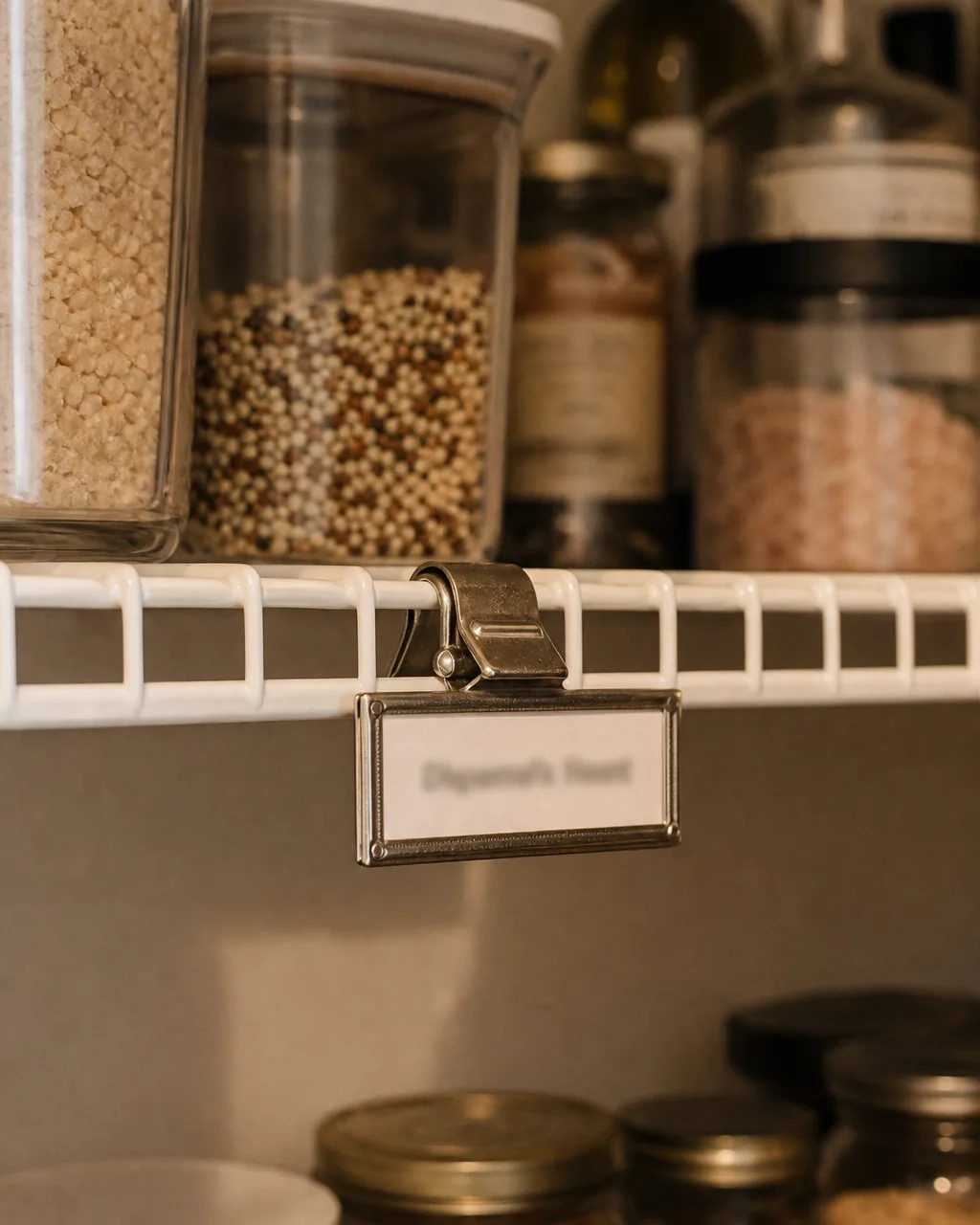
A close-up of a wooden pantry shelf edge with a blank cream label strip, above a shelf holding a clear bin of rice and glass jars of grains with kraft paper labels

Labeling the bin itself creates a problem the moment that bin gets swapped, refilled with something else, or moved to a different shelf during a reorganization — the label goes with it, and now it’s wrong. A label on the shelf edge stays put no matter what sits on top of it.

This matters more in a small pantry than a large one, because tight shelves get reshuffled constantly as new bulk containers or bags compete for the same narrow footprint. A shelf-edge label tells anyone restocking exactly where a category belongs, regardless of which specific container is currently there.

Keep the wording generic — a category, not a brand or a quantity — so the label stays accurate even when what’s actually stored there changes.

  • Label the category, not the specific product or brand
  • Position labels at the front edge where they’re visible without pulling the shelf’s contents forward
  • Use a consistent label style across every shelf for a single system anyone in the house can follow
  • Update labels when a shelf’s purpose changes, not the containers on it
  • Keep wording short enough to read at a glance while restocking

A Floor Basket for Bulky Bags That Refuse to Shelve

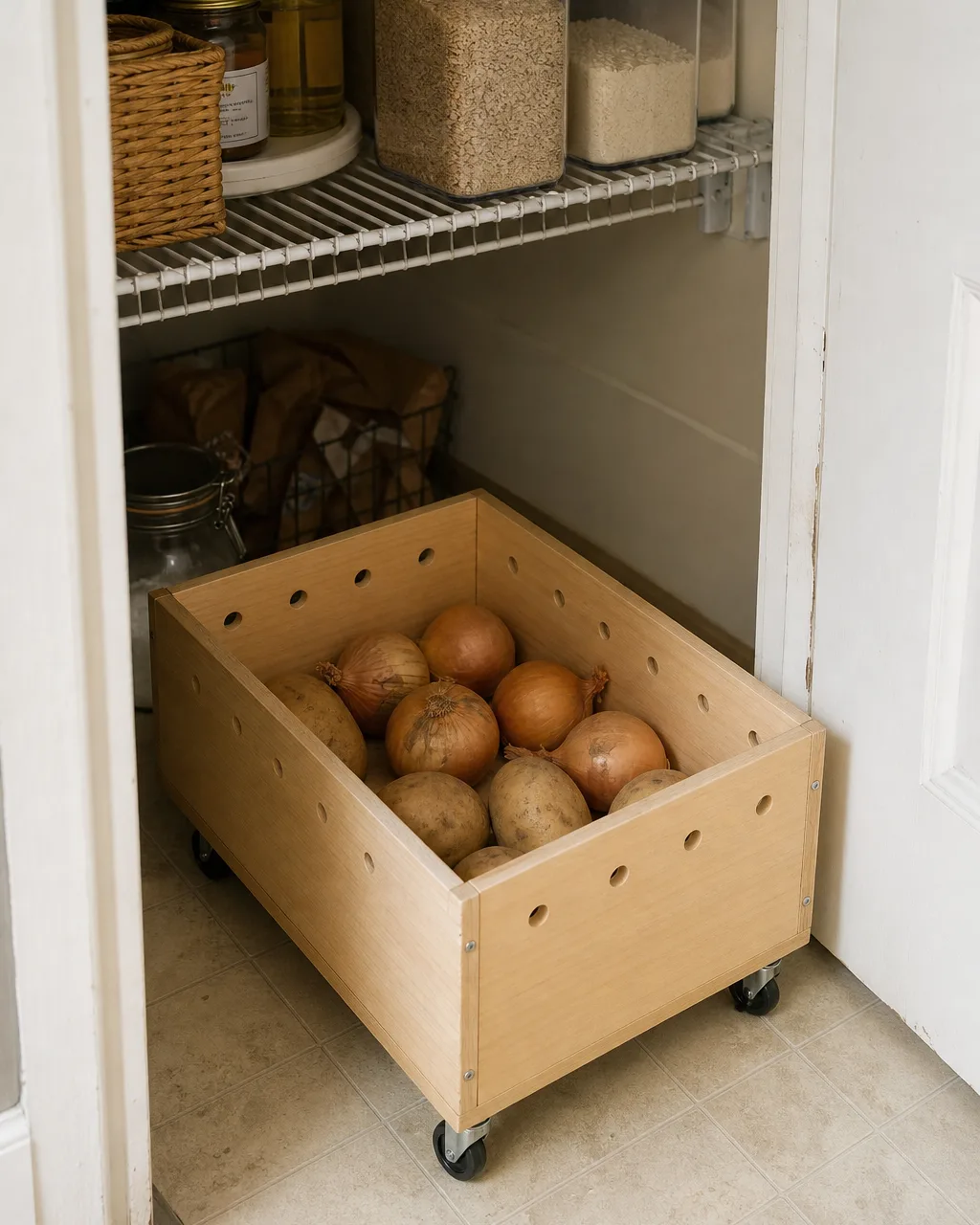
A large woven basket on the pantry floor holding a soft cream fabric sack and a large kraft paper bag, tucked into the base of the pantry beneath the shelving

Large bags of flour, dog food, or bulk rice almost never fit a standard shelf depth, and forcing them onto one usually means they hang over the edge or block the shelf below. The floor is the one surface in a small pantry sized for something that big.

A single basket at the base of the pantry gives oversized bags a dedicated home instead of letting them get wedged wherever they happen to fit that week. It’s also the last hidden inch on this list — floor space in a narrow closet is easy to overlook once your eyes are on the shelves above it.

Keep this basket for genuinely oversized items only. If it starts holding things that would fit a shelf, it turns into overflow clutter instead of solving the specific problem it’s meant to fix.

  • Reserve the floor basket strictly for bags too large for any shelf
  • Choose a basket wide enough to keep bags upright rather than slumping sideways
  • Position it where it doesn’t block the door’s swing or a step stool’s footing
  • Fold or roll the top of soft bags closed before setting them in the basket
  • Empty and rotate the basket’s contents as bags are used up, not just when it’s full
About the author
Nora Ellis

Nora writes about small, livable rooms for real apartments. Her own pantry is a repurposed hall closet barely two feet wide, run honestly on these same moves — a wire rack claiming the back of the door, a tension rod standing her baking sheets on edge, and a shelf-edge label system her whole household actually follows. Every idea in this guide gets pressure-tested against a real narrow closet, not a showroom pantry.

Nora Ellis edits Styled Home Notes. Visit the Nora Ellis author page. More from Nora: pantry organization ideas, pantry shelf organization ideas, kitchen cabinet organization ideas.

Similar Posts