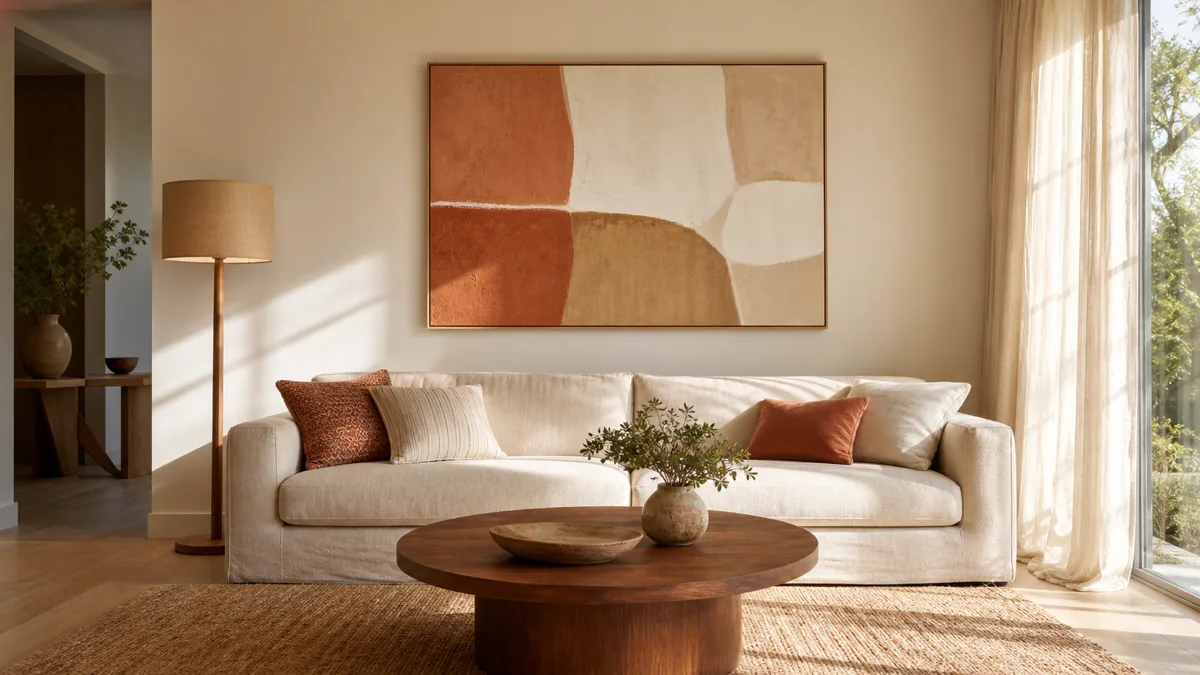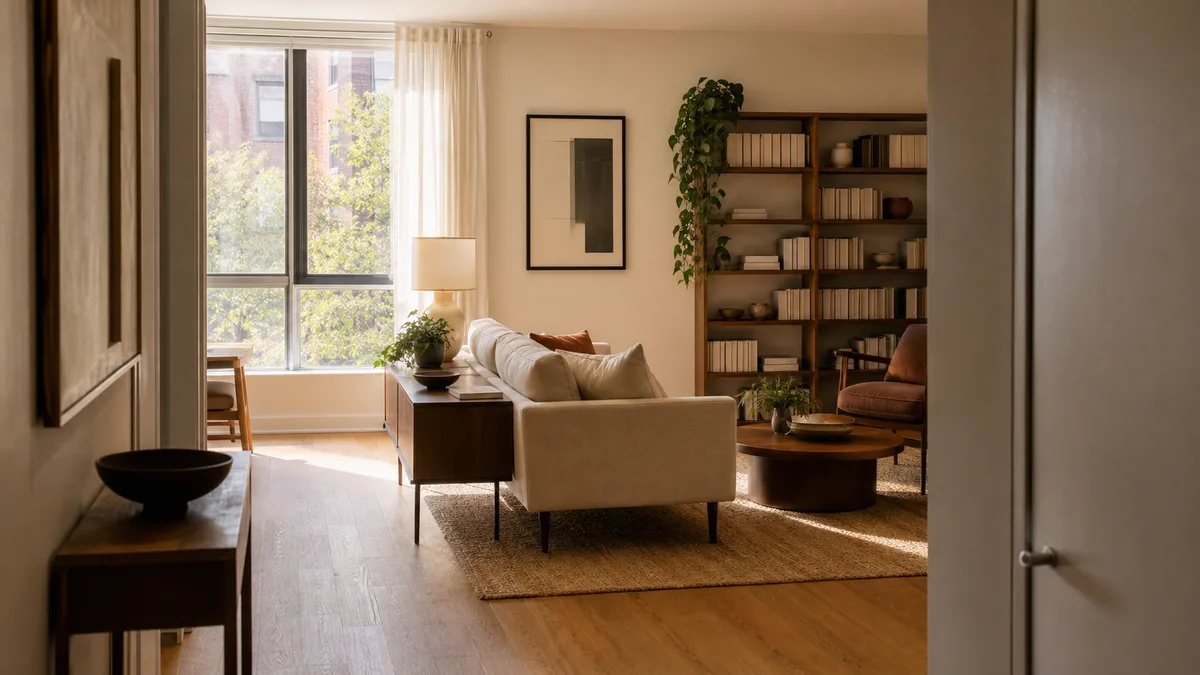
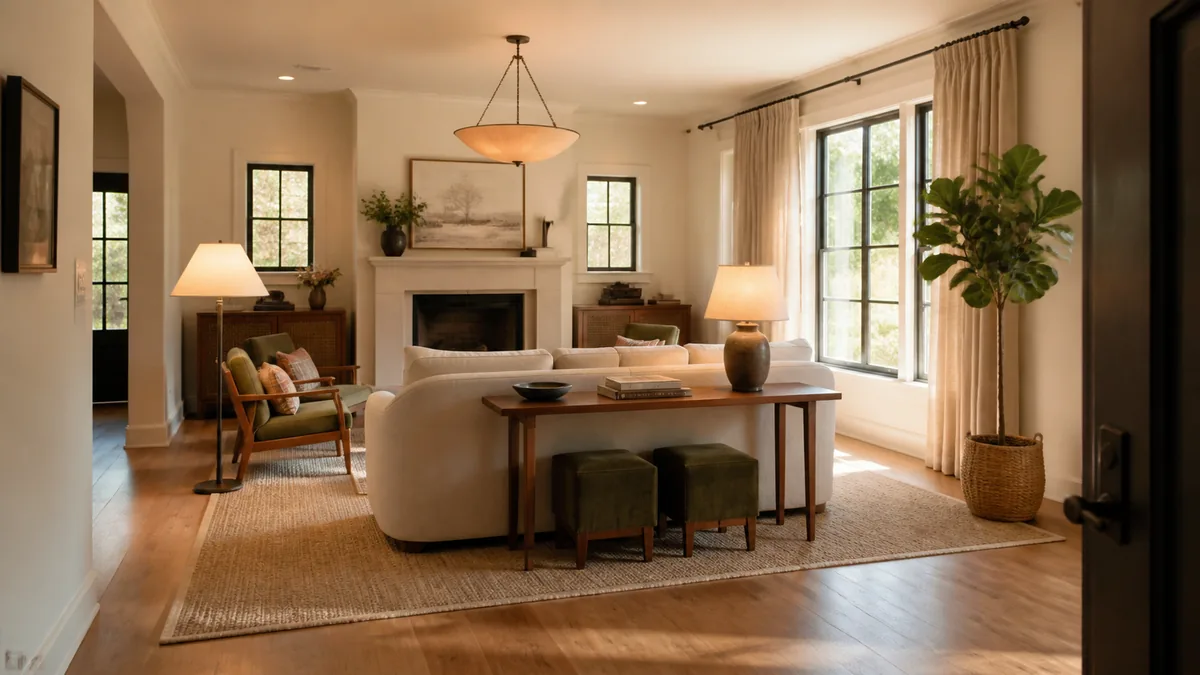
21 Living Room Ideas That Make Your Space Feel Complete
A living room does not come together all at once. It happens in layers — a rug that finally anchors the furniture, a lamp that changes how the room feels after dark, a shelf arrangement that gives the wall something worth looking at.
These twenty-one ideas cover the full range of what makes a living room feel finished, from the biggest layout shift to the smallest finishing detail. Every one of them works independently, so start wherever your room needs the most help.
Working with limited square footage? Apartment living room ideas covers that side. This page is about design — the choices that turn a functional room into one you want to spend time in.
- 1 Float the sofa away from the wall
- 2 Two conversation zones
- 3 Layer three light sources
- 4 Large-scale area rug
- 5 Wood accent wall
- 6 Mix throw pillow textures
- 7 Floating shelves gallery
- 8 Statement pendant light
- 9 Round coffee table
- 10 Console table behind sofa
- 11 Curtains wide and high
- 12 Leaning mirror
- 13 Oversized indoor plant
- 14 Warm ceiling tint
- 15 Reading nook
- 16 Asymmetric mantel
- 17 Layered rugs
- 18 Sheer linen panels
- 19 Window bench with storage
- 20 Mix wood tones
- 21 Woven wall hanging
1. Float the sofa away from the wall
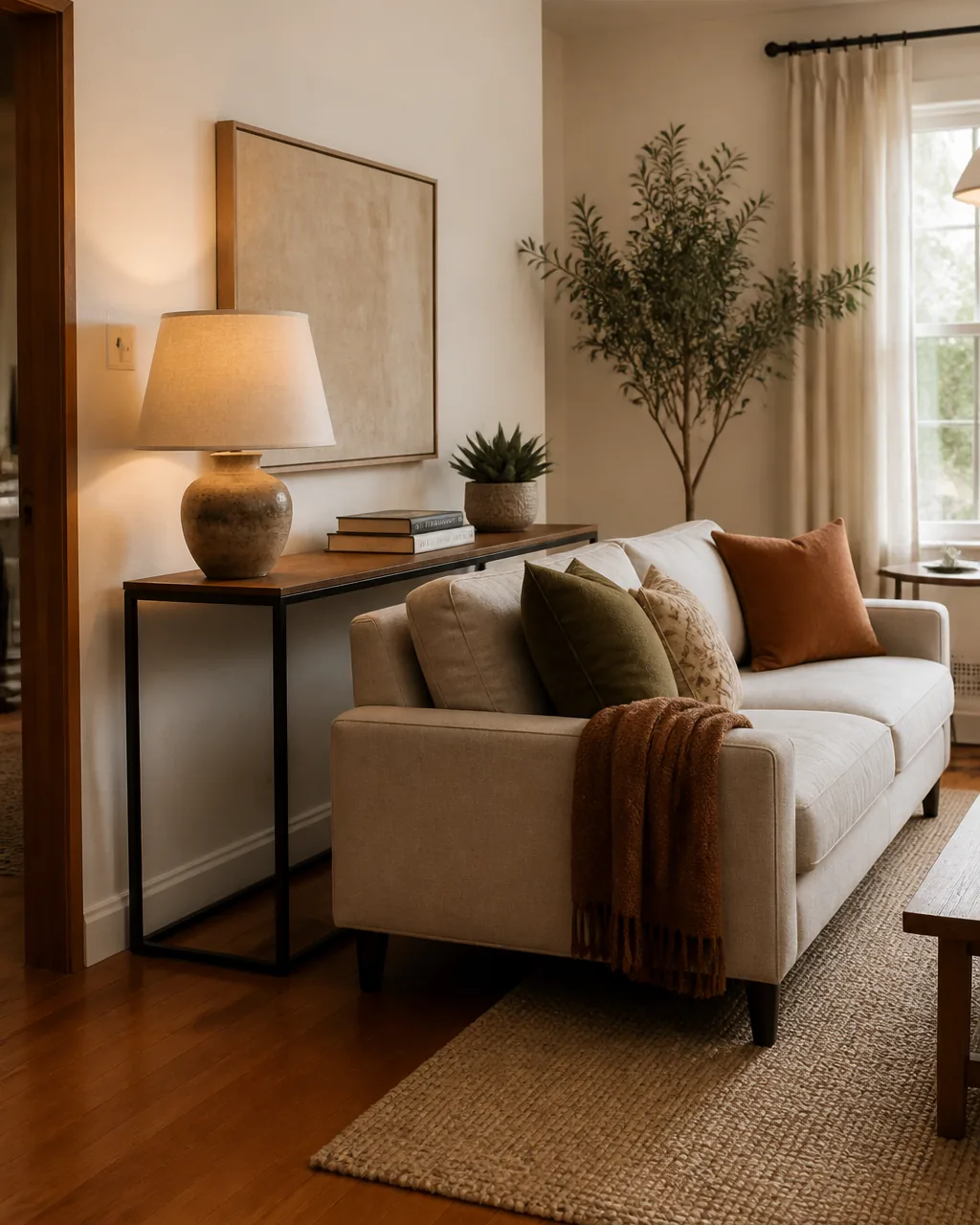
Pushing furniture against every wall is one of the most common layout habits, and breaking it changes the entire feel of a room. Even six inches of space between the sofa back and the wall makes the seating group feel intentional rather than parked.
- Place a slim console table in the gap to hold a lamp, a few books, or a small plant
- The console gives the sofa a finished back and adds surface area without taking floor space
- Floating the sofa creates a natural pathway behind it, improving traffic flow through the room
- Rooms with floating furniture read as larger because the eye travels around and behind pieces
- If you have an open floor plan, the floated sofa becomes a room divider without blocking sightlines
2. Create two conversation zones instead of one long row
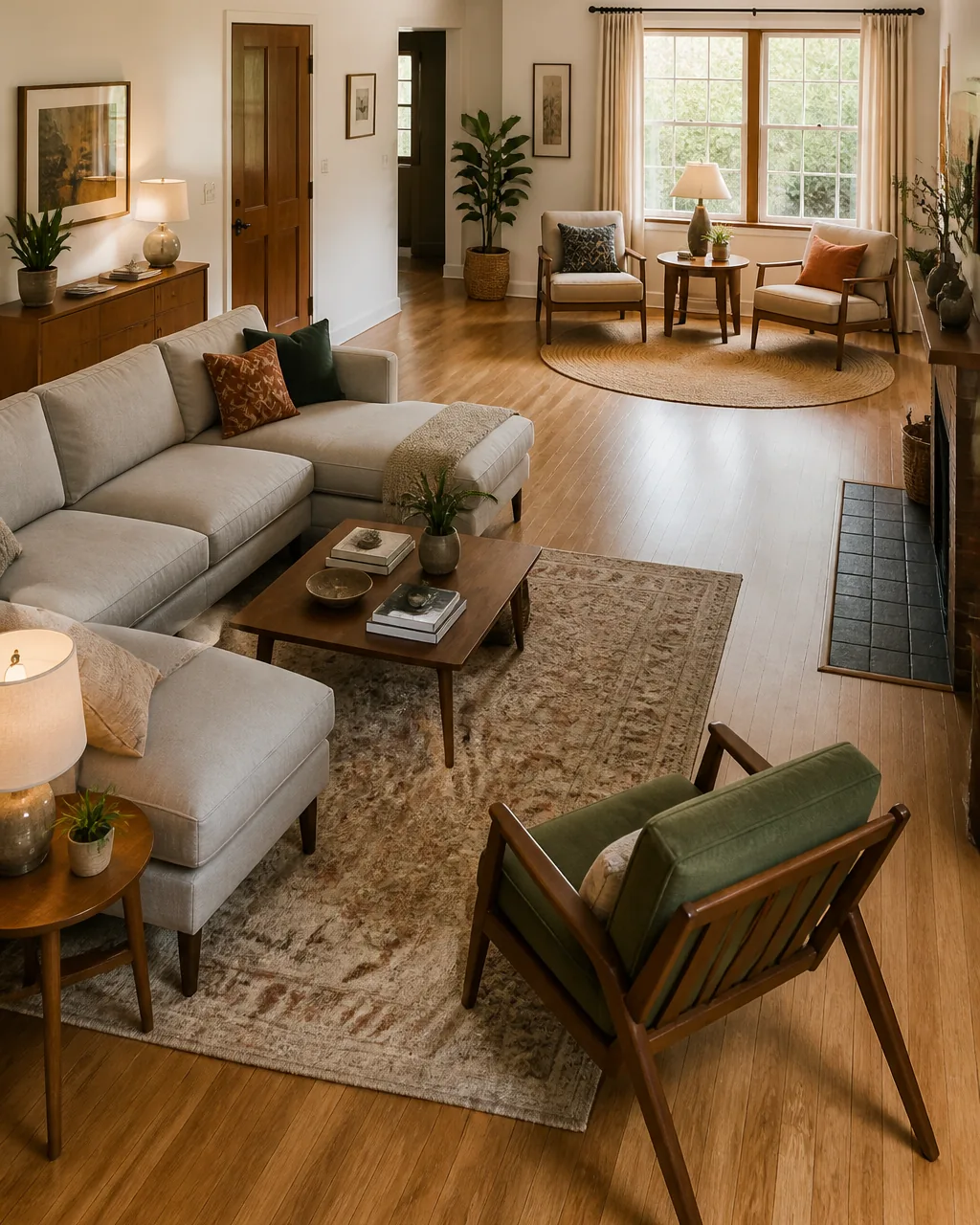
One long sofa facing a TV works for watching screens but not for conversation. Splitting seating into two clusters — an L-shape on one side and a pair of chairs on the other — gives the room two purposes without adding square footage.
- Angle chairs toward the sofa group so people in both zones can talk without shouting
- Keep a clear walking path between zones so the room still flows
- A smaller rug under each cluster visually anchors each zone
- This layout works well in rectangular living rooms where a single sofa arrangement leaves dead space on one end
- You do not need matching furniture for the second zone; a pair of thrift-store chairs with a small side table between them works
3. Layer three light sources at different heights
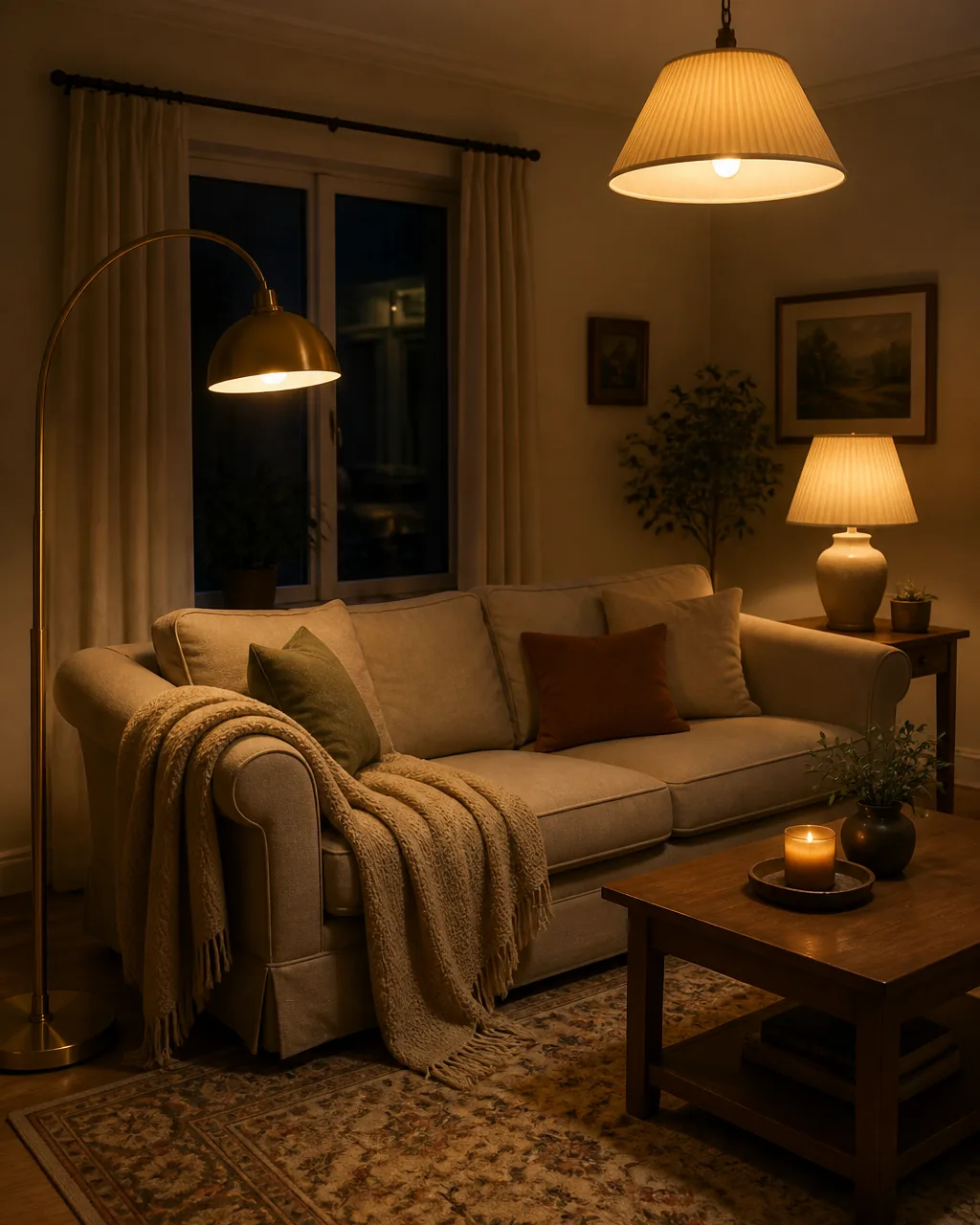
One overhead light flattens everything. Three sources at different heights — floor, table, and overhead — create depth and warmth that a single fixture cannot match.
- Start with a floor lamp next to a reading chair for ambient light at standing height
- Add a table lamp on a console or side table for mid-level warmth
- Use the overhead fixture (pendant, chandelier, or flush mount) at the lowest comfortable wattage so it fills without washing out the other layers
- Warm-toned bulbs in the 2700K range give the room an evening feel without looking orange
- Dimmer switches on even one of the three sources give you control over the room's mood without touching the other two
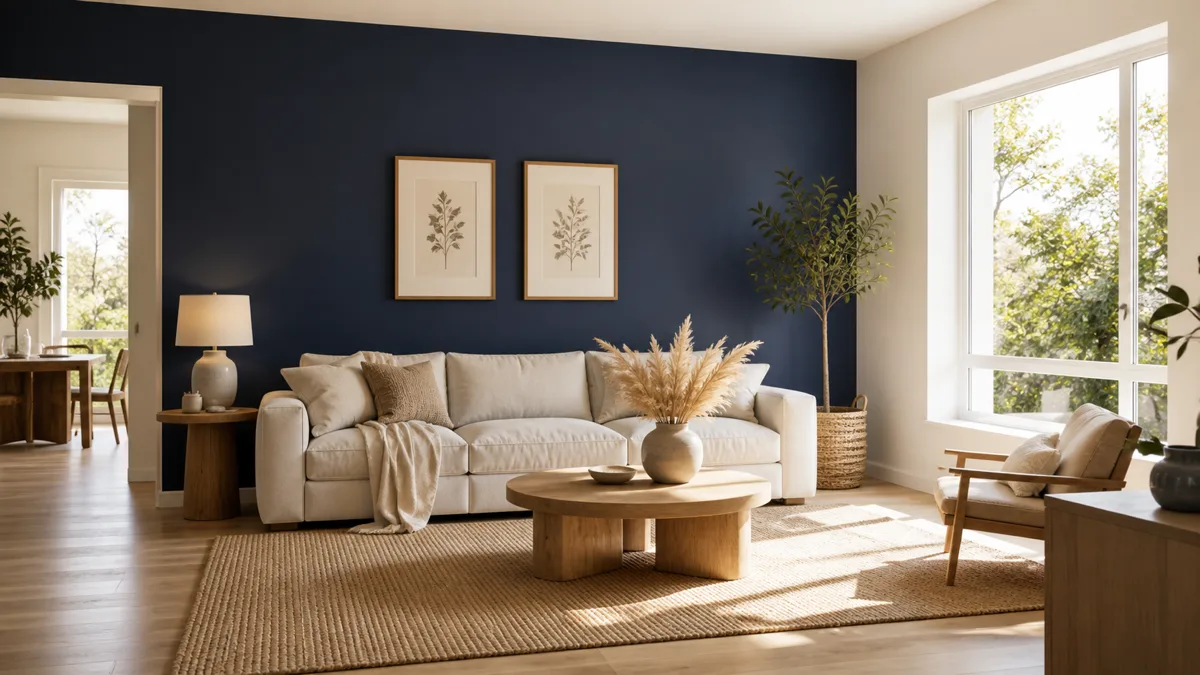
4. Anchor the room with a large-scale area rug
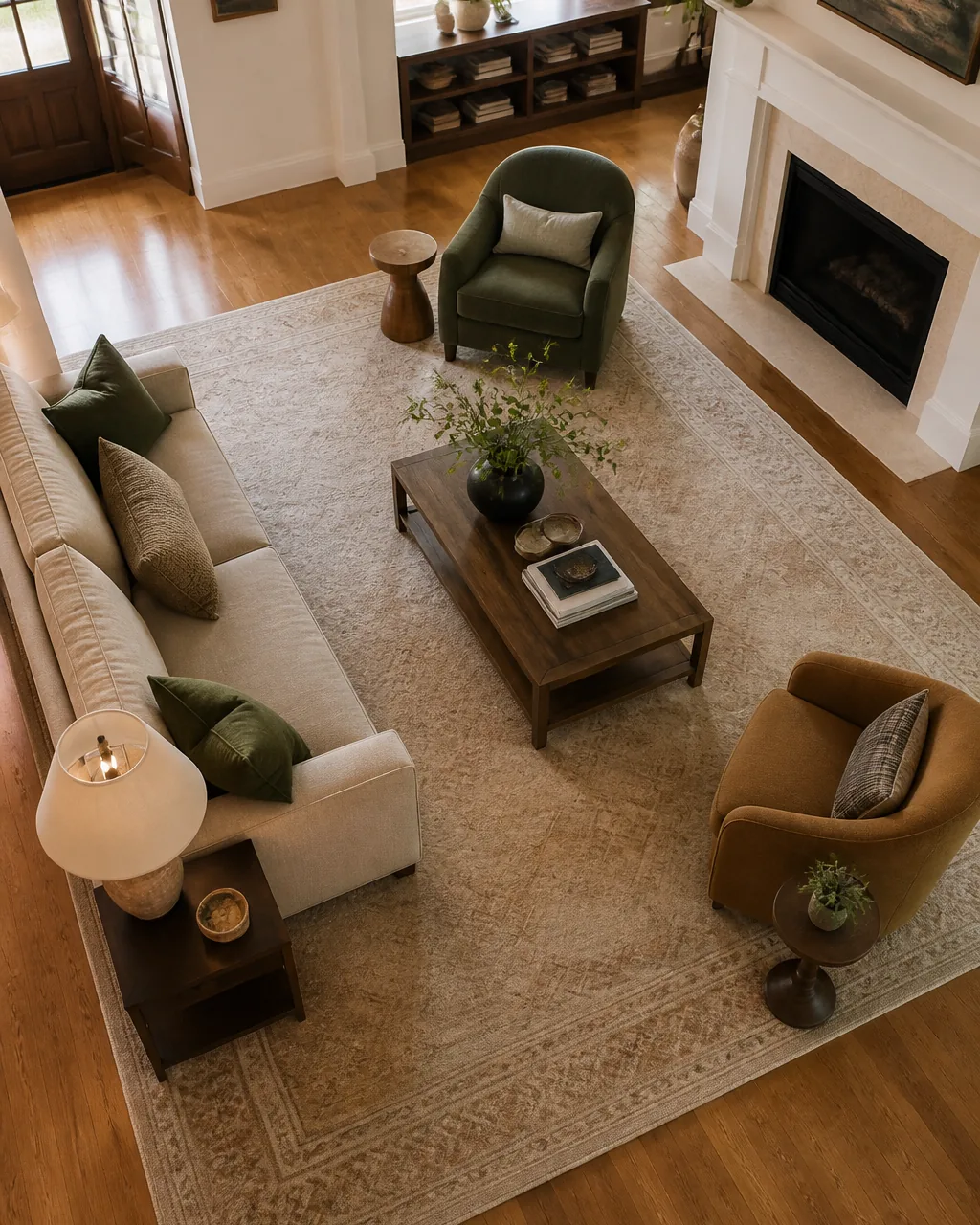
A rug that is too small for the seating group makes the furniture look like it is drifting. The front legs of every seat should land on the rug so the group reads as one connected zone.
- An 8-by-10-foot rug works for most standard sofa-and-two-chair arrangements
- The rug should extend at least six inches beyond the outer edges of the seating to keep the group from looking cramped
- A subtle pattern in warm neutrals adds texture without competing with pillows or throws
- Layering a smaller rug on top of a larger one is a separate idea (see number seventeen) — this one is about getting the foundation rug right
- If hardwood floors run throughout, the rug also dampens echo and makes the room feel quieter
5. Add a wood accent wall behind the sofa
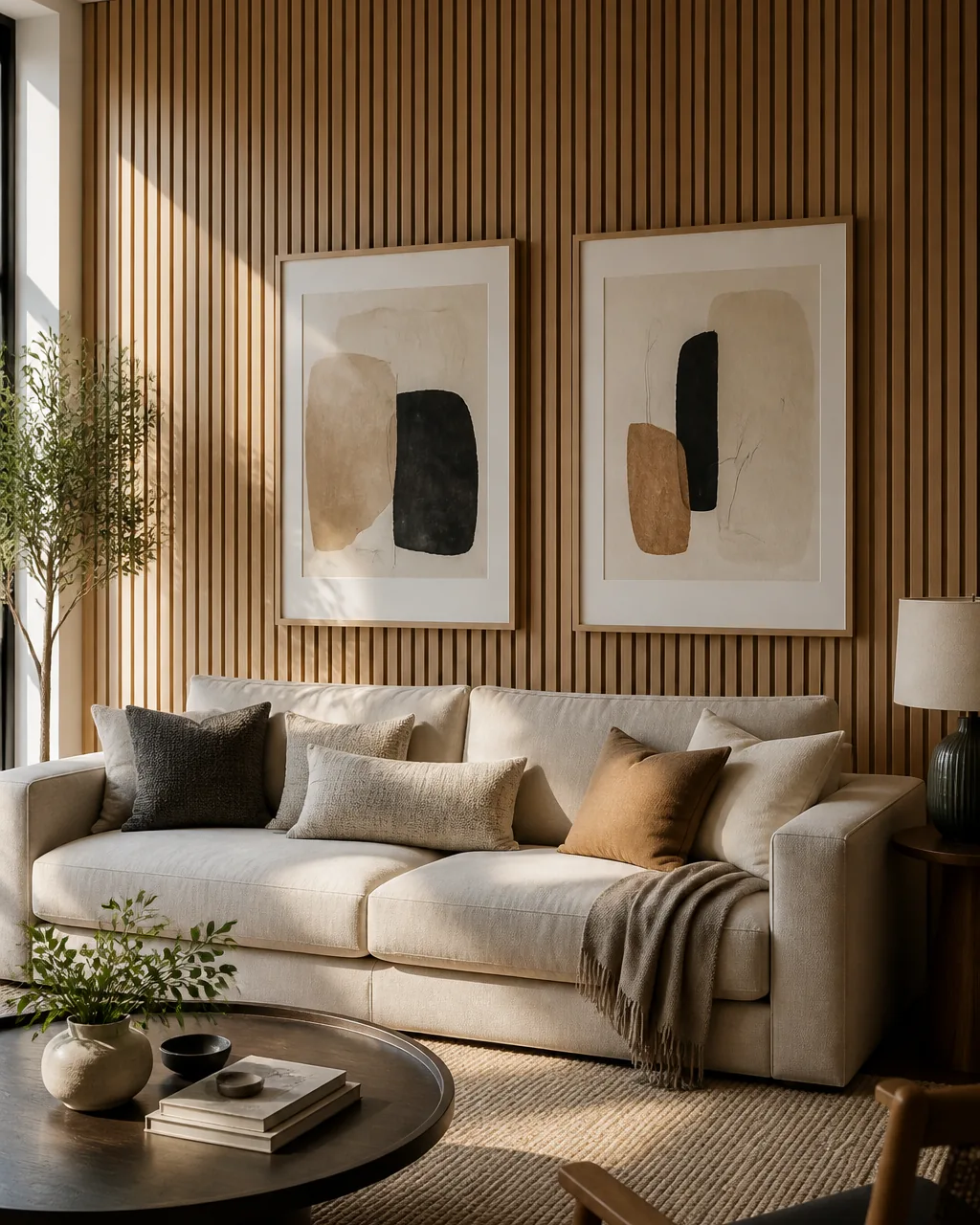
A single textured wall behind the sofa gives the room a focal point without painting the whole space. Vertical slats, shiplap, or reclaimed planks all add warmth and dimension that flat drywall cannot.
- Vertical slats make a room feel taller; horizontal planks make it feel wider — pick based on what your room needs
- Natural oak or walnut tones warm up cool-toned rooms without paint
- Slats with slight gaps between them let wall color show through and keep the texture from feeling heavy
- You can still hang art on a slatted wall with picture rail hooks that grip the top of a slat
- Peel-and-stick wood panels are a renter-friendly version that comes off cleanly — see living room accent wall ideas for more approaches
6. Mix two complementary throw pillow textures
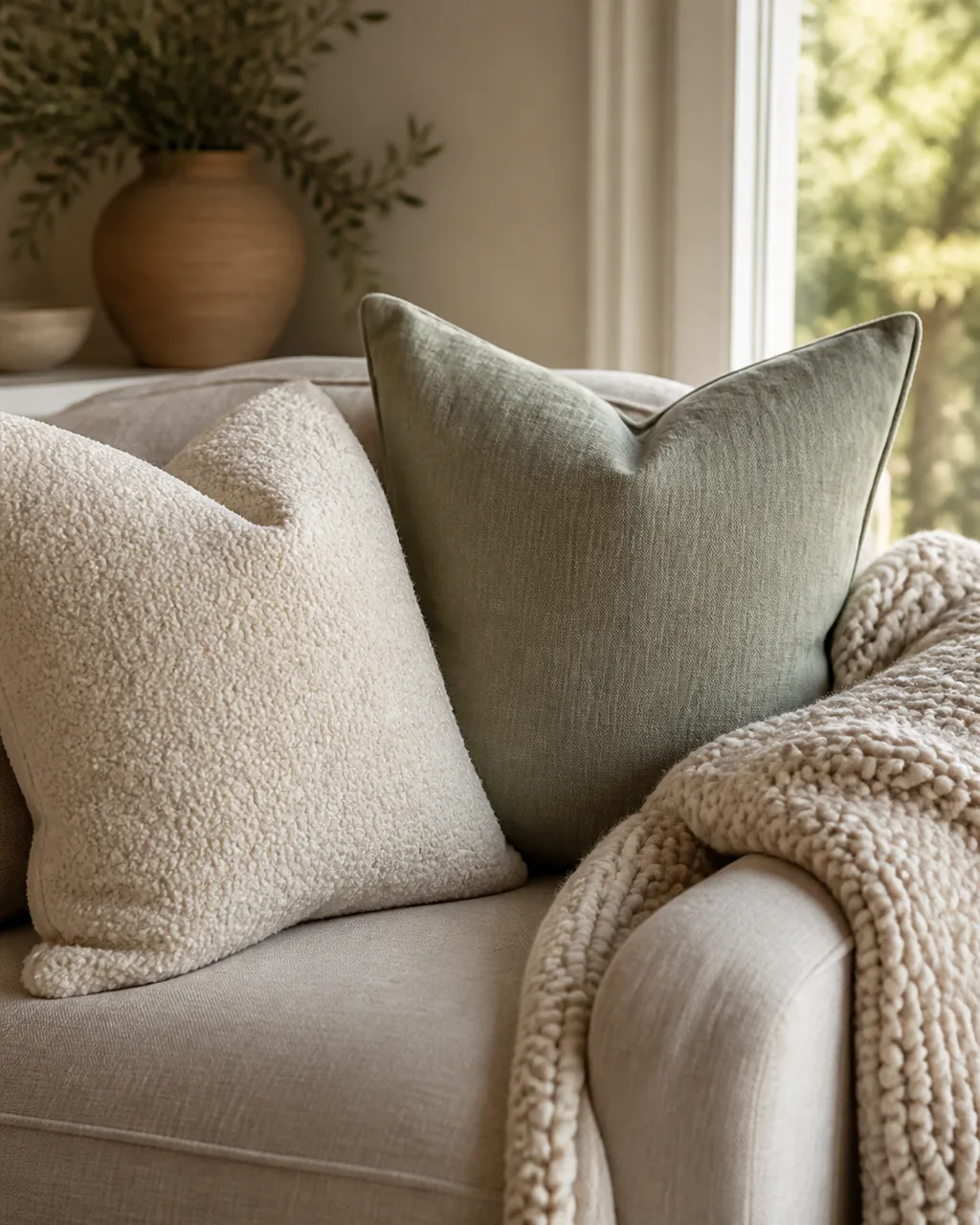
Matching pillows look intentional but boring. Pairing two textures — a nubby bouclé with a smooth linen, or a velvet with a flat-weave — adds visual interest while keeping the color palette cohesive.
- Stick to two or three textures maximum; more than that starts to feel cluttered
- Keep colors in the same warm or cool family so the textures do the differentiating, not the colors
- Odd numbers of pillows (three or five) create a more natural arrangement than even stacks
- A chunky knit throw draped over one arm completes the layered look without adding another pillow
- Replace seasonally if you want — linen and cotton in summer, velvet and wool in winter — to change the room's feel without redecorating
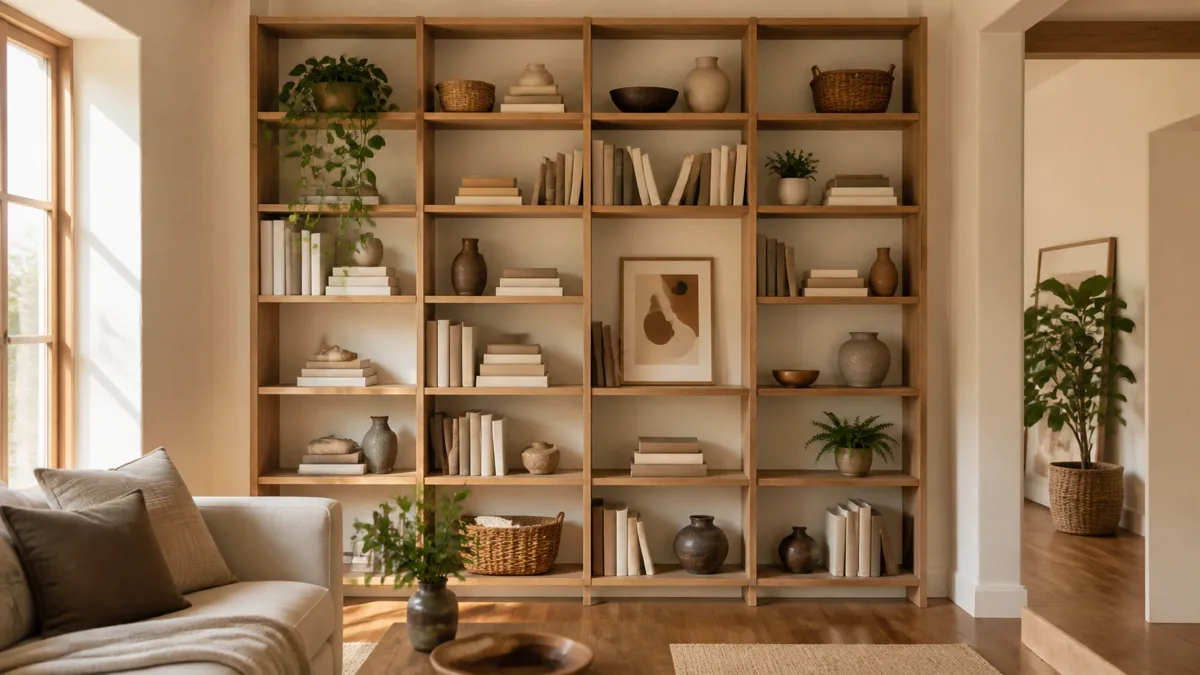
7. Install floating shelves as a mini gallery
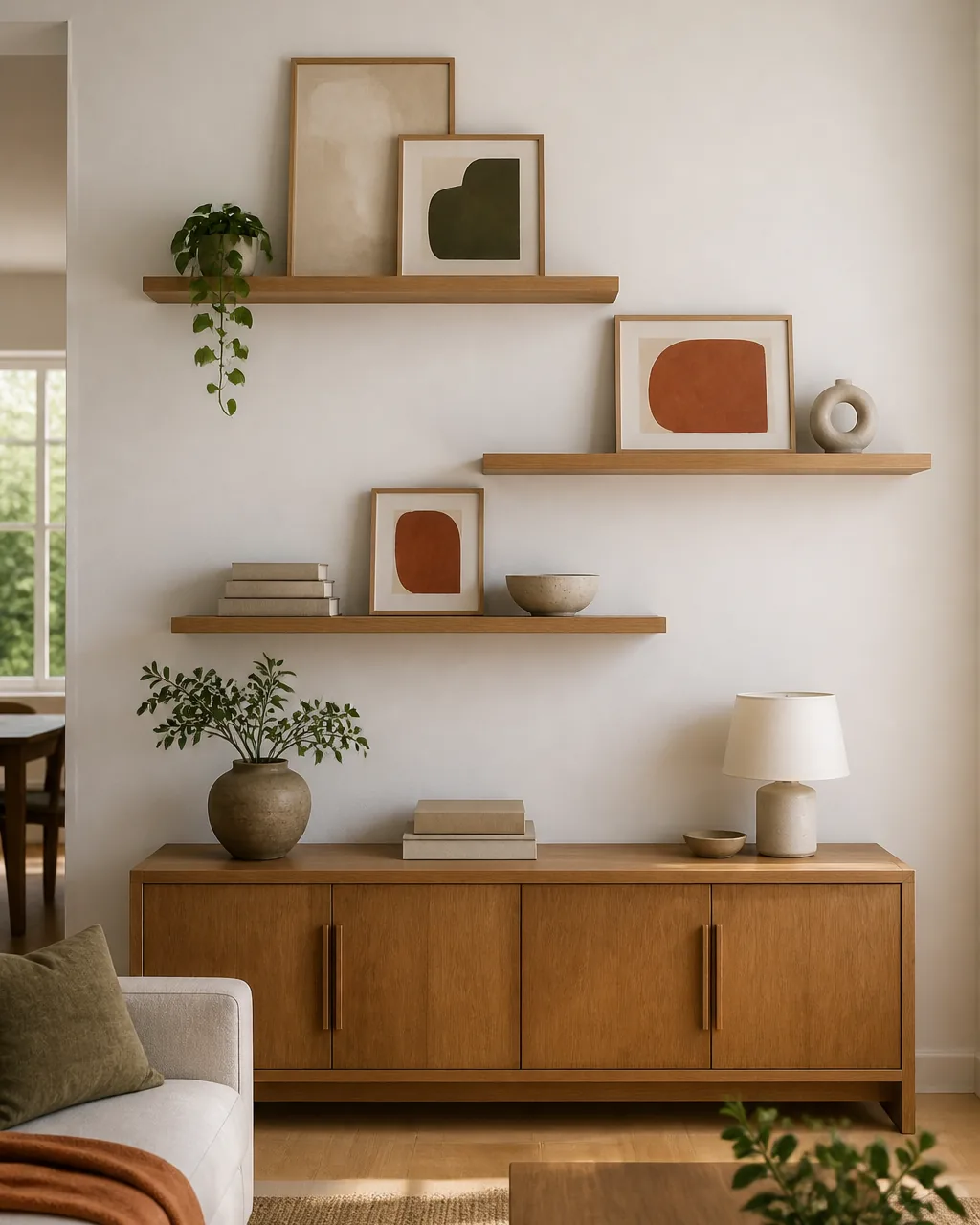
A blank wall above a credenza or console is wasted potential. Floating shelves at staggered heights turn that wall into a gallery you can rearrange whenever you want.
- Stagger shelves at slightly different heights rather than lining them up in a grid — asymmetry reads as curated
- Lean framed prints against the wall instead of hanging them so you can swap art without new holes
- One trailing plant in a small ceramic pot adds life without needing dedicated plant-care space
- Horizontal book stacks (three to five books per stack) act as risers for smaller objects
- Leave at least one shelf section mostly empty so the arrangement breathes — see living room bookshelf styling for the full technique
8. Swap overhead lighting for a statement pendant or chandelier
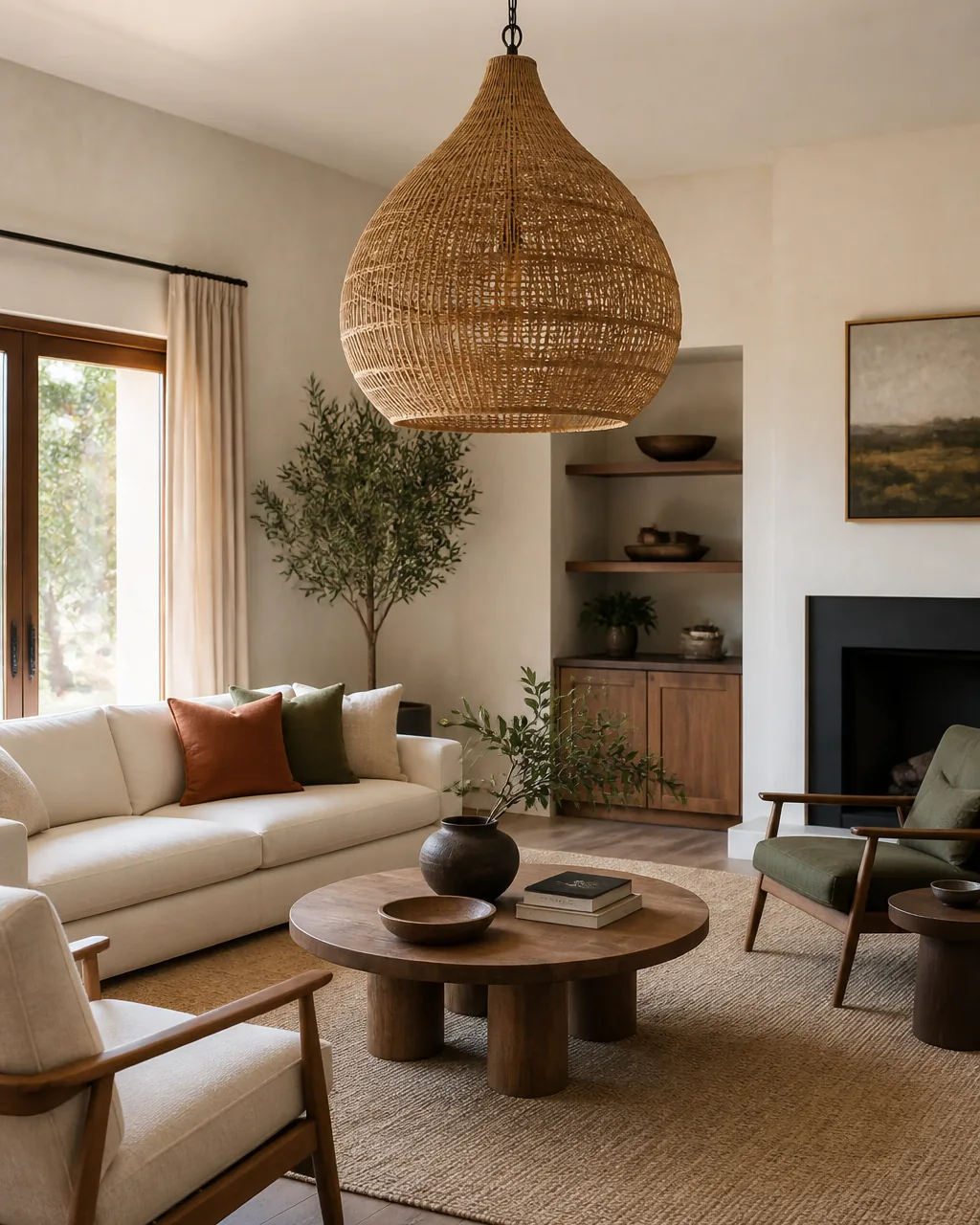
A builder-grade flush mount does its job but adds nothing to the room. Replacing it with one sculptural fixture — rattan, metal, or glass — gives the ceiling a focal point and changes the room's character.
- A pendant or chandelier should hang at least seven feet above the floor in a living room to avoid head clearance issues
- Oversized fixtures (24 inches or wider) work in standard-height rooms if the drop is short
- Woven or open-frame fixtures scatter light in patterns across the ceiling and walls, adding texture after dark
- Match the fixture's material to one other element in the room — if you have a rattan basket planter, a rattan pendant ties them together
- Swapping a light fixture is one of the few changes that transforms a room from the moment you walk in
9. Introduce a round coffee table to soften angular furniture
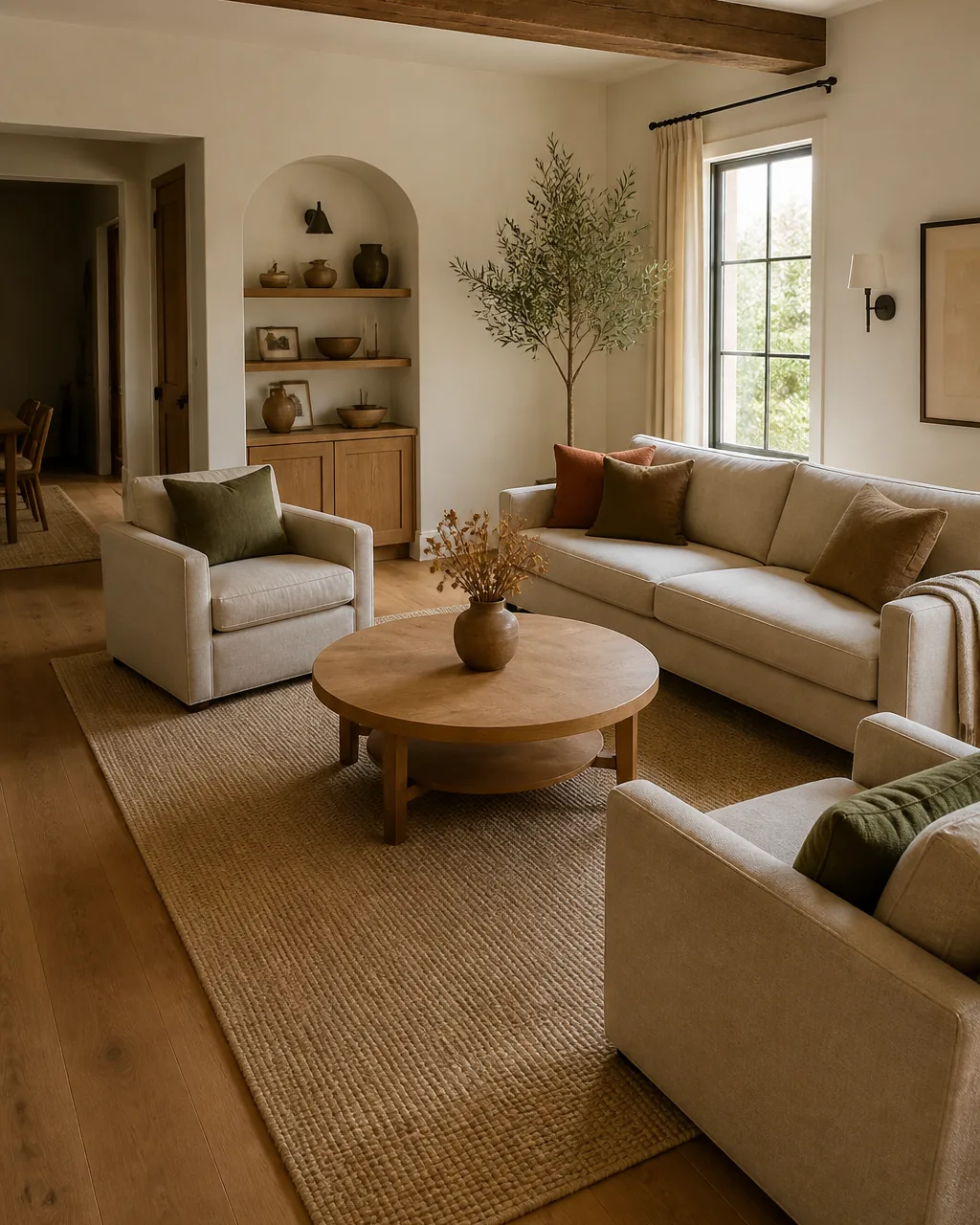
Rectangle sofa, rectangle rug, rectangle media console — the same shape repeated creates visual monotony. A round coffee table breaks the pattern and creates easier traffic flow because there are no sharp corners to dodge.
- A round table 36 to 42 inches in diameter fits most standard sofa arrangements
- The gap between the table edge and sofa cushion should be 14 to 18 inches — close enough to reach a drink, far enough to walk past
- A wood top adds warmth in a room with a lot of upholstered surfaces
- If you have children, the lack of sharp corners is a practical safety benefit
- A round table also works well with a sectional, sitting in the curve of the L
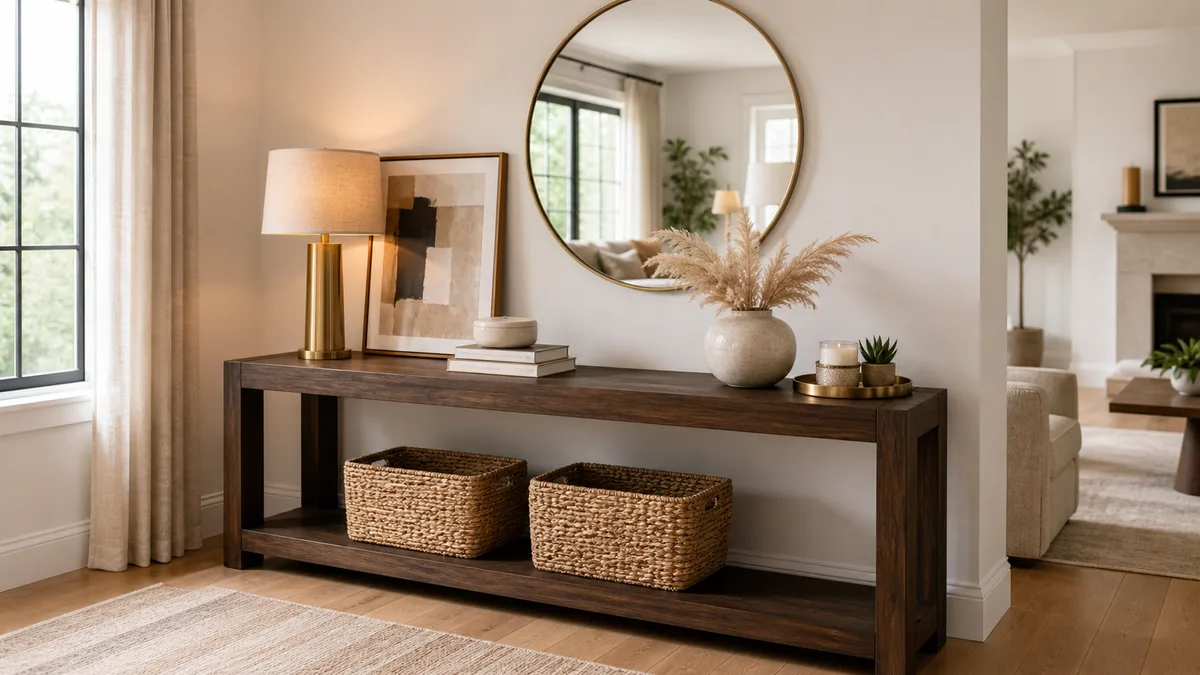
10. Use a console table behind the sofa to define the living zone
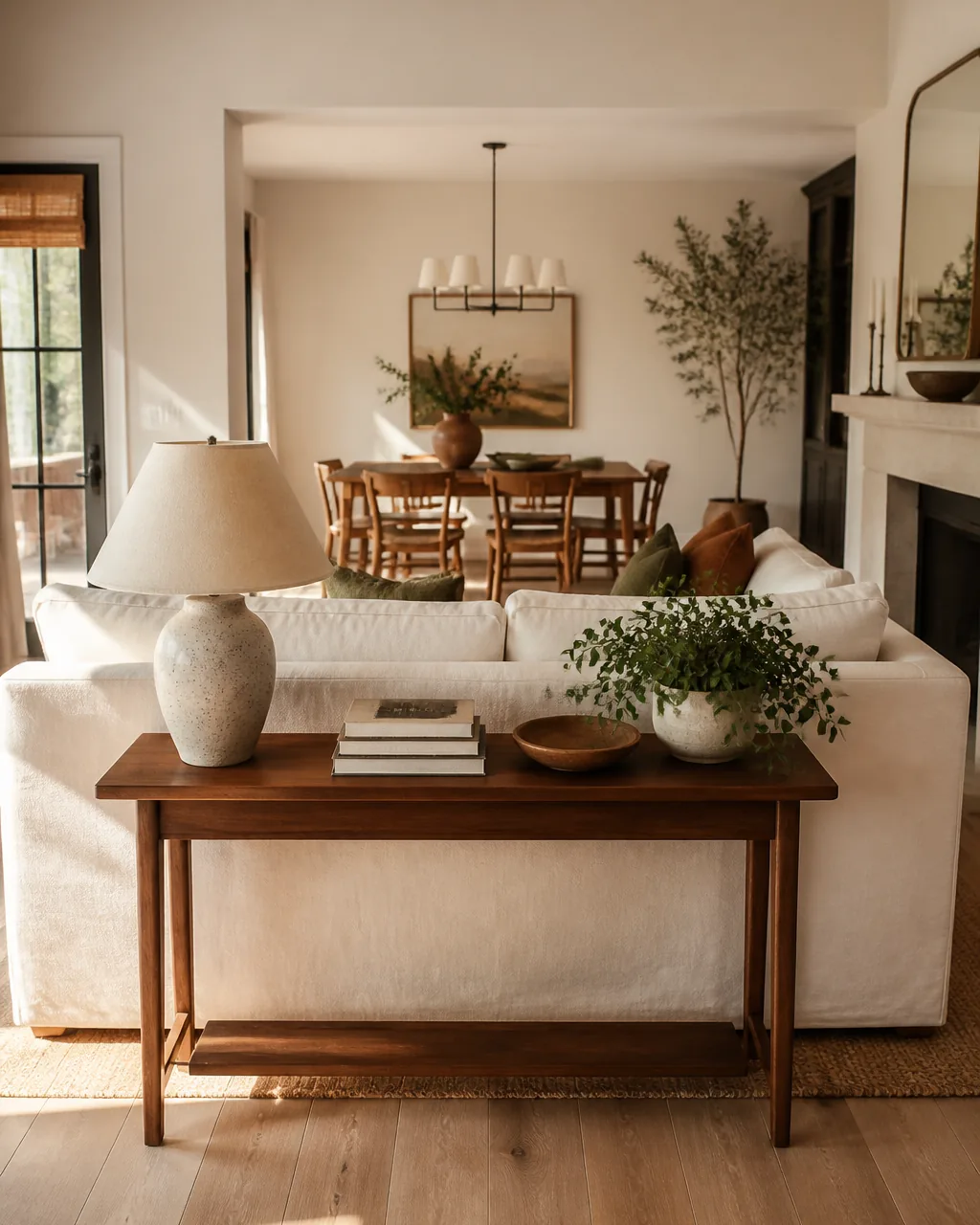
In open floor plans, a console table placed against the sofa back creates a visual boundary between living and dining zones without a wall. For more on styling the console itself, see living room console table decor ideas.
- The console height should be at or slightly below the top of the sofa back so it does not block sightlines
- A table lamp on one end gives the living zone its own light pool, reinforcing the sense of a separate room
- Books and a small plant fill the surface without cluttering it
- This works especially well when the sofa is floated (idea one) — the console fills the gap and gives the sofa a finished back
- A narrow console (10 to 14 inches deep) fits even in tight floor plans without eating into the dining side
11. Hang curtains wide and high to make windows look larger
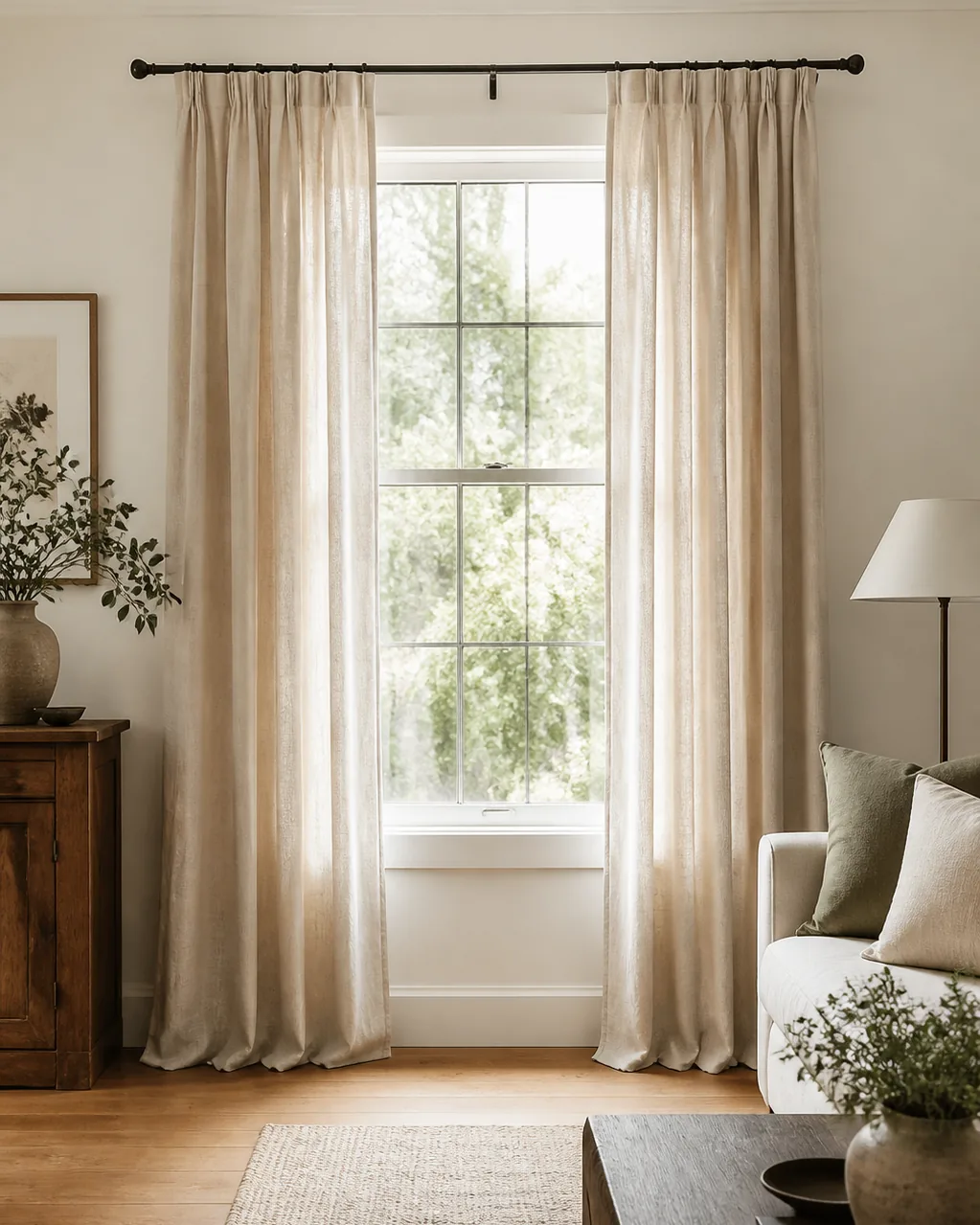
Mounting curtain rods at the window frame makes the window look exactly as small as it is. Hanging the rod four to six inches above the frame and extending it six inches past each side tricks the eye into seeing a larger window.
- Floor-length panels that barely kiss the floor look the most polished — too short reads as a mistake, too much pooling reads as neglect
- Linen or cotton blends in a neutral tone let light through while adding softness
- Two panels per window, even if the window is narrow, create fullness when drawn open
- This works on every window size and is one of the fastest ways to make a room feel taller
- For more curtain approaches, see living room curtain ideas
12. Add a large leaning mirror to double natural light
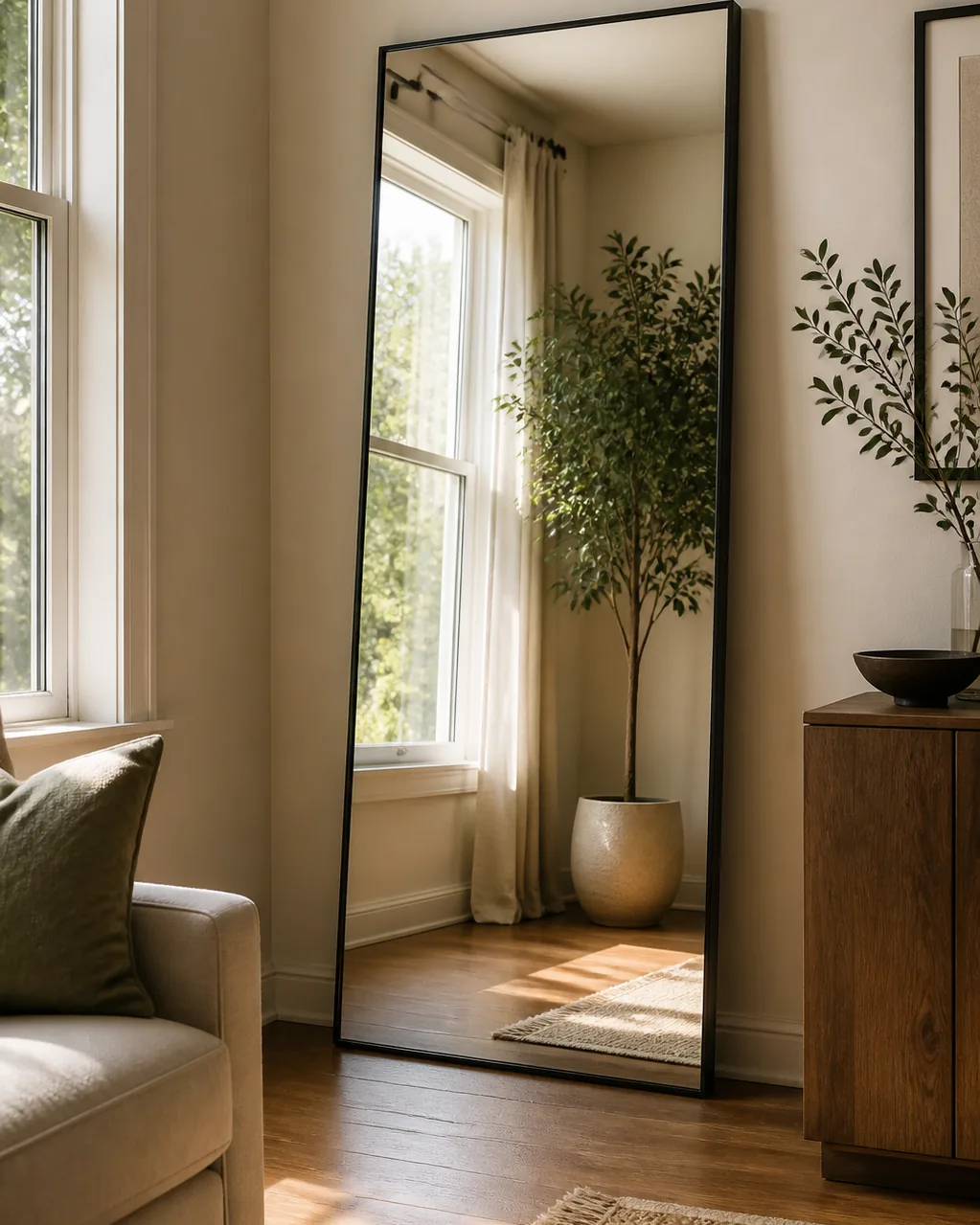
A mirror placed opposite the brightest window reflects daylight back into the room, effectively doubling the perceived light. A leaning mirror five feet tall or larger also makes the room feel deeper.
- Position the mirror directly across from a window for maximum light bounce
- A thin black or gold frame keeps the mirror from looking like a leftover from a bathroom remodel
- Leaning against the wall rather than hanging adds a casual, editorial feel and avoids the need for heavy wall anchors
- A plant placed near the mirror appears twice, amplifying any greenery in the room
- Avoid placing mirrors directly opposite a cluttered area — they double the visual noise too
13. Bring in one oversized indoor plant as a living sculpture
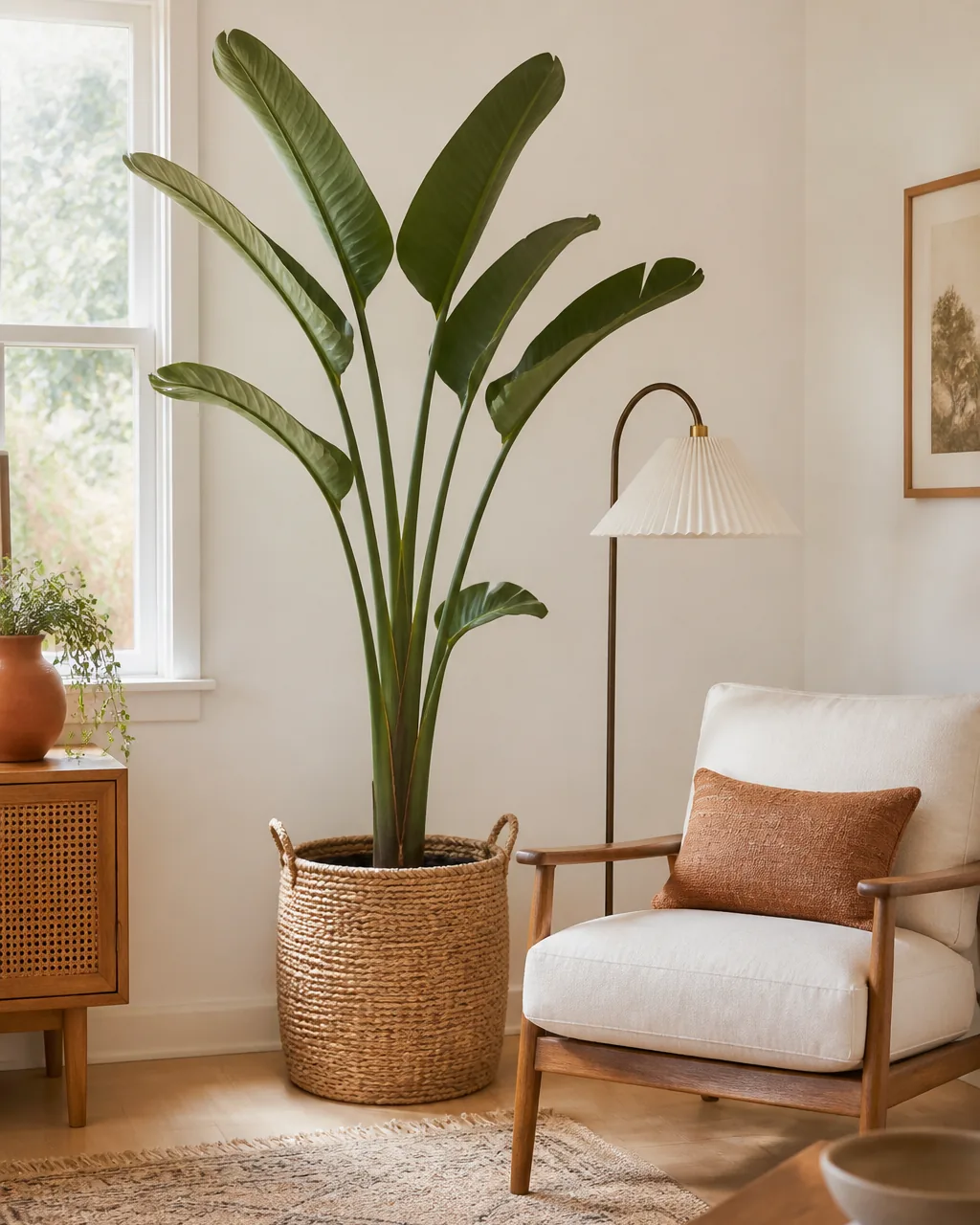
A single large plant — fiddle leaf fig, bird of paradise, or olive tree — fills a corner with life in a way that no lamp or side table can replicate. Treating it as sculpture rather than decoration means giving it enough space to be the focal point of that corner.
- A woven seagrass or rattan basket as a planter cover ties the plant into an organic living room palette
- Position the plant where it gets bright indirect light from a nearby window — a dead corner with no light will kill it slowly
- One oversized plant has more visual impact than five small ones scattered across surfaces
- The pot (or basket) should be proportional to the plant — a tree in a tiny pot looks top-heavy
- If low light is your reality, a snake plant or ZZ plant can reach three to four feet and survives almost anywhere
14. Paint the ceiling a warm tint instead of stark white
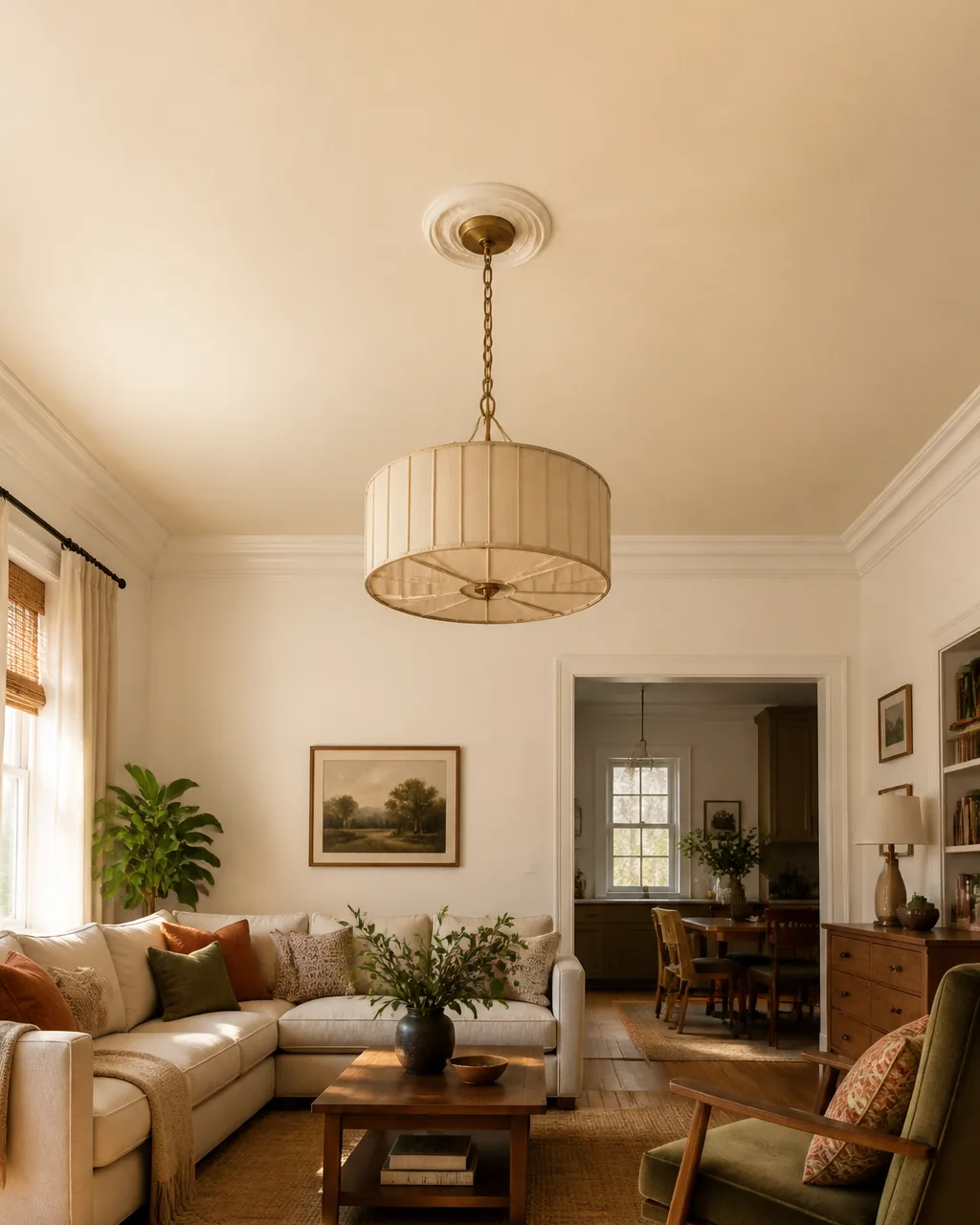
Stark white ceilings bounce light well but feel institutional. A warm cream, soft linen, or pale blush on the ceiling wraps the room in warmth from above — a change most people feel but cannot name.
- Choose a shade two to three steps warmer than the wall color so the shift is subtle, not dramatic
- Test a sample on the ceiling, not a wall swatch, because overhead surfaces read differently in natural light
- Warm ceilings work especially well in rooms with cool-toned floors or furniture — they balance the palette
- Crown molding at the wall-ceiling junction gives the color shift a clean stopping point
- This is one of the least expensive, highest-impact changes on this entire list — a gallon of paint and a few hours transform how the room feels
15. Create a reading nook with an accent chair and floor lamp
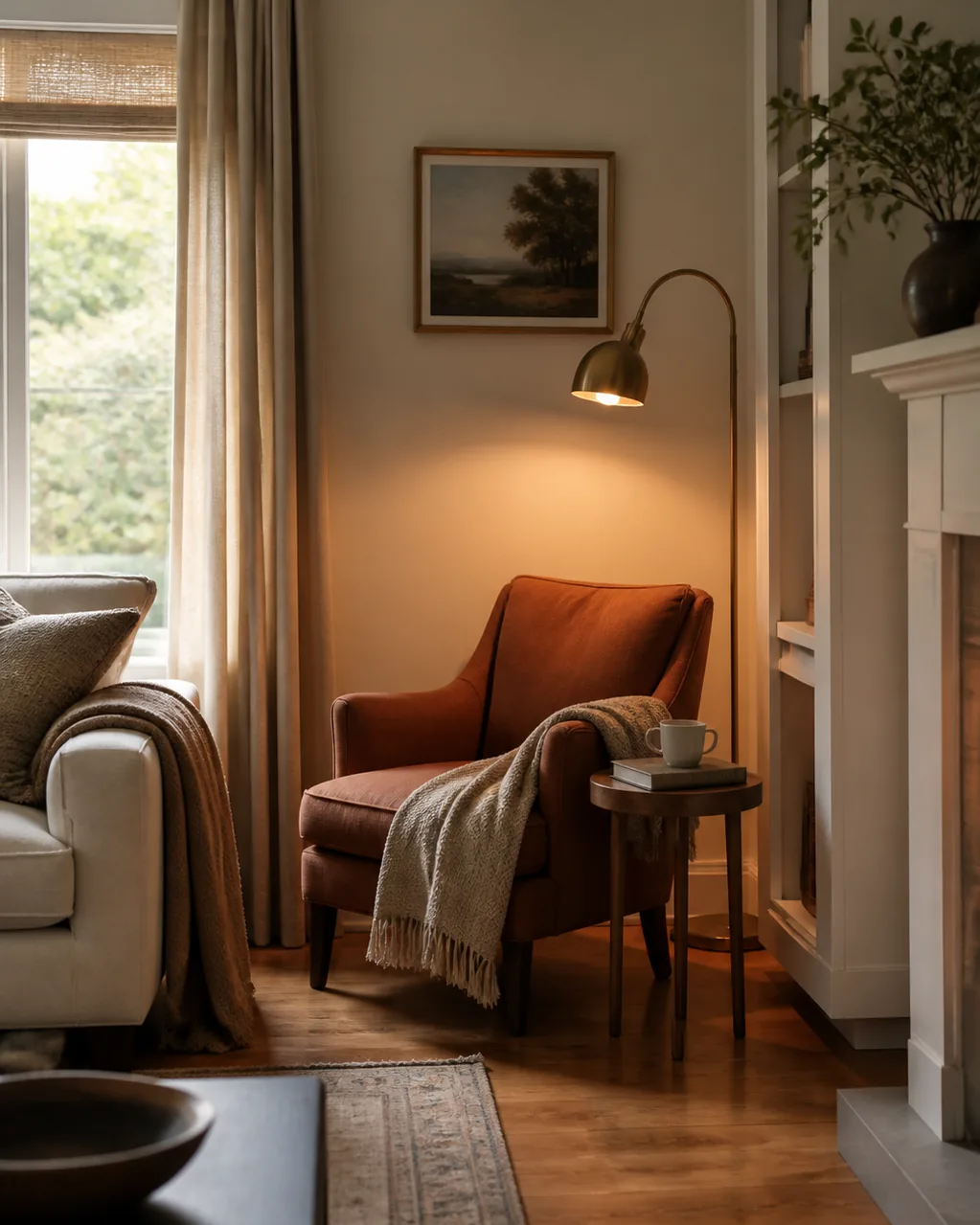
Carving out one corner for a dedicated reading chair, lamp, and side table gives the room a quiet counterpoint to the main seating group. It reads as intentional, and it gives anyone in the household a place to sit that is not the sofa.
- Position the nook away from the TV and main conversation area so it feels like a separate zone
- An upholstered chair in a warm fabric — olive, rust, or deep mustard — adds color without matching the sofa
- An arched floor lamp behind the chair provides task lighting without a side-table lamp crowding the surface
- A throw blanket draped over one arm signals comfort and softens the chair's outline
- The nook does not need a rug of its own; the room's main rug extending under or near the chair is enough
16. Style the mantel with an asymmetric arrangement
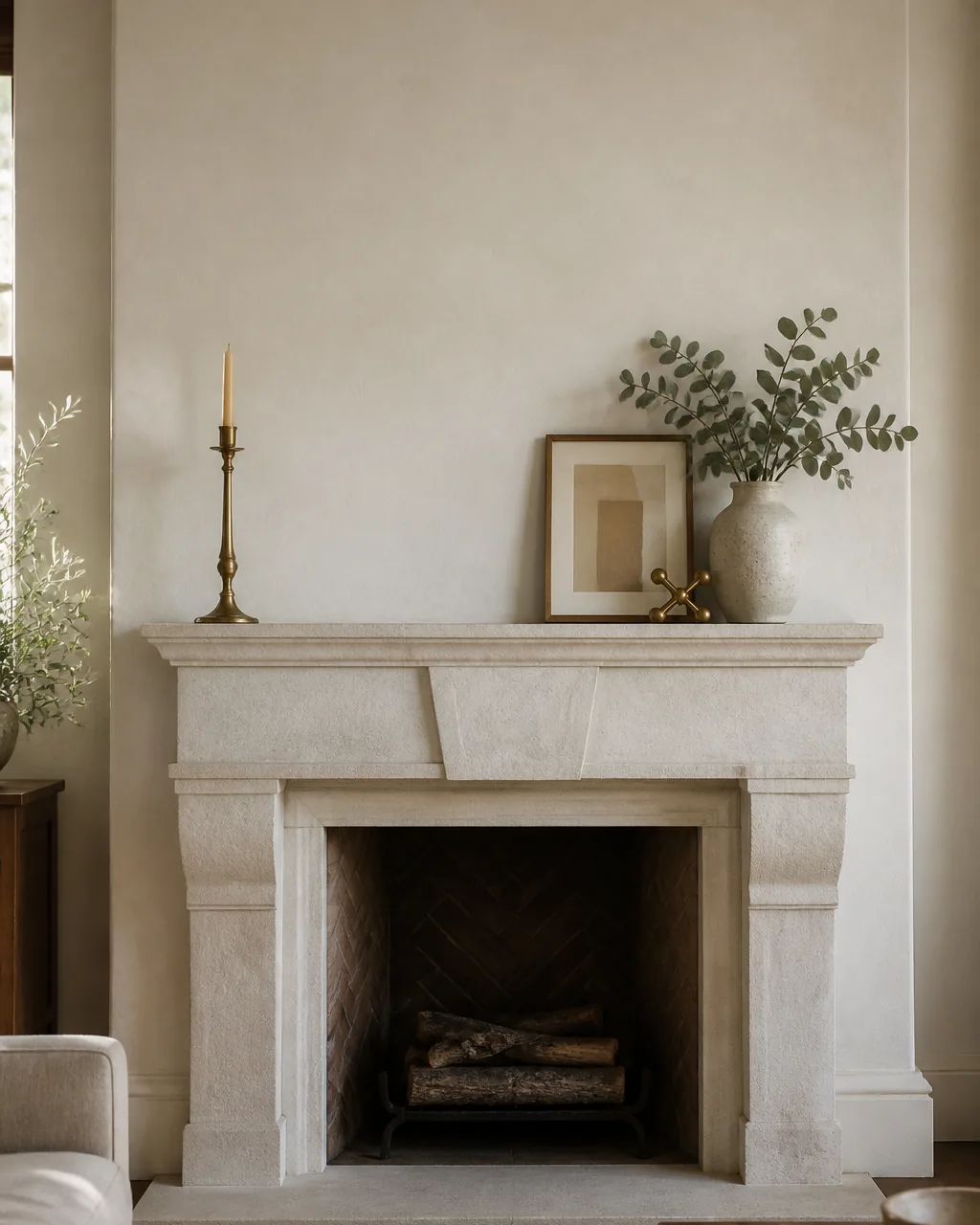
Matching candlesticks on either side of a centered mirror is safe but predictable. Asymmetric styling — one tall piece anchoring one end, a cluster of shorter objects on the other — creates movement and editorial polish.
- Start with the tallest object on one side (a candlestick, a vase, or a framed print propped vertically)
- Build a cluster of two to three shorter objects on the opposite side — a small print, a ceramic vessel, a brass object
- Leave the center relatively open so the eye moves across the mantel rather than locking onto the middle
- Odd numbers within the cluster (three objects, not four) feel more natural
- Dried stems or eucalyptus in the vase add organic texture without needing to maintain fresh flowers
21 Living Room Ideas at a Glance
- 1Float the sofaPull it six inches from the wall, add a console behind
- 2Two conversation zonesSplit seating into clusters facing each other
- 3Three light layersFloor lamp, table lamp, and overhead at warm tones
- 4Large area rugFront legs of all seats on the rug
- 5Wood accent wallVertical slats or shiplap behind the sofa
- 6Pillow texture mixBouclé with linen, same color family
- 7Floating shelf galleryStaggered heights, leaning art, trailing plant
- 8Statement pendantOne sculptural fixture replaces builder-grade light
- 9Round coffee tableBreaks angular monotony, easier traffic flow
- 10Console behind sofaDefines the living zone in open floor plans
- 11Curtains wide and highRod above frame, panels to the floor
- 12Leaning mirrorOpposite window to double natural light
- 13Oversized plantOne tree-scale plant in a woven basket
- 14Warm ceilingCream or blush instead of stark white
- 15Reading nookAccent chair, floor lamp, side table in a quiet corner
- 16Asymmetric mantelOne tall piece, clustered shorter objects opposite
- 17Layered rugsVintage pattern over neutral base rug
- 18Sheer linen panelsSoft diffused light, no heavy drapes
- 19Window benchSeating perch with hidden blanket storage
- 20Mixed wood tonesDark walnut with light oak, same undertone
- 21Woven wall hangingOrganic texture above the sofa
17. Layer a vintage rug over a larger neutral base rug
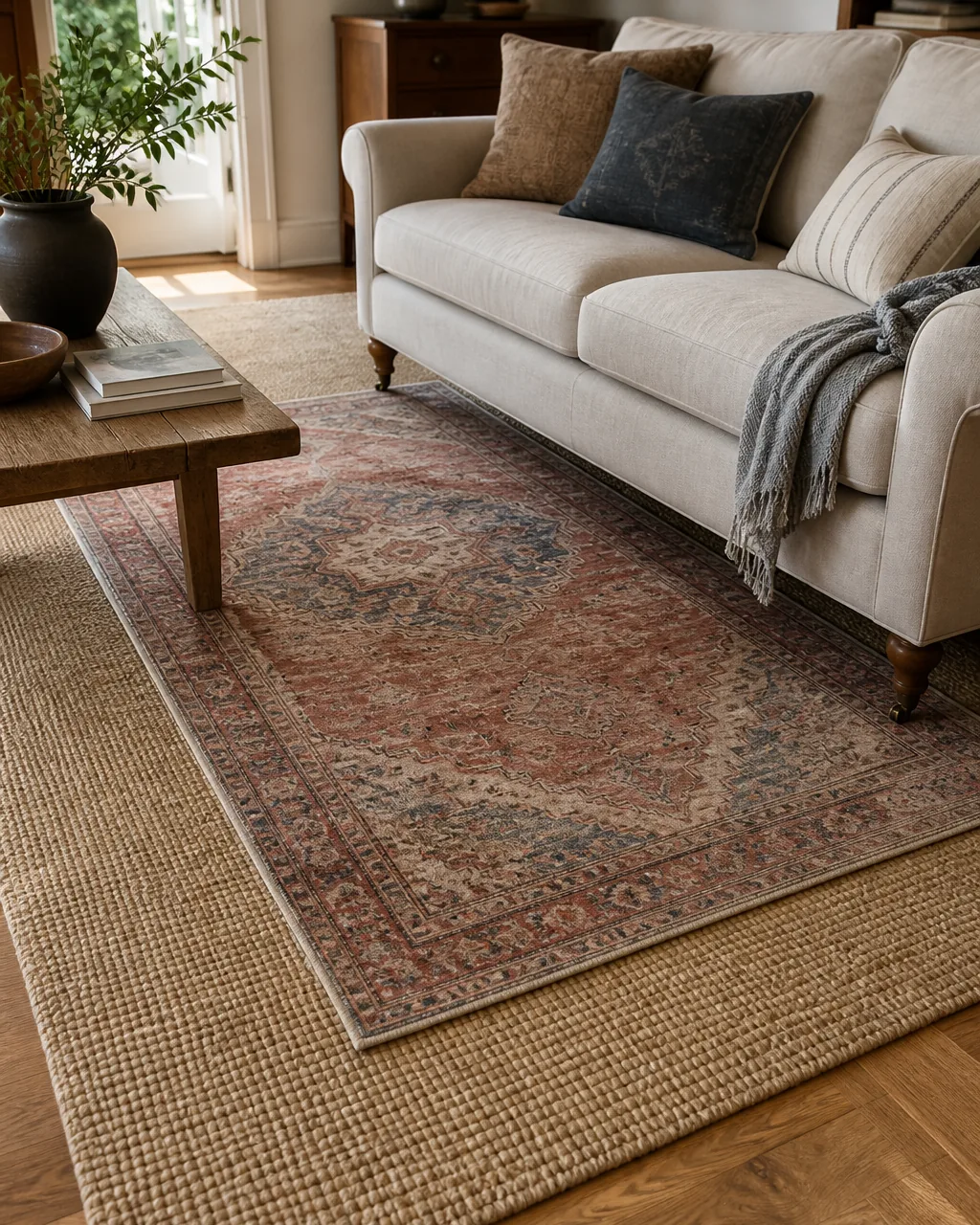
A single rug anchors the room. A second, smaller rug layered on top of it adds character, color, and the unmistakable look of a collected-over-time space rather than a one-trip-to-the-store one.
- Start with a large neutral base (jute, sisal, or a flat-weave in beige) under the full seating group
- Layer a smaller vintage or patterned rug on top, centered under the coffee table
- The layered rug defines a zone within the zone — it draws the eye to the center of the conversation area
- Contrast matters: a colorful medallion rug pops against a plain jute base; two busy patterns compete
- Vintage rugs with some wear actually look better layered because the fading reads as patina, not damage
18. Replace heavy drapes with sheer linen panels
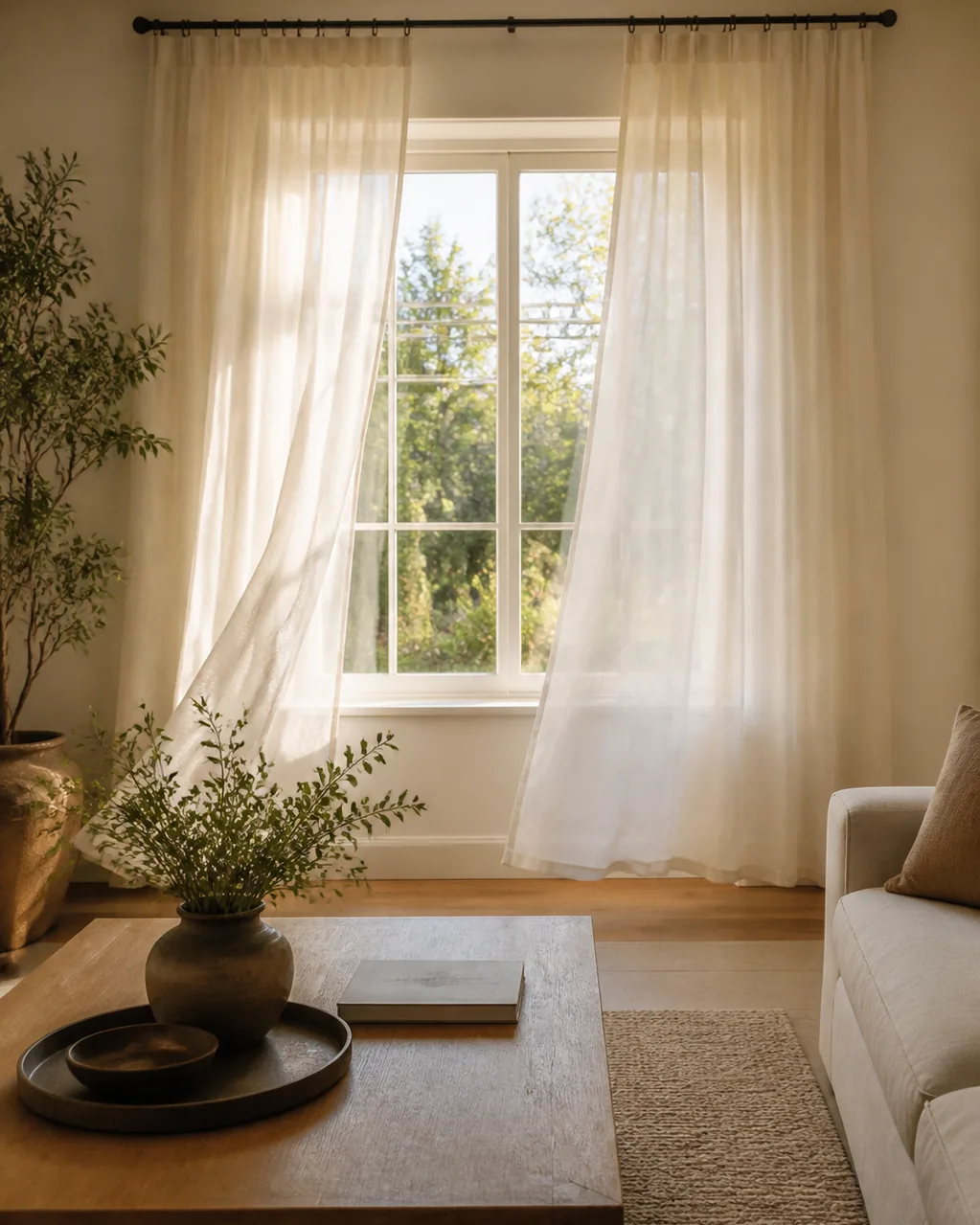
Heavy curtains add formality and block light. Sheer linen panels add softness and movement while letting daylight pour through, which is what most living rooms actually need.
- Off-white or natural linen sheers work in both modern and traditional rooms
- The gentle movement when a window is open adds life to the room that static drapes cannot
- Simple rod-pocket or ring-clip tops keep the look relaxed — no pinch pleats needed
- Sheers provide daytime privacy in ground-floor rooms without turning the room into a cave
- If you need blackout capability for a media setup, layer a blackout shade behind the sheers and use each independently
19. Add a window bench with hidden storage underneath
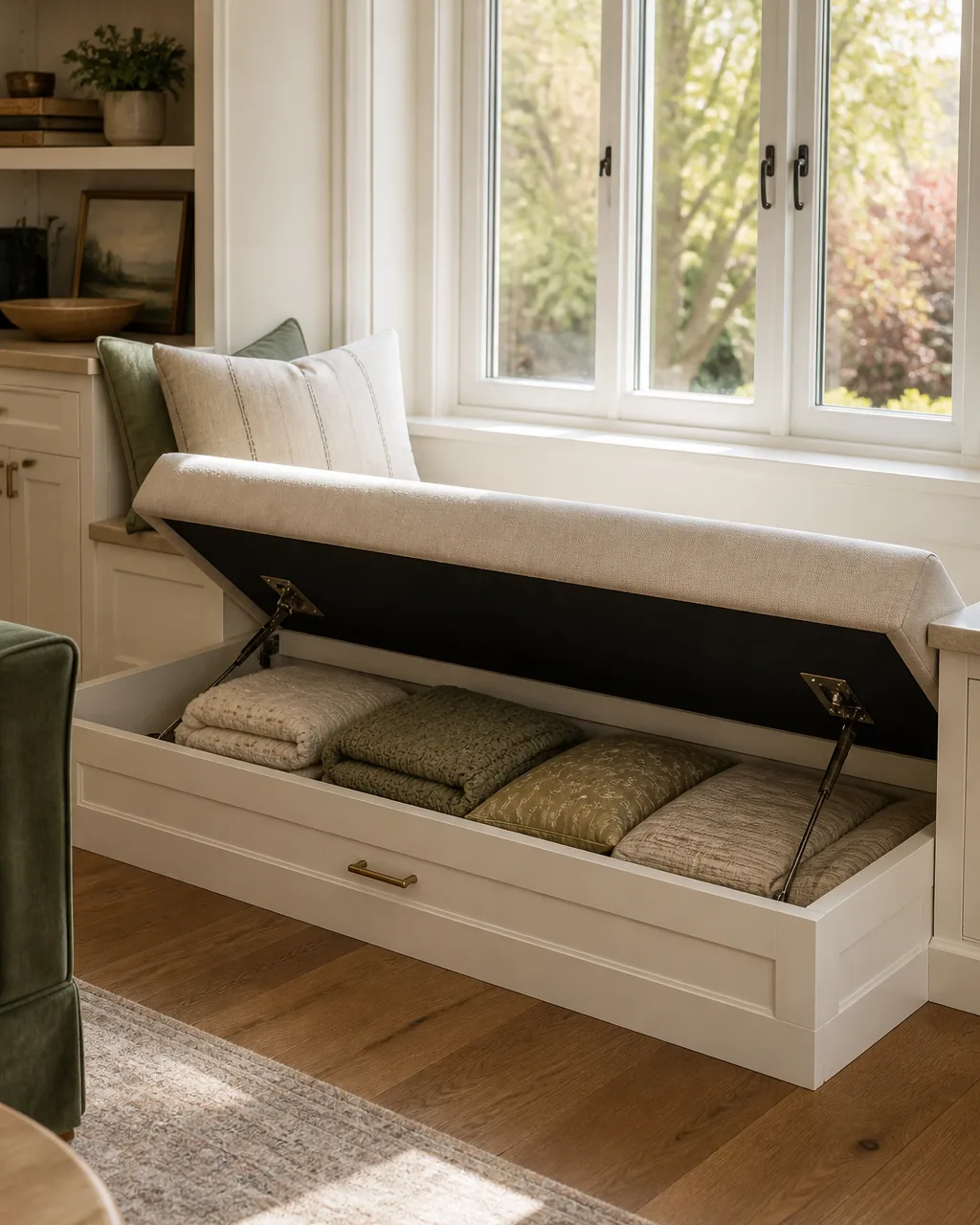
A window bench turns a wall that was doing nothing into a reading perch, an extra seat for guests, and a storage compartment for blankets and pillows that would otherwise pile on chairs.
- A bench 18 to 20 inches deep and 16 to 18 inches tall matches standard seat dimensions
- Upholstering the top cushion in a neutral linen ties it into the room's textile palette
- A hinged top with a piano-hinge mechanism opens smoothly and stays open while you reach inside
- Two or three decorative pillows on top signal that it is a seat, not a shelf
- Even in a rental, a freestanding storage bench (not built-in) gives the same effect and moves with you
20. Mix wood tones intentionally instead of trying to match
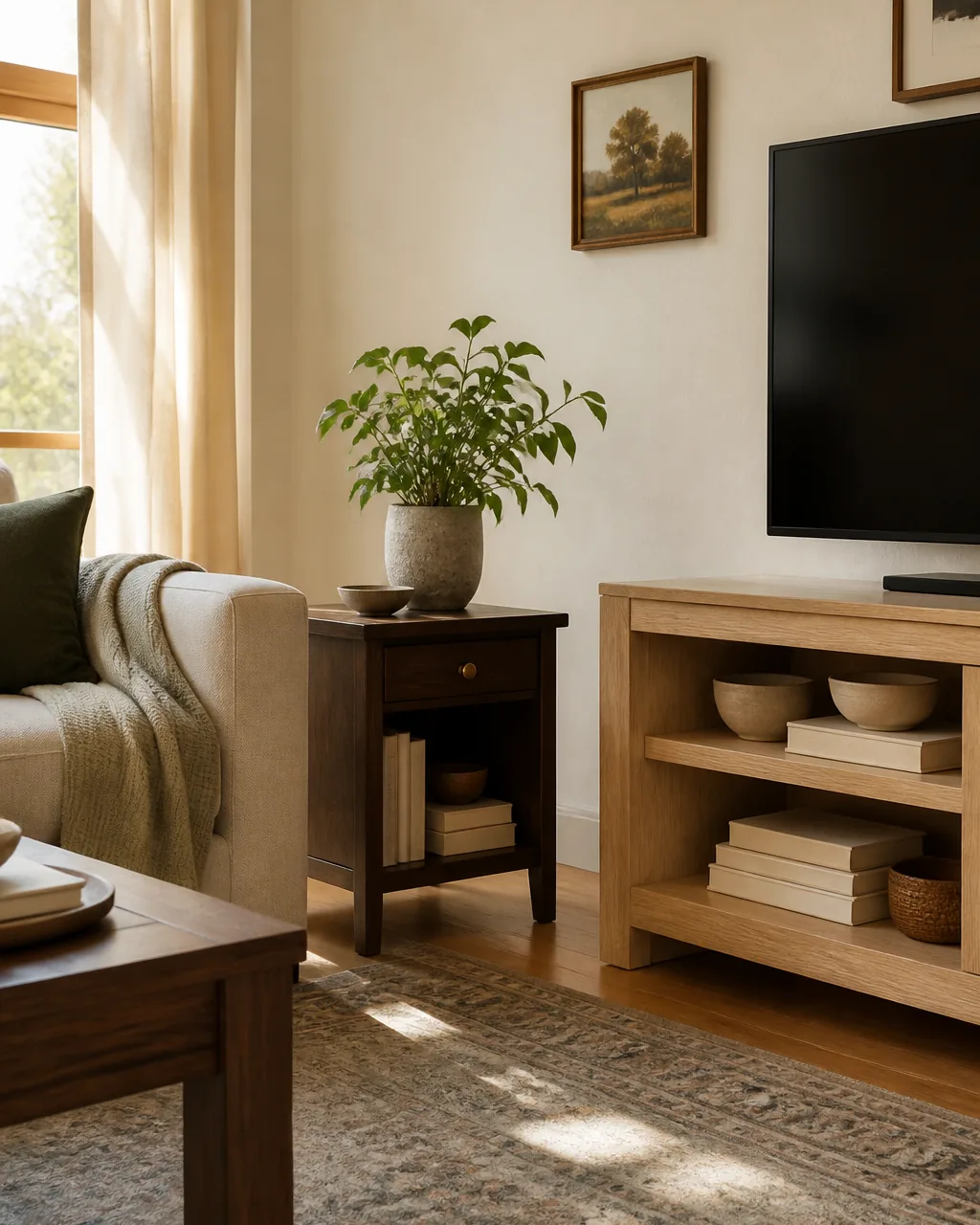
Matching every wood surface in a room is almost impossible and looks flat when you pull it off. Mixing two or three tones intentionally — dark walnut next to light oak, for example — adds depth and keeps the room from looking like a catalog set.
- The connection is undertone, not shade: warm walnut and warm oak work because both lean amber
- A cool gray-washed oak next to warm cherry clashes because their undertones fight
- Start with the largest wood surface (floor, media console, dining table) and pick a complementary tone for smaller pieces
- If you are working with Japandi living room ideas, mixed wood tones are central to the aesthetic
- Metallic legs (brass, black iron) on some furniture break up the wood and prevent the room from feeling like a cabin
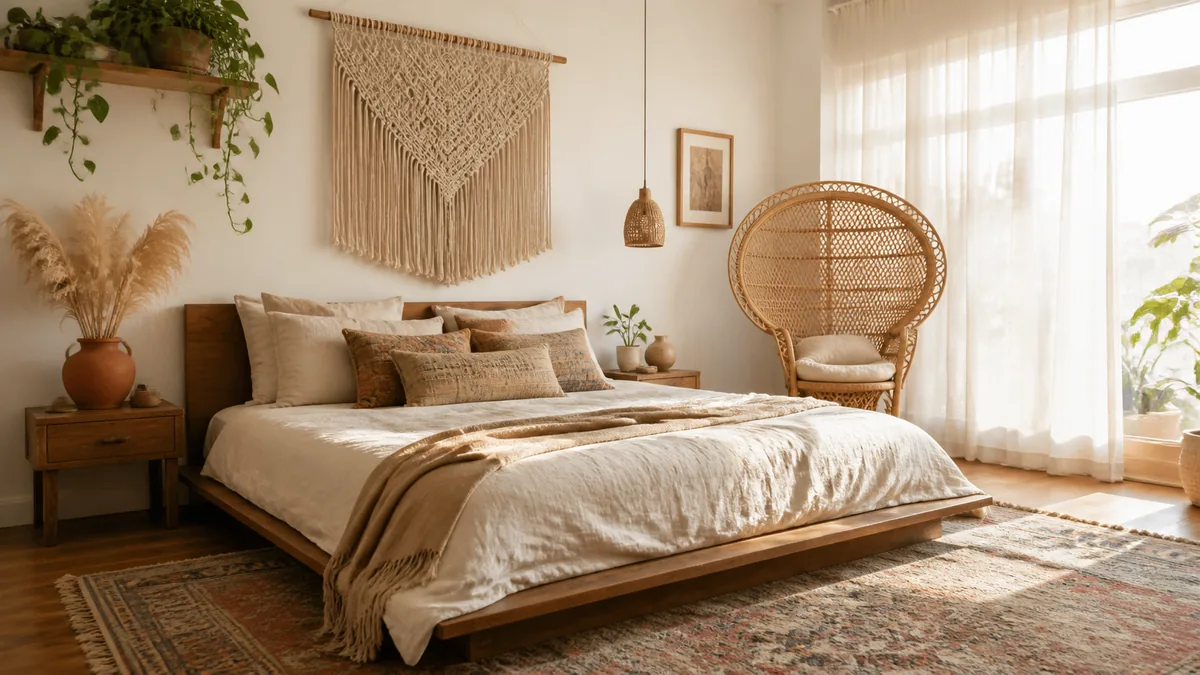
21. Add a woven or textured wall hanging above the sofa
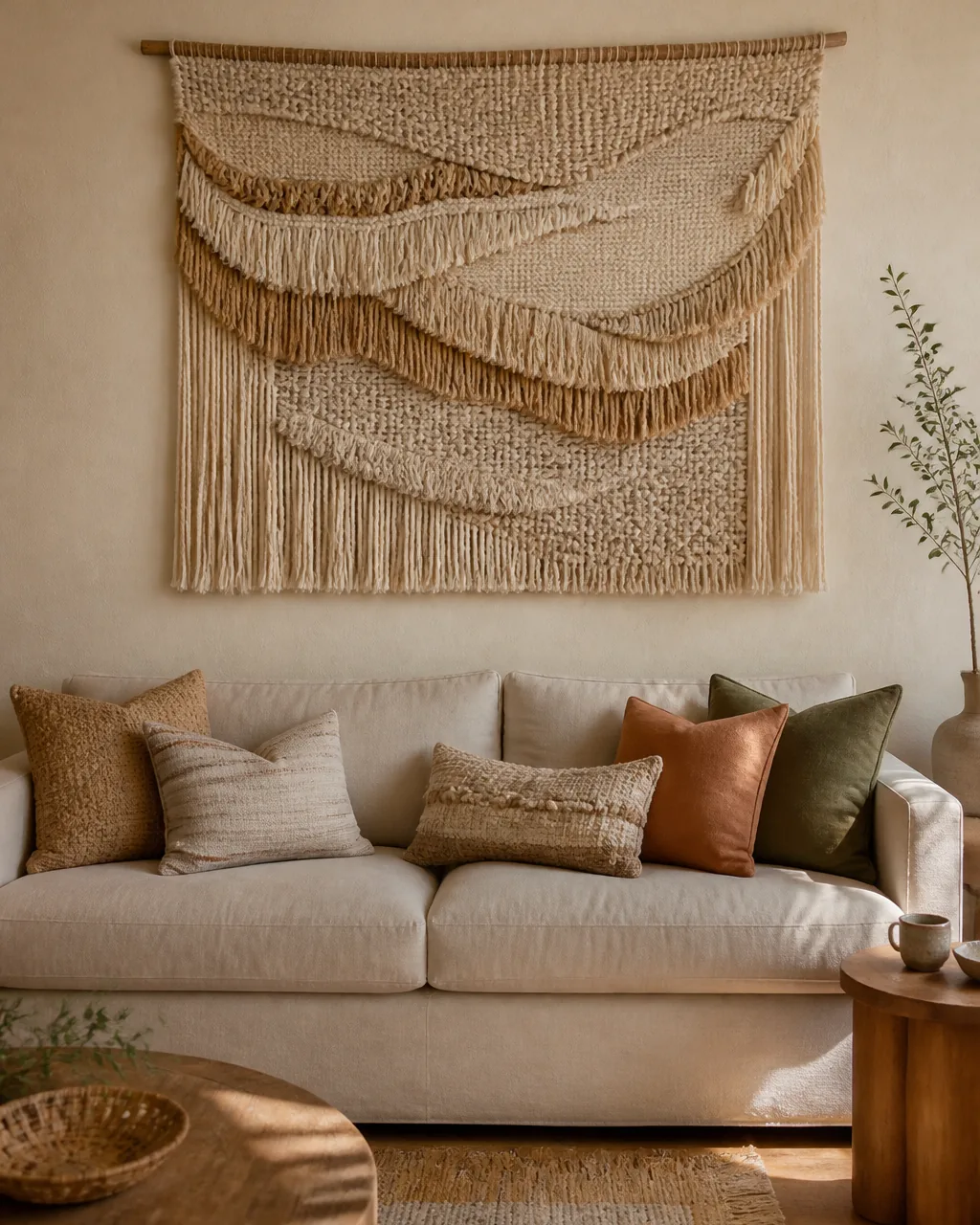
A flat wall behind the sofa is the biggest blank canvas in most living rooms. A woven wall hanging — macramé, a textured tapestry, or a fiber art piece — fills that space with dimension and warmth that a framed print cannot deliver.
- Scale the hanging to at least two-thirds the width of the sofa so it does not look lost on the wall
- Hang it 6 to 8 inches above the sofa back for a connected look
- Neutral fibers (cream, tan, clay) coordinate with almost any color palette
- The three-dimensional texture catches side light and casts subtle shadows that change throughout the day
- A wall hanging is lighter than a gallery wall arrangement and requires fewer holes — often just one or two brackets
- For more approaches to filling that wall, see living room wall art ideas
A living room that feels complete is not about buying twenty-one new things. It is about making deliberate choices with what you already have and adding just a few pieces that connect the room. Start with the idea that solves your biggest frustration — a rug that finally anchors the furniture, a lamp that fixes the light, or a pillow swap that warms up the sofa — and let the room build from there.