25 Small Apartment Organization Ideas That Maximize Every Inch
Small apartments don’t lose to a lack of space. They lose to wasted inches — bare walls, dead under-furniture gaps, the back of every closed door, and pieces of furniture that only do one job.
These are 25 small apartment organization ideas grouped into five directions you can actually act on this weekend. None of them require breaking your lease, drilling fifty new holes, or buying a single matching set of bins.
Skim the list, jump to the move you need first. Five directions, twenty-five specific apartment moves. None require breaking your lease.
- 1Floor-to-ceiling shelves
- 2Pegboard wall
- 3Wall-mount bike
- 4Leaning ladder
- 5Over-couch ledge
- 6Bed risers + bins
- 7Sofa-length drawer
- 8Flat under-couch bin
- 9Skip hard plastic
- 10Slim kitchen cart
- 11Door pocket organizer
- 12Hooks on door backs
- 13Kitchen cabinet door
- 14Bathroom cabinet door
- 15Door mirror + shelf
- 16Storage ottoman
- 17Entry bench lid
- 18Nesting tables
- 19Mismatched heights
- 20Drop-leaf table
- 21Double closet rod
- 22Cube storage mix
- 23Entry hook board
- 24Five-hook rule
- 25Mini pantry tower
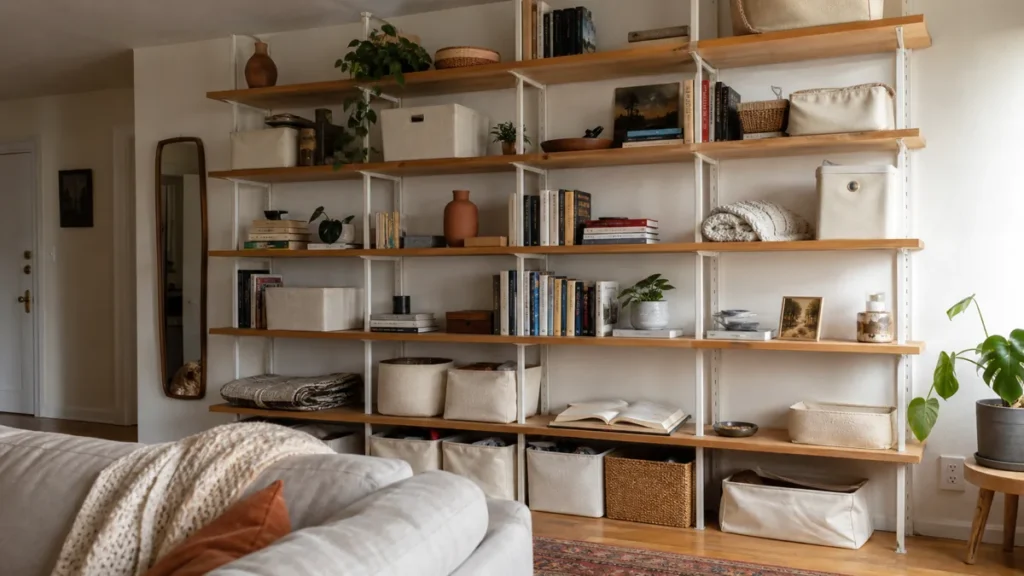
Mount Floor-to-Ceiling Shelves on a Bare Wall

The fastest way to add storage in any apartment is to use the cubic feet you already own — the air between the top of your existing furniture and the ceiling. A floor-to-ceiling shelving unit on a single bare wall gives you the storage of a small closet without taking floor footprint you don’t have.
Mix closed bins on the lower three shelves with open display higher up. Bins hide the visual chaos at sitting level; open shelves up high give the room air and stop the unit from reading like a warehouse.
Pegboard a Tight Kitchen or Hallway Wall

Pegboard is the most rearrangeable storage you can install in a rental. Two screws into a wall stud, and you have a surface that holds twenty different tools, baskets, hooks, and plants — in any layout you want, changed in seconds.
Mount it somewhere narrow you’ve been ignoring: the wall between the fridge and the doorway, a stretch of hallway, the side of a kitchen cabinet. Keep the heaviest items low and lean toward useful items, not decorative ones — pegboards earn their space when you actually grab from them.
Hang a Bike, Foldable Drying Rack, or Ladder High on the Wall

Big single-purpose objects — bikes, drying racks, step ladders — are the worst floor offenders in small apartments. They’re too useful to throw out and too big to ignore. So put them on the wall instead.
- Wall-mount your bike on a horizontal bike hook above eye level. A real bike-storage hook (not a generic shelf bracket) costs about $25 and holds 60+ lbs.
- Use a leaning ladder as wall-edge storage for blankets, scarves, or a towel rotation. It adds storage without adding a single drill hole — and it doubles as decor.
The wall above seated furniture is almost always wasted. That’s where these heavy items live now.
Add a Slim Over-the-Couch Storage Ledge

A 4-to-6-inch deep wall-mounted shelf above your sofa is one of those moves that costs almost nothing and changes how a room functions. It catches all the items that would otherwise live on the coffee table — a book mid-read, a candle, a small dish for your keys — and pulls them off the floor plane entirely.
Mount it high enough that nobody bumps their head sitting down (about 12-14 inches above the back of the sofa works). Keep it intentionally under-styled: three to five small objects, not a museum row.
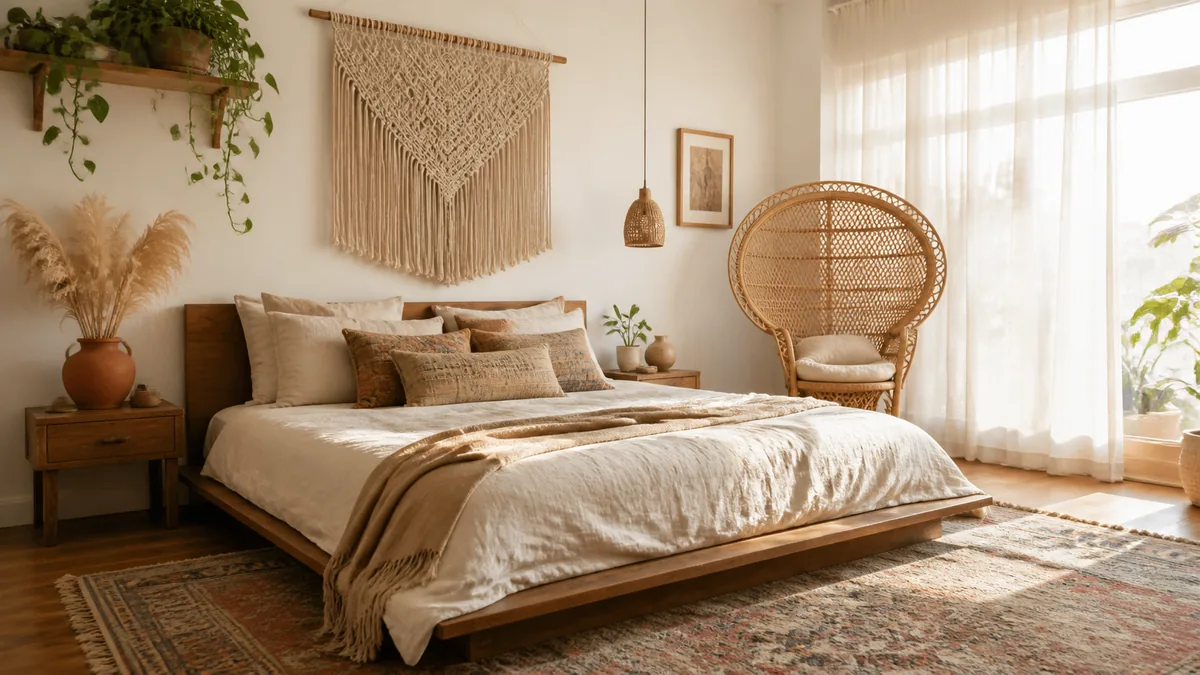
Lift the Bed Frame and Add Rolling Bins

A standard 14-inch bed gives you almost nothing underneath. A bed frame at 18-22 inches gives you most of a small dresser. Bed risers are the cheapest version ($15 for a set of four) and add about 5 inches — usually enough to slide rolling bins beneath.
Rolling bins matter more than static ones. You will not lift and reach into a bin under your bed every week. You will roll one out. The wheels are doing the actual work here.
You don’t need all twenty-five at once. Pick the row that matches what feels tight, and jump to the three or four moves that fix it.
Use a Sofa-Length Underbed Drawer for Off-Season Bedding

If you can swing it, a long sofa-length single drawer beats four small bins for the same volume. One pull, and the entire stockpile of winter quilts or guest bedding is in front of you. No reaching into the back, no forgetting what you have.
Buy a bed frame with this built in if you’re shopping, or retrofit with a single long drawer on casters. Keep it for things you actually access seasonally — not the bin where you bury what you don’t want to deal with.
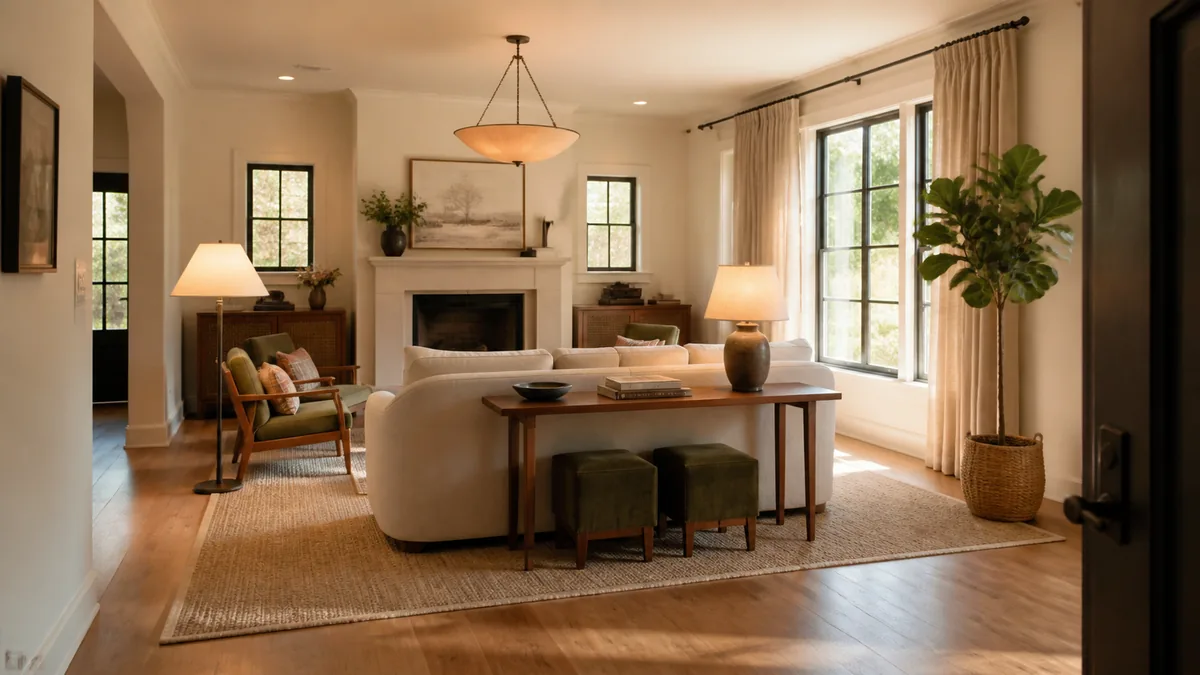
Slide Flat Bins Under the Couch

Most sofas have 3-5 inches of clearance to the floor. That’s enough for flat under-couch bins — the kind designed for under-bed but undervalued in living rooms. Use them for the awkward category of objects nobody knows where to put: yoga mats, board games, throw blankets you only use sometimes, magazines you actually read.
- Flat fabric bins with side handles that you can pull out with one finger.
- Skip the hard plastic for under-couch use; fabric collapses if you forget what’s inside, hard plastic doesn’t.
If you’re stockpiling more than one bin’s worth, the broader storage-ideas-for-small-spaces playbook maps where everything goes.
Tuck a Slim Cart Under the Kitchen Counter Overhang

Most apartment kitchens have a 2-3 inch lip at the toe-kick or counter overhang — just enough for a slim wheeled cart to slot under and disappear. This is the move when there’s no pantry, no walk-in storage, and no room for a free-standing shelving unit.
Pick the cart by depth, not by tiers. The depth has to clear the overhang and still let you roll it out. Three tiers is the sweet spot — top for daily use, middle for weekly, bottom for backup.
Add Over-the-Door Pocket Organizers Where No One Sees Them

Closet doors and bathroom doors are the most overlooked storage surface in any apartment because nobody walks past them looking for storage. Hang a clear pocket organizer on the inside of one, and you instantly have twelve to twenty small-item slots that don’t take a single square inch of floor or shelf.
Use clear vinyl, not opaque fabric. The whole point is being able to see what’s in each pocket without opening every one. If your closet door is glass or louvered, move it to the back of a bathroom door instead.
Mount Hooks on the Back of Every Door You Don’t Use

Every door in your apartment has two sides. The back is almost always doing nothing. Three to four flush-mount hooks turn each door into a small wardrobe — a robe and tote on the bedroom door, a towel and a robe on the bathroom door, a coat and a bag on the entry door.
Skip the over-the-door rack styles — they wobble and chip the paint. Mount actual hooks with two short screws into the door itself. If you’re worried about deposit, use the heavy-duty Command versions; the cleanest renters do this and don’t lose a dollar at move-out.
Most organization advice is written for people who own walls. Renters need rules that work in 500 square feet and don’t cost the deposit at move-out. These four hold up.
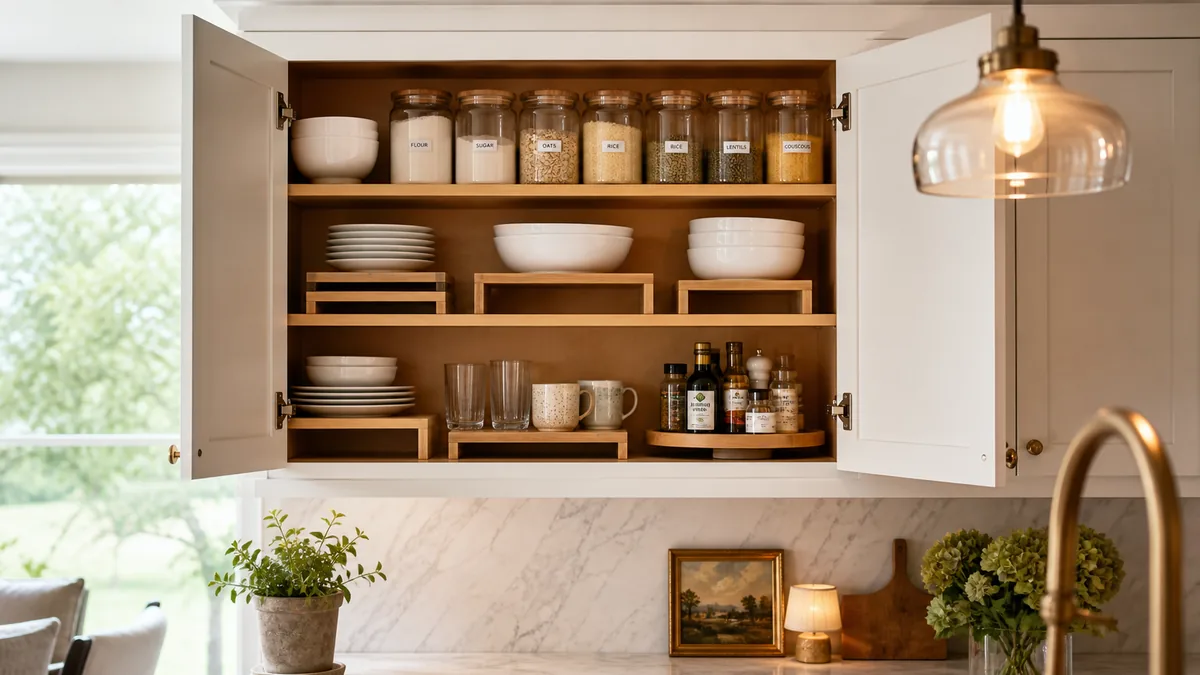
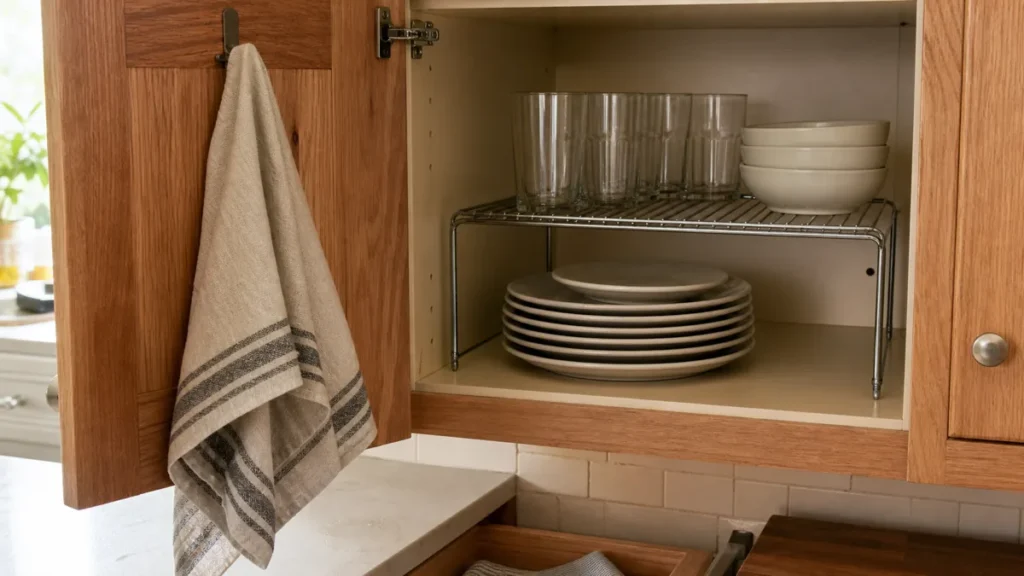
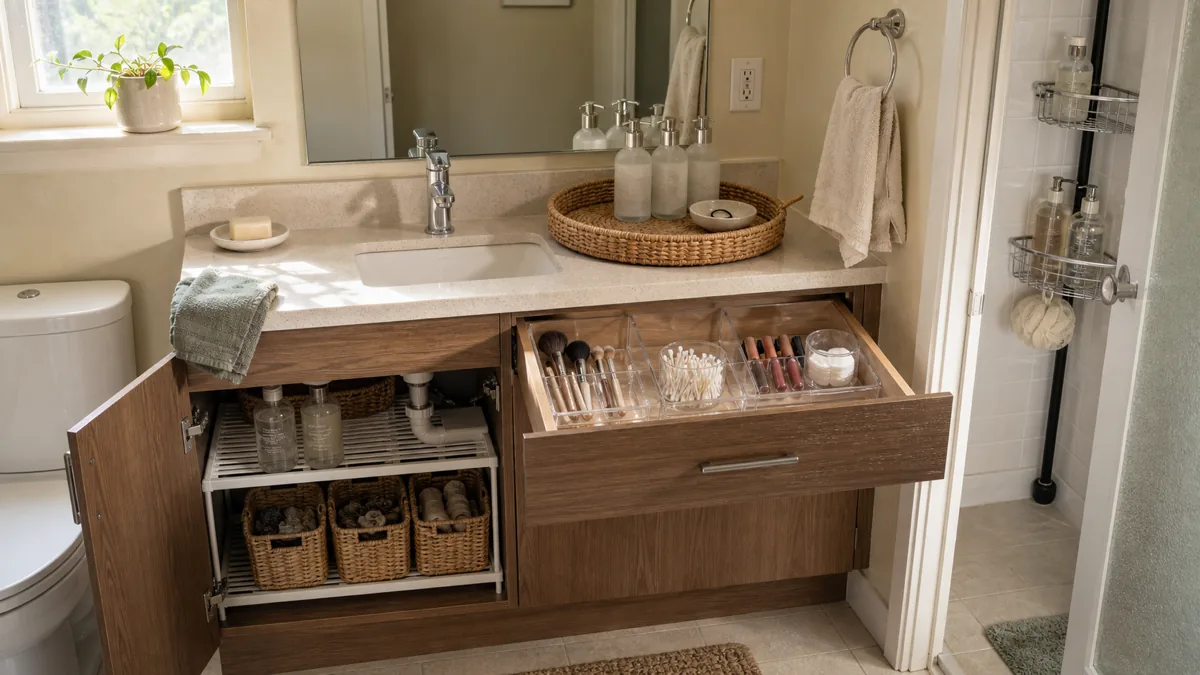
Use the Inside of Cabinet Doors for Small Tools

Cabinet doors are the unsung storage real estate of small kitchens and bathrooms. A wire-mesh or fabric door-mount organizer puts the items you use weekly (peelers, scissors, measuring spoons, hair ties, sunscreen) at hand level instead of buried in a drawer.
- Kitchen cabinet doors for small cooking tools that get lost in drawers.
- Bathroom cabinet doors for sunscreen, contact lens cases, hair ties, and small bottles that fall over on shelves.
Make sure the cabinet door has clearance to close. Measure twice — the organizer plus contents has to clear the front of any items on the shelf inside.
Hang a Door-Mounted Mirror with a Hidden Shelf

If you have a full-length mirror anywhere in your apartment and a door with no use behind it, those two facts can become one piece of storage. A door-mounted mirror with a hidden shelf behind it doubles the door’s job — a full mirror on one side, a slim apothecary shelf on the other.
These come pre-built (search “mirror cabinet door-mount”) or you can DIY with a tall slim cabinet and a mirror front. Either way, the items that live here should be ones you reach for in passing: small jewelry, a backup phone charger, a folded scarf, sunglasses.
Pick a Storage Ottoman That Doubles as a Coffee Table

Single-purpose furniture is the enemy of small apartment living. A coffee table that’s only a coffee table earns about 12 cubic feet of nothing. A storage ottoman that’s also a coffee table earns the same surface plus an entire bin’s worth of hidden capacity underneath.
Look for a flat hinged top with a deep cavity, and an upholstered surface that’s actually firm enough to set a drink on without it tipping. This is the single highest-value multi-purpose piece you can buy for a small apartment — and the best furniture for small spaces playbook has more buying logic for similar pieces.
Choose an Entryway Bench with a Hinged Lid

The entryway is the single highest-traffic, lowest-storage spot in most apartments. A bench with a hinged lid solves two problems at once — you have somewhere to sit while pulling on shoes, and you have a hidden bin for the four pairs of shoes nobody wants to look at on a rack.
Get a bench at least 18 inches deep — that’s the magic number for adult shoes. And put it close enough to the door that people actually use it; a bench three feet from the door becomes a coat-pile instead of a shoe-storage solution.
Buy a Nesting Table Set That Tucks Away

Nesting tables are the most flexible side-furniture piece in a small apartment because they expand only when you need them and disappear when you don’t. Three tables fanned out for a Saturday dinner with guests; nested into one footprint by Monday morning.
- A nesting set beats two stand-alone side tables for the same footprint.
- Different heights add visual interest on top of the storage flexibility.
Choose mismatched but related — the same wood tone, different shapes, slightly different heights. Three identical tables read more like a furniture store than a real home.
The 5-Direction Small Apartment Organization System
- 1Up the wallsFloor-to-ceiling shelves, pegboards, and wall mounts. The air above your furniture is free storage.
- 2Under the furnitureBed risers, rolling bins, flat under-couch storage. Five wasted inches per piece adds up fast.
- 3Behind the doorsPocket organizers, hooks, and inside-cabinet racks. Every closed door is unclaimed storage.
- 4Inside multi-purpose piecesStorage ottomans, hinged-lid benches, drop-leaf tables. One footprint that does two jobs.
- 5Through zone systemsDouble closet rods, cube storage, pantry towers. Each zone gets one purpose-built system.
styledhomenotes.com
Use a Drop-Leaf Dining Table Against the Wall

A full dining table in a small apartment is often the single biggest piece of furniture by footprint, and it’s empty 23 hours a day. A drop-leaf or wall-mounted folding table inverts that — folded flat against the wall when not in use (4 inches deep, basically a console), unfolded for actual meals.
Test the unfold mechanism before you buy. A drop-leaf that takes both hands to wrestle open will end up flat against the wall permanently. The good ones swing out and lock with one hand.
Build a Vertical Closet System with Adjustable Rods

Most apartment closets come with one hanging rod and a single shelf above. That’s about 30% efficient. Adding a second hanging rod below the first — using a $20 hanging double-rod extender — instantly doubles the hanging capacity for everything except full-length items.
The shelf above the upper rod is usually deeper than the rod itself. Use fabric bins instead of stacking loose items; bins keep their shape and stack against the back wall so you actually see what’s in the closet when you open the door.
Cube Storage for Books, Bins, and Display

Cube storage is unfairly maligned because of dorm furniture flashbacks, but the design is actually brilliant for small apartments — modular, mixable, and equally good at displaying and hiding. The fix for the dorm look is mixing what goes inside the cubes.
A 3×3 unit with all closed bins looks like a wall of cardboard. The same unit with three bins, three open books, and three single objects (a vase, a small lamp, a framed picture) reads like real furniture. Aim for roughly one-third closed storage, one-third open books, one-third single objects.
A Single Honest Hook Wall for Bags and Hats

A hook wall is the move when your entryway is too narrow for a coat closet and too small for a bench. Five hooks on a mounted board hold bags, hats, scarves, and the items that would otherwise pile on a chair or counter — without taking any floor space at all.
- Mount the hooks on a board first, then mount the board to the wall as one piece. It’s easier to align and easier to take down if you move.
- Five hooks is the magic number — enough for two people’s daily-use bags and hats, not so many that the wall reads cluttered.
Add a Mini Pantry Tower in an Awkward Corner

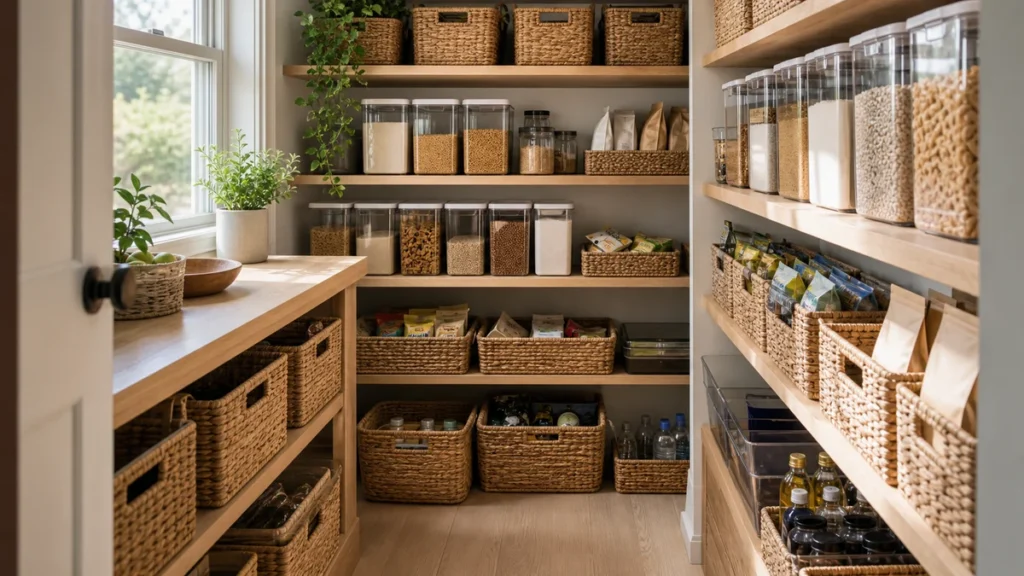
Most apartment kitchens have one awkward corner that’s too small for a normal cabinet but too big to ignore — the space between the fridge and the wall, the gap beside the stove, the dead corner where two walls meet. A narrow pull-out pantry tower (15-18 inches wide) was designed for this slot.
These come in two flavors: pull-out drawer towers (better — you see everything when you open it) and door-fronted towers (cheaper but you’ll lose track of what’s in the back). If you have the budget, go drawer. If not, the door version still beats the empty corner by a mile.