12 Studio Apartment Ideas to Make One Room Feel Like a Whole Home

In a studio, your bed, your sofa, your kitchen, and your desk all live in one room. What makes it feel like a home instead of one crowded box is not more square footage. It is drawing invisible walls.

Every idea here does the same quiet job: it carves the single room into zones, so each part feels like its own little space. A divider here, a rug there, a sofa turned the right way, and suddenly one room reads as several.

None of it needs a renovation, and most of it works in a small living room too. These are the twelve moves that do the most.

Jump to the studio idea
12 ways to zone a studio apartment

A studio feels like a home when one room reads as several. These twelve moves all draw invisible walls: a divider here, a rug there, a sofa turned the right way. Start with how you want to split the room and add the rest over time.

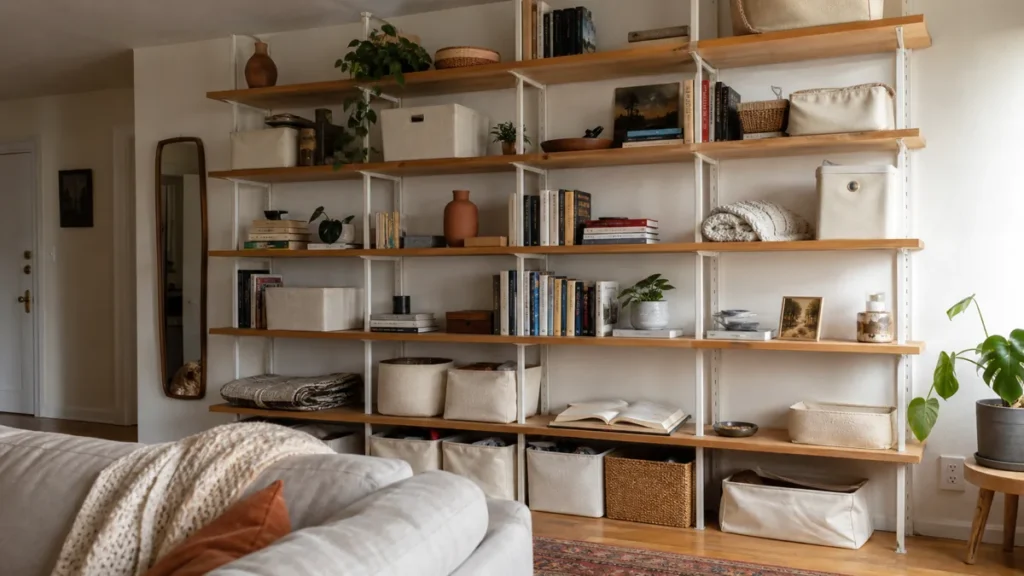
Zone It With an Open Shelf Divider

A low open bookshelf set sideways into the room is the cleanest way to split a studio without building a wall. Because you can see through the open back, it separates the sleep side from the living side while light still travels the whole room, so nothing feels boxed in. It earns its footprint twice by holding storage at the same time.

A studio apartment split by a tall open wood shelf set perpendicular to the wall, the bed zone visible behind it and the sofa zone in front, daylight passing through the open shelving filled with baskets and plants
  • Set the shelf perpendicular to the wall, between your bed and your living area.
  • Pick an open-backed unit so daylight still crosses the room.
  • Fill it with baskets and books so it divides and stores at once.

Curtain Off the Sleep Zone

When a shelf is too much, fabric is the cheapest wall there is. A curtain on a ceiling track pulls around the bed to make a private sleep nook, then slides open to give the floor back during the day. It is the most renter-friendly divider going, no construction and no holes in the walls.

A soft sage curtain on a ceiling track half-drawn around a made bed in a studio, creating a private sleep nook, with the sofa and living area visible beyond the curtain
  • Mount a ceiling track so the curtain drops cleanly around the bed.
  • Choose a soft, light fabric that filters rather than blocks the light.
  • Pull it closed at night for a sleep zone, open by day for space.

Float the Sofa as a Room Divider

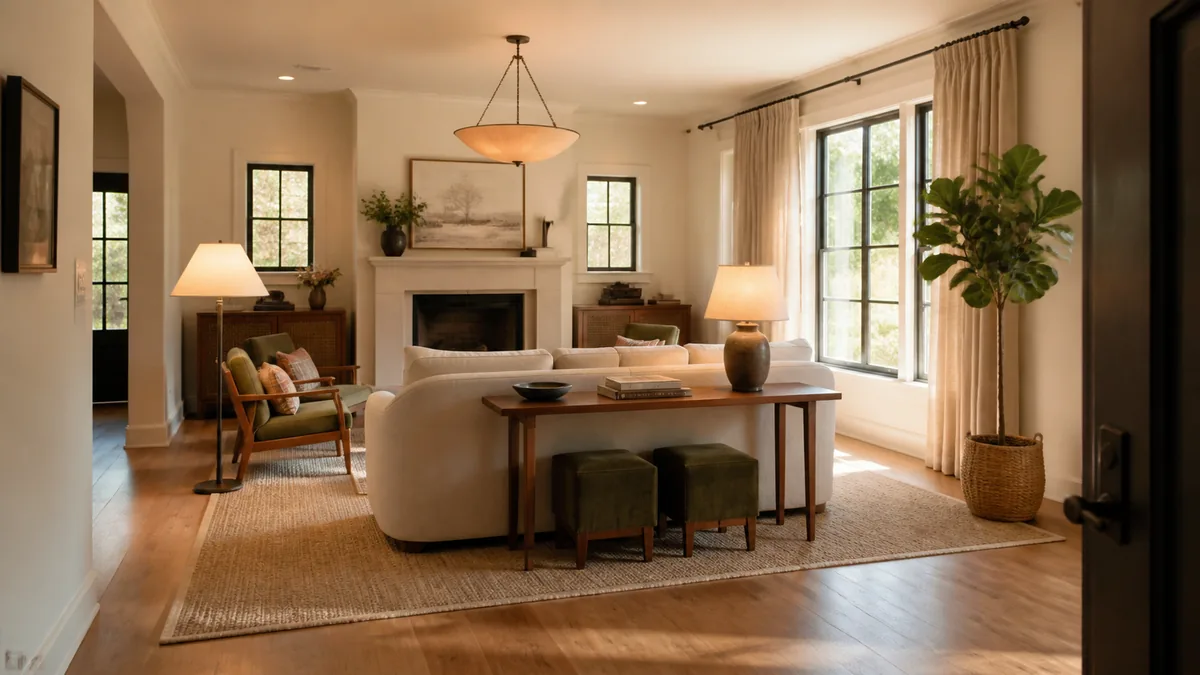
The biggest layout shift in a studio is pulling the sofa off the wall. Turn its back to the bed and face it toward the living area, and the sofa back becomes an invisible wall. On one side you have a bedroom, on the other a living room, with nothing but the couch drawing the line.

A studio where the sofa is floated in the middle of the room with its back to a made bed and its front facing a living zone with a coffee table and rug, the sofa back acting as a divider, a kitchenette behind
  • Pull the sofa away from the wall and turn its back to the bed.
  • Add a slim console behind it to firm up the divide and hold lamps.
  • Face the sofa into a rug-and-coffee-table zone so it reads as a room.
Pick what your studio struggles with most — start there, add the rest over time
Where should you start?

You will not do all twelve moves at once. Pick the problem below that matches your studio right now, and start with those two or three ideas.

It feels like one big undivided boxDraw the zones. Start at Idea 1 an Open Shelf Divider, turn the couch with Idea 3 Float the Sofa, and define the floors with Idea 4 Zone Rugs.
Your bed has no privacyScreen the sleep zone. Start at Idea 2 Curtain Off the Bed, raise it with Idea 5 a Lofted Bed, and tuck it behind Idea 1 an Open Shelf.
You are out of floor spaceGo up and double up. Start at Idea 7 Vertical Storage, pick Idea 6 Double-Duty Furniture, and reclaim the floor with Idea 5 a Raised Bed.
There is nowhere to workCarve out an office. Start at Idea 11 a Corner Work Nook, add Idea 8 a Fold-Down Desk, and light it with Idea 12 Zone Lighting.

Give Each Zone Its Own Rug

Two rugs do the work of two rooms. The eye treats each rug as the floor of a separate space, so even one open studio reads as a bedroom and a living room. Different textures or tones make the split look deliberate rather than like you ran out of one rug.

A studio with two distinct rugs marking two zones on one continuous floor: a soft cream rug under the bed area and a flat-weave jute rug under the sofa and coffee table
  • Anchor the bed on one rug and the sofa on another.
  • Vary the texture or tone so the two zones read as intentional.
  • Size each rug to its zone so the furniture sits on it, not beside it.

Raise the Bed to Reclaim the Floor

In a studio the floor is your rarest resource, so stack functions upward. A lofted or platform bed lifts the sleep zone and frees the space beneath for a desk, a dresser, or a reading spot. Even a low platform with drawers turns dead under-bed space into real storage.

A lofted wood bed in a high-ceiling studio with a desk, chair, and storage dresser tucked into the open space underneath, freeing the floor below the raised sleep zone
  • Lift the bed on a loft or platform to open the floor beneath.
  • Slide a desk or dresser into the reclaimed space under it.
  • Keep a low platform with built-in drawers if a full loft feels too tall.

Choose Double-Duty Furniture

Every piece in a studio should earn its footprint twice. A storage ottoman, a drop-leaf table, a sofa that folds out to a bed, each does two jobs in the space of one. The fewer single-use pieces you own, the more open the whole room feels. A few smart small-space furniture picks do most of the lifting.

A studio living zone with double-duty pieces: a daybed sofa with storage drawers underneath, a sage storage ottoman with its lid open showing storage, and a drop-leaf table folded against the wall
  • Pick a sofa or daybed with storage or a fold-out bed built in.
  • Use a storage ottoman as a coffee table, seat, and hidden bin.
  • Add a drop-leaf or nesting table that opens only when you need it.
What separates a studio that feels like a home from one that feels like a crowded box
A 4-rule system for laying out a studio

Making a studio work is less about buying more and more about how you divide the one room you have. These four rules are what make the twelve ideas come together instead of just filling the space.

Draw zones before you add anythingA studio reads as a home when the eye can tell where the bedroom ends and the living room begins. Decide the zones first, then mark them with what you already have: a shelf or curtain to separate the bed, a floated sofa as an invisible wall, a different rug under each area. Get the boundaries right and the room stops feeling like one undivided box.
Build up, not outThe floor is your rarest resource, so stack functions vertically instead of spreading them across it. Run storage up the walls, raise the bed to reclaim the space beneath, and lift the eye with tall shelving so the ceiling feels higher. Every job you move off the floor and onto a wall buys back open space, which is what makes a small room feel roomy.
Make every piece earn its footprint twiceIn one room there is no space for single-use furniture. Choose pieces that do two jobs, a storage ottoman, a sofa that folds out to a bed, a desk that folds flat to the wall, so you fit a whole home’s worth of function into a studio. The fewer things that only do one thing, the more open and calm the room stays.
Unify the look, light it in partsBecause the whole studio is visible at once, hold everything to one quiet palette so the single room reads cohesive instead of busy. Then light each zone on its own, a lamp by the bed, one by the sofa, one at the desk, so each area glows separately after dark the way real rooms do. One palette plus layered light is what ties a one-room home together.

Take Your Storage Up the Walls

When the floor is full, the walls are your next frontier. Tall shelving, over-door racks, and hooks draw storage upward and keep the floor clear, which is what makes a studio read as roomy instead of packed. Going vertical also pulls the eye up and makes the ceiling feel higher. It pairs well with the rest of your small apartment organization.

A wide studio wall with tall floor-to-ceiling shelving holding baskets, blank-spine books, and plants, plus over-door storage, the floor in front left clear, the bed zone to the left
  • Run shelving up toward the ceiling instead of out across the floor.
  • Add over-door racks and hooks for the space you usually ignore.
  • Store the everyday things low and the seldom-used things up high.

Add a Fold-Down Desk or Table

You cannot spare the footprint of a full-time table in a studio, so use one that disappears. A wall-mounted surface folds down to a desk or dining spot when you need it and back to a slim shelf when you do not. It gives you a work or eating zone without giving up the floor all day.

A wall-mounted fold-down wood desk in a studio deployed flat for use, with a laptop and a small chair, the made bed visible through a doorway behind it
  • Mount a fold-down surface at desk height on a clear stretch of wall.
  • Fold it flat when you are done so it reads as a slim shelf.
  • Pair it with a stackable or tuck-under chair to clear the floor fully.

Hang a Big Mirror to Double the Light

One large mirror is the cheapest way to make a studio feel twice its size. Placed across from the window, it bounces daylight back into the room and reflects the view, so the single space reads brighter and deeper. A leaning floor mirror does the same with zero drilling, which renters will appreciate.

A large wood-framed leaning floor mirror in a studio placed across from a bright window, reflecting the bed zone and daylight, visually doubling the room, a tall plant beside it
  • Place a large mirror opposite the window to bounce the daylight.
  • Lean a floor mirror against the wall to skip the drilling.
  • Angle it to reflect the brightest, prettiest part of the room.
Save this for later

12 Studio Apartment Ideas to Make One Room Feel Like a Whole Home

  1. 1Zone it with an open shelfA low open bookshelf set sideways splits the bed side from the living side while light still travels through. It divides and stores at once, the start of any styled small living room.
  2. 2Curtain off the sleep zoneA ceiling-track curtain pulls around the bed for a private nook and slides open by day. It is the most renter-friendly divider going, no construction.
  3. 3Float the sofa as a dividerTurn the sofa’s back to the bed and its front to the living area, and the sofa back becomes an invisible wall between two rooms.
  4. 4Give each zone its own rugTwo rugs do the work of two rooms; the eye treats each as a separate floor. Vary the texture so the split looks deliberate.
  5. 5Raise the bed to reclaim the floorA lofted or platform bed lifts the sleep zone and frees the space beneath for a desk, a dresser, or storage.
  6. 6Choose double-duty furnitureA storage ottoman, a fold-out sofa, a drop-leaf table; each does two jobs in the space of one. A few smart small-space furniture picks do most of the lifting.
  7. 7Take storage up the wallsTall shelving and over-door racks keep the floor clear and the ceiling feeling higher, the backbone of good small apartment organization.
  8. 8Add a fold-down deskA wall-mounted surface folds down for work or dining and back to a slim shelf, so you get the zone without giving up the floor.
  9. 9Hang a big mirrorA large mirror across from the window bounces daylight and reflects the room, making one space read brighter and twice as deep.
  10. 10Keep one calm paletteHold the bed, sofa, and storage to one quiet palette so the whole room reads cohesive, the same restraint behind any minimalist small space.
  11. 11Carve a work nook into a cornerA compact desk in a corner with a shelf above gives work a contained home, so the day has a clear start and stop.
  12. 12Light each zone separatelyA lamp per zone makes each area feel like its own room after dark; keep the lounge glowing while the sleep zone stays dim.

styledhomenotes.com

Keep One Calm Palette

Because the whole studio is on display at once, every clashing color shows up together. Holding the bed, sofa, and storage to one quiet palette of warm neutrals and wood lets the single room read as calm and cohesive instead of busy. One palette is the simplest thing that makes a small space feel intentional, the same restraint behind any minimalist small space.

A studio where the bed, sofa, storage, and dining chair all share one warm palette of cream, soft sage, and light wood, the single room reading cohesive and calm
  • Pick three or four quiet colors and let everything live inside them.
  • Repeat the wood tone across the bed, shelves, and table.
  • Add interest with texture, not with louder colors.

Carve a Work Nook Into a Corner

Working from home in a studio works better when “work” has a corner of its own. A compact desk and chair tucked into a corner, with a shelf above, gives you a real work zone that does not eat a whole wall. Containing the office to one spot means the workday has a clear start and stop, which matters when your desk and your bed share a room.

A compact wood desk and cane chair tucked into a studio corner with a floating shelf above holding plants and blank-spine books, a task lamp on the desk, the bed visible to the right
  • Claim one corner for the desk so work stays contained to it.
  • Add a shelf above to go vertical and keep the desktop clear.
  • Face the desk to the wall or window so the rest of the room disappears.

Light Each Zone Separately

Skip the single overhead and give each zone its own light. A bedside lamp, a floor lamp by the sofa, a task light at the desk, each pool of warm light makes its zone feel like a separate room after dark, the way real rooms have their own switches. You can keep the lounge glowing while the sleep zone stays dim.

A studio at dusk lit by layered lamps instead of one overhead: a warm bedside lamp, a floor lamp by the sofa, and a small desk task light, each zone glowing on its own with a city view in the window
  • Add a lamp to each zone instead of relying on the ceiling light.
  • Use warm bulbs so every pool of light feels soft and inviting.
  • Light only the zone you are using and let the others fall dim.

A studio starts to feel like a home the moment one room reads as several. Pick your zones first, mark them with a divider, a rug, or a turned sofa, then add the space-savers from there until the single room finally feels like more than one box.

About the author
Nora Ellis

Nora Ellis edits Styled Home Notes, where she shares practical decorating, organization, and small-space ideas for creating a more styled and functional home. Every article is reviewed for clarity, usefulness, image sourcing, and Pinterest-to-page alignment before publication. Visit the Nora Ellis author page.

Similar Posts