20 Bathroom Organization Ideas That Keep Every Surface Clean

Bathrooms collect chaos faster than any other room in the apartment. Products multiply (skincare plus cleanser plus serum plus sunscreen plus three toothpaste varieties), surfaces fill up overnight, and every Sunday clean ends with the same mess by Wednesday. The fix isn’t more storage. It’s mechanism design — where each thing lives, and how easy it is to put back.

These are 20 mechanism-first bathroom organization ideas you can copy this weekend, one zone at a time. None of them ask for a remodel, and most cost less than a single drugstore haul.

Jump to an idea
20 bathroom organization ideas at a glance

Skim the list, jump to the mechanism you want to copy first. Twenty ideas grouped from foundation moves to weekly maintenance — pick one zone per weekend until the whole bathroom runs itself.

Start with Counter Zero and a 90-Second Daily Reset

A vanity counter cleared of clutter except for a single round woven seagrass tray holding two cream pump bottles and a small ceramic dish, with a chrome faucet behind and a mirror reflecting a crooked hand towel

Every bathroom organization system starts with the same step: get the counter back to zero. Pull everything off, wipe it down, and put back only what you actually use daily — three to four items grouped onto one tray, nothing loose.

The tray is the system’s anchor. A woven seagrass tray with a low rim catches everything that would otherwise scatter — a pump bottle slides toward the back, a small ceramic dish holds the items that have no home (a hair tie, a single bobby pin), and a third bottle stands in front. That’s the counter when it’s running right.

  • The 90-second reset is what keeps it that way. Every evening before bed: rinse the dish, wipe the counter, return the bottles to the tray. It’s not a Sunday project. It’s a daily 90-second loop that prevents the mess from compounding.

Build an Under-Sink Tiered Shelf with Risers and Bins

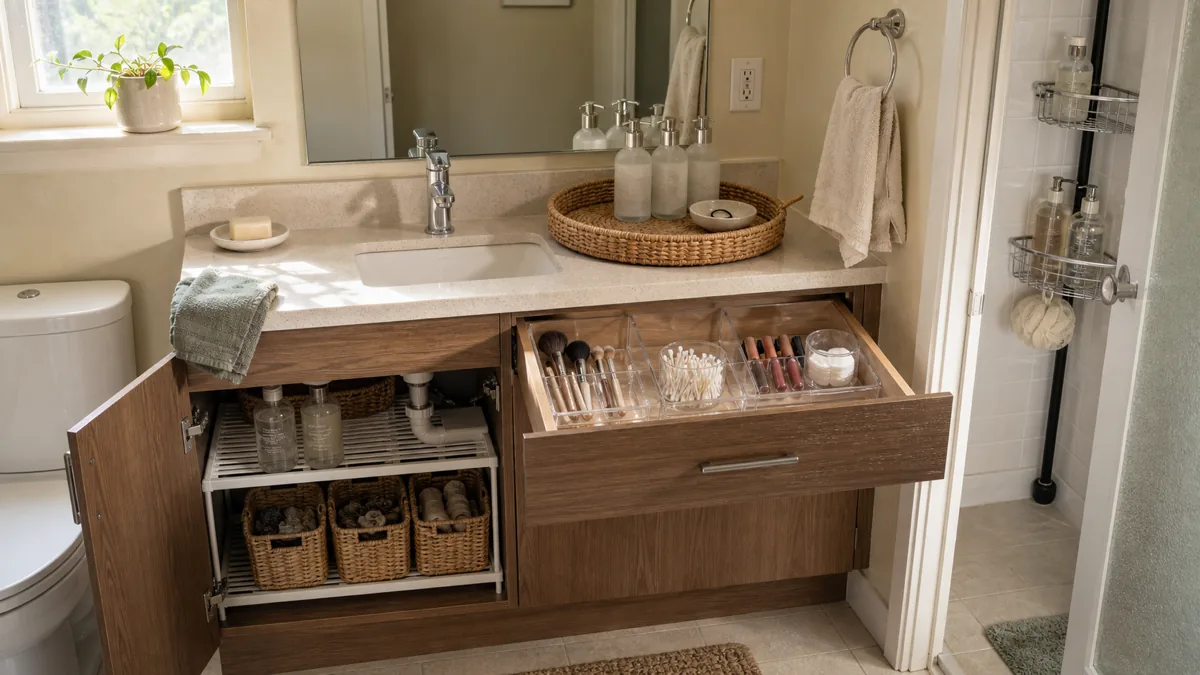
An open bathroom under-sink cabinet with both doors open showing a white wire two-tier riser framing the chrome P-trap pipe, the upper tier holding two clear bottles and a folded washcloth, three woven natural-fiber storage baskets lined up on the lower shelf

The under-sink cabinet is the most-wasted storage in most bathrooms. The P-trap pipe takes up the middle, the shelf height is too tall for half your bottles, and everything ends up in a jumble around the pipe. A wire riser with four vertical legs solves it in one move.

The riser sits over the P-trap so the pipe runs up through the open frame. The upper tier becomes a second shelf at half-height — the right height for tall pump bottles and a folded washcloth. The cabinet floor below the riser stays clear for woven baskets in a row, each holding one category.

  • The lower row of woven storage bins is the other half of this system. Three baskets, three categories: cleaning supplies on the left, extra hand towels in the middle, backup paper goods on the right. The baskets pull out by the rim — no rooting around for what you can’t see.

Add Floating Shelves Above the Toilet for Vertical Storage

A wall above a standard residential toilet with three warm-walnut wood floating shelves mounted at distinct heights against a cream-painted drywall, the lowest holding rolled cream towels plus a small terracotta succulent, the middle a woven basket of toilet paper plus a glass apothecary jar, the highest a small framed botanical line drawing plus a small green ceramic vase with dried eucalyptus and a folded sage washcloth

The wall above the toilet is the most under-used vertical real estate in any bathroom. Three floating shelves at distinct heights turn that wall into a small open pantry — towel storage, hidden paper-goods backup, and a few quiet decorative items that signal the room is cared for.

The shelves mount with hidden brackets (the brackets sit inside the wall, the shelf itself looks flush), so the visual reads as floating wood with nothing holding it up. The mechanism is invisible. The storage is real.

Stack the heaviest items low and the lightest items high — rolled hand towels on the bottom shelf, a basket of toilet paper plus a glass jar of cotton balls in the middle, a small framed print and a ceramic vase on top. If your living room or apartment is small enough that this kind of vertical thinking applies in every room, the broader storage-ideas-for-small-spaces playbook maps the same logic across the rest of the home.

Pick the worst zone first — everything else is easier after
Which bathroom zone is your worst chaos?

Bathrooms organize in zones, not all at once. Pick the zone that bugs you most every morning and start there — the other three will feel easier after the worst one is done.

Under-sink jumbleIf the under-sink cabinet is a pile of bottles around the P-trap pipe, start with the wire tier riser plus woven baskets (#3 and #4) and the lazy susan (#9). One Saturday afternoon, three mechanisms in place, that whole cabinet behaves.
Drawer chaosIf the top drawer is where cosmetics live in a pile and the middle drawer is a backup graveyard, start with compartment dividers (#8) and three-zone function dividers (#19). Two drawers, two systems, fifteen minutes each.
Counter overflowIf the counter never stays clear, start with counter zero plus the 90-second daily reset (#1 and #2), then add two functional trays (#13). The visible mechanism trains the habit; the habit keeps the counter clear.
Shower bottle pileIf the shower floor or ledge is a pile of half-empty bottles, start with a tension-pole caddy (#14) or a hanging shower-head caddy (#15). Pick the one your ceiling height allows; both add real storage with zero drilling.

Use Behind-Door Hooks and Over-Door Pockets for Renter-Safe Storage

The inside face of an open bathroom door showing a brushed chrome over-door hanger at the top holding a cream linen robe, a hair dryer with its cord wrapped, and a cotton mesh laundry bag; below it a cream cotton 8-pocket fabric organizer hanging from a second over-door hanger holding small items in each pocket; the door opening onto a hallway

If you rent, the back of the bathroom door is the storage you forgot you have. Two over-door hangers — one for hooks at the top, one for a pocket organizer below — and you’ve added the equivalent of a small linen closet without a single screw in the wall.

The hangers themselves are the renter-safe mechanism. Each one is a brushed chrome curved bracket that sandwiches the door between two arms — the door closes normally, the hangers stay put. When you move out, you slide them off. There’s no patching, no painting, no security deposit conversation. For the broader rental-safe organization playbook across every room of the apartment, the small-apartment-organization-ideas walkthrough covers more of the same logic at apartment scale.

  • The pocket organizer is the workhorse for everything small. Eight cotton pockets in a 2-by-4 grid hold the items you forget you own — a washcloth, dry shampoo, a hairbrush, a hand mirror, a packet of bobby pins, medical tape, a spray bottle, a folded hand towel. Twelve seconds to find any of them. They’re not in a drawer. They’re on the door.

Divide the Top Drawer with Compartment Trays for Cosmetics and Tools

A bathroom vanity top drawer pulled fully open shown from directly above with six warm-walnut wood compartment dividers organizing five lipsticks standing vertically, dense cotton swabs on end, stacked cotton pads, three horizontal makeup brushes, a small pile of bobby pins, and three lip balm tubes lying horizontally

The top vanity drawer is where cosmetics either find a system or live in a pile. Compartment dividers — wood, acrylic, or rigid plastic, whichever fits your drawer height — turn that drawer into six small rooms instead of one big chaos zone.

Six is the right number. Two rows of three, with each compartment holding one category — lipsticks vertical, swabs on end, pads stacked, brushes horizontal, bobby pins loose, lip balms horizontal. The rule isn’t “everything matches.” The rule is “everything has its own walls.” Once you can see the structure, you stop digging.

Put a Lazy Susan Under the Sink for Bottles You Reach Daily

A bathroom under-sink cabinet open showing a 14-inch matte black metal lazy susan disc set in front of the chrome P-trap pipe, with five varied bottles arranged around the perimeter — a frosted glass pump, a tall clear plastic spray bottle, a brown apothecary glass with pump, a short opaque white pump, and a tall amber-clear glass with cork stopper

A lazy susan inside the under-sink cabinet pulls all your daily-reach bottles into a single rotating ring. Instead of reaching behind the front row for the bottle in the back, you spin the disc and the back becomes the front.

Five or so bottles around the perimeter is the right load — any more and they crowd each other, any fewer and the disc looks under-used. Mix the bottle forms (a pump, a spray, a pour-cap) so each one reads at a glance. The susan rotates on a center post; the disc spins; the back row stops being a graveyard.

Stack Tiered Bins in the Linen Closet by Use Frequency

An open apartment linen closet with three painted wood shelves, the middle shelf holding three woven natural-fiber bins stacked in clearly graduated sizes — a large 16-inch bottom bin, a medium 12-inch middle bin, and a small 8-inch top bin — creating a staircase silhouette; the upper shelf holds folded cream face towels on the left and folded sage hand towels on the right; the lower shelf holds two folded sage bath sheets

Linen closets fail when everything sits at the same height. A stack of three graduated bins on the middle shelf solves that — the smallest bin on top, medium in the middle, largest on the bottom — creating a visible staircase of access.

Use-frequency matches the size order. The top (smallest) bin holds the items you reach for least — backup toiletries, small spare items. The middle bin holds weekly-use items — folded hand towels, washcloths. The bottom (largest) bin holds the bulky everyday categories — rolled washcloths, a spray bottle, the items that need volume.

Folded towels stack above and below the bin tier. The closet stops feeling like a black hole and starts behaving like a small grocery shelf.

What keeps bathroom systems from drifting back to chaos
A 4-rule system for bathroom organization that lasts

Most bathroom-organization projects fail two weeks after the initial Saturday. These four rules are what separates a system you re-do every six months from one that runs on its own for years.

Mechanism beats minimalismA wire riser with visible legs, a drawer divider you can see through, a lazy susan that visibly spins — the mechanism does the work. Empty surfaces don’t. The “less stuff” version of organization breaks the moment one bottle comes back. The mechanism version absorbs the bottle into its slot and keeps running.
Decant only what you actually use, not what you ownIf you decant every product into matching amber bottles you stop using half of them — the unfamiliar packaging breaks the recognition cue. Decant only the items you reach for every day. Leave occasional-use products in their original packaging. The decanted system stays small and gets used; an over-decanted system becomes a museum.
Containers match drawer depth, not aestheticA beautiful set of tall canisters that don’t fit your drawer is a guarantee they end up on the counter as clutter. Measure your drawer height first, then buy containers that fit with at least half an inch of clearance above the lid. Function-fit beats matching-set every time.
One-in-one-out is the only sustainable ruleWithout it, the bathroom drifts back to chaos in six months because product accumulation is the actual problem — not where things live. A new product can enter only when its category counterpart leaves. The system stays at constant volume. The counter stays at three items. The rule does the maintenance work for you.

Decant Daily Essentials into Open Glass Canisters and Roll Containers

A bathroom counter close-up showing three plain unembossed clear glass canisters with visibly open tops holding cotton swabs standing on end, loose cotton balls, and stacked cotton pads, plus one tall cream paper-tube container with an open top revealing a wooden roll core wound with cream muslin makeup-remover cloths, all in soft morning daylight

Three things keep you from using your daily essentials: the bag they came in, the box they came in, and the lid you have to unscrew. Decant them. The transformation costs you twenty minutes once and saves you ten seconds every day for years.

Glass canisters with open tops (no lids) hold the daily cotton items — swabs on end, balls loose, pads stacked. You don’t unscrew anything. You don’t dig. You see what you have and you grab.

  • For items that come on a roll — muslin makeup-remover cloths, cotton bandage rolls, anything wound around a core — use a tall open paper tube container that lets the roll sit inside vertically with a tail of fabric peeking out the top. Grab the tail, pull the next cloth, the roll unwinds itself.

Zone the Counter with One Tray per Function

A bathroom vanity counter shot from a slight overhead angle showing two distinct trays separated by a clear counter gap — a left warm-walnut rectangular tray holding three skincare items (a tall frosted pump bottle, a medium frosted jar, a small clear dropper bottle) and a right round warm-walnut tray holding three oral-care items (a clear glass cup with two toothbrushes vertical, a small frosted jar of floss, a small cup with interdental brushes); chrome faucet centerback

If one tray works for daily essentials, two trays work for two routines. The counter splits cleanly into a skincare zone and an oral-care zone — left tray and right tray, with a clear gap between them so the boundary is visible.

The skincare tray holds the morning-and-evening face routine: a serum, a moisturizer, a treatment oil. The oral-care tray holds the twice-daily mouth routine: toothbrushes upright in a glass cup, floss in a small jar, interdental brushes in a smaller cup. Each tray’s low rim contains its zone — items don’t migrate, the categories don’t blur, and the visual logic of the counter teaches the routine.

Upgrade the Shower with a Tension-Pole Caddy or Hanging Caddy

A shower stall framed by cream subway tile walls showing two caddy systems simultaneously — a matte black metal tension pole running from ceiling to floor in the left corner with four wire baskets attached at distinct heights holding shampoos, conditioners, body washes, a loofah, and a bar of soap with a razor; on the right a brushed-chrome 2-tier caddy hanging from the shower head via two visible chrome S-hooks looping over the shower arm, holding more bottles and a body brush

Showers usually offer one tiny built-in soap dish and zero other storage. Two caddy systems fix that without drilling, and the right one depends on your shower’s geometry.

A tension-pole caddy runs floor-to-ceiling in one corner. The pole presses against the ceiling at the top and the floor at the bottom — the pressure holds it in place — and four wire baskets attach along the pole at different heights. That handles a multi-person shower easily (top basket for one person’s shampoos, lower basket for another’s).

  • A hanging shower-head caddy is the alternative for showers without floor-to-ceiling clearance. Two S-hooks loop over the shower head arm and a 2-tier wire caddy hangs below. It holds half the volume of a tension pole but installs in 30 seconds and works in any shower geometry. Pick one or run both if you share the shower with somebody who has very different products.

Display Towels on a Wall Ladder or in Rolled-Stack Cubbies

A warm-walnut wood leaning ladder propped against a cream-painted drywall in a bathroom corner at a clear 75-80-degree angle, the top resting against the wall and the bottom feet about 8 inches forward on the tile floor creating a visible leaning triangle, four rectangular rungs holding one folded sage face towel on top, one rolled cream hand towel on the second rung, two rolled cream towels on the third, and a larger cream rolled bath sheet on the bottom; an adjacent wood vanity at right with a small plant on top

A leaning wood ladder against the wall is the most space-efficient towel display in a small bathroom. It needs zero hardware — gravity and friction hold it up — and it stores four to six towels in less than two square feet of floor.

The leaning angle is the whole mechanism. The top rests against the wall, the bottom feet sit forward on the floor about eight inches, and the resulting triangle is what keeps the ladder stable. Stack the rungs with mixed forms — a folded towel on top, a rolled hand towel, two rolled body towels, a single bath sheet on the bottom. The varied silhouette reads as deliberate, not random.

Save this for later

The 5-Zone Bathroom System

  1. 1CounterOne woven tray with three to four grouped daily items — pump bottle, small dish, lip balm. The 90-second evening reset keeps it that way.
  2. 2DrawersTop drawer: six-compartment dividers for cosmetics and small tools. Middle drawer: three function zones (daily / weekly / backup) divided by tall wood walls.
  3. 3Under-sinkWire tier riser over the P-trap pipe, three woven baskets on the cabinet floor, lazy susan in front for daily-reach bottles. Three mechanisms, one cabinet.
  4. 4ShowerTension-pole caddy in one corner if you have full ceiling clearance, or a hanging shower-head caddy with S-hooks over the arm. Zero drilling, real storage.
  5. 5Linen + doorLinen closet: three graduated bins on the middle shelf, folded towels above. Bathroom door: over-door hooks at top, over-door pocket organizer below.

styledhomenotes.com

Label Every Decanted Bottle for 5-Second Recognition

A close detail shot of three amber-colored glass pump bottles in a row on a warm-walnut wood tray, each bottle wearing a cream-colored rectangular adhesive label showing only a single icon — the left bottle has a hand-drawn water-drop icon, the middle bottle has a single 3-lobed leaf icon, the right bottle has a 5-tooth flat comb icon; matte black plastic pump tops; soft warm daylight from a left-side window highlighting the amber bottle shoulders

The moment you decant shampoo into a generic amber bottle, you lose the recognition cue. Three identical amber bottles look identical. The fix is a single icon on each label — drop, leaf, comb — that reads in half a second from across the bathroom.

The icons skip the reading step entirely. A drop means liquid soap or face cleanser. A leaf means anything plant-based or for hair. A comb means hair-and-styling. You don’t read the label. You see the shape. Your hand reaches before your brain finishes the sentence.

This is the difference between a beautiful decanted system you stop using after two weeks and one that runs for years. Without the icons, you’re guessing — and guessing is what makes people give up and switch back to the supermarket bottles.

Follow a One-In-One-Out Rule for Every Product Category

A bathroom counter showing a one-in-one-out exchange — a crisp white cardboard product box on the left with a brand-new frosted-glass pump bottle peeking out the open top, a clearly-worn cream squat squeeze bottle in the center-right showing discoloration near the cap and a peeling label corner, with a warm-walnut tray of other bottles in soft-focus background waiting

The reason your bathroom drifts back to chaos is product accumulation. You buy the new serum before finishing the old one. The old one stays “just in case.” Six months later, the cabinet has three half-empty bottles of the same category and zero room for anything else.

The one-in-one-out rule fixes it permanently. A new product can only enter the bathroom when an old one in the same category leaves it. Buy the new serum, finish or toss the current serum the same day. The new pump sits in its box waiting for the slot — the slot opens when the old worn bottle goes in the bin.

The tray behind the swap is the destination. The new bottle moves in, the slot in the tray that the old bottle used to occupy is what the new one fills. The cabinet stops growing. The counter stays at three items. The rule does the work.

Zone the Vanity Drawer by Function — Daily / Weekly / Backup

A top-down view of a deeper bathroom vanity middle drawer pulled fully open showing three rectangular front-to-back zones separated by two prominent warm-walnut wood divider walls about 2.5 inches tall running across the full drawer width, the front zone holding a wood hairbrush, a tube and a small pump, the middle zone holding a small bag, a glass jar of cotton balls, a cotton swab box, cosmetic scissors, and a nail file, the back zone densely packed with backup items including folded washcloths, spray bottles, jars, and tubes

If the top drawer is for small items (cosmetics, swabs, brushes), the middle drawer is for function — and three zones are the right way to split it.

Two tall wood divider walls run across the drawer width, creating three front-to-back rectangular zones. The front zone is daily use — hairbrush, hand lotion, anything you reach for every morning. The middle zone is weekly use — cotton ball jar, face mask packet, scissors, nail file — things you grab a few times a week but not every day. The back zone is backup — extra spray bottles, ointment tubes, jars you’ll need in a month.

Items earn their zone by how often you actually reach for them, not by what they are. A serum used twice a day belongs in the front zone even if it’s a “skincare” item. A face mask used once a month belongs in the back even if it’s “skincare” too. Function beats category.

Reset the Bathroom Every Sunday in Under 5 Minutes

A wide pull-back shot of a real apartment bathroom in clear post-Sunday-reset state — a warm-walnut vanity with one round woven seagrass tray holding three frosted glass pump bottles and a small ceramic dish, a small cream ceramic bud vase holding a single sprig of fresh sage eucalyptus, a chrome towel ring with one perfectly hung clean cream cotton hand towel, a warm-walnut leaning ladder against the right wall holding four fresh towels at distinct rungs, a small window with cream sheer linen curtain pulled half-open admitting soft warm Sunday late-morning natural daylight

The Sunday reset is what separates an organized bathroom from a bathroom that was organized once.

Five minutes, every Sunday morning. Rinse the tray and put back only the three or four bottles you actually used during the week. Replace the hand towel with a clean one. Roll a fresh set of towels onto the ladder, oldest on the bottom. Trim a small sprig of fresh eucalyptus or another sturdy herb into the bud vase. Wipe the counter and the chrome.

That’s the whole system. Sundays are the reset. The other six days, the 90-second daily loop keeps it from drifting. The bathroom you’ll see Sunday afternoon — calm, organized, lit by late-morning window light — is the bathroom your routines deserve every day of the week.

About the author
Nora Ellis

Nora Ellis edits Styled Home Notes, where she shares practical decorating, organization, and small-space ideas for creating a more styled and functional home. Every article is reviewed for clarity, usefulness, image sourcing, and Pinterest-to-page alignment before publication. Visit the Nora Ellis author page.

Similar Posts