How to Organize a Small Apartment in One Weekend (A Real Schedule, Not a Bin Shopping List)
Most small-apartment-org articles are 20-idea menus. You save them, Friday comes, and you have 20 ideas but no schedule. A schedule is what gets you to a done apartment — not another menu.
If you have already been saving small-apartment ideas without executing them, the 20-idea small apartment organization playbook is the visual menu you have probably already seen. This is the schedule that turns it into Saturday.
The plan is fourteen specific actions across five time blocks. Friday Night, 60 minutes of prep. Saturday morning, three hours of declutter split into three zones. Saturday afternoon, three hours of Zone 1 setup split into entry, living, and bedroom.
Sunday morning, three hours of Zone 2 setup split into kitchen, bathroom, and linen. Sunday afternoon, two hours of building a maintenance system. Done Sunday at 3pm. Paste it into your phone Friday afternoon and follow the blocks in order.
Five time blocks, fourteen specific steps. Friday Night is sixty minutes of prep. Saturday morning is three hours of declutter split into three zone passes. Saturday afternoon is three hours of Zone 1 setup. Sunday morning is three hours of Zone 2 setup. Sunday afternoon is two hours of building a maintenance system. Done Sunday at 3pm.
- 1Friday Night — 60-Minute Setup
- 2Sat AM — Declutter Entry + Living
- 3Sat AM — Declutter Kitchen + Bathroom
- 4Sat AM — Declutter Bedroom + Closet
- 5Sat PM Zone 1 — Entry Setup
- 6Sat PM Zone 1 — Living Setup
- 7Sat PM Zone 1 — Bedroom Setup
- 8Sun AM Zone 2 — Kitchen Setup
- 9Sun AM Zone 2 — Bathroom Setup
- 10Sun AM Zone 2 — Linen Closet
- 11Sun PM — Daily Reset Rule
- 12Sun PM — Weekly Catch-Up Rule
- 13Sun PM — Monthly Purge Rule
- 14Sun PM — Rule Card + Monday Reset
Friday Night — The 60-Minute Setup Block

Sixty minutes after work. Low energy is fine — this block is map-and-prepare, not actually-move-things. The goal is that tomorrow morning you walk straight into action with zero thinking.
- Walk every room with a notepad (10 min). Pick the top six chaos hotspots.
- Be specific — “entry — shoes piled” beats “entry — messy.”
- Measure the four storage zones (15 min) — entry bench, side table drawer, dresser top, closet floor.
- Note inches, not “kind of small.”
- Stack every storage bin you already own (10 min). Pile them in the living room so you can SEE what you have.
- Most people are surprised by what they already own. Hold off on buying more.
- Order trash bags + donation bags + a label marker (10 min) — ready by Saturday 8am.
- Pick them up tonight if you can. One less errand tomorrow.
- Charge the cordless vacuum (15 min) so it is full power tomorrow.
- Clear in-progress work projects out of the way and sleep early.
Friday Night is the only block where low energy is allowed. From Saturday morning forward, the schedule expects you to be present and rested.
Saturday Morning — Declutter the Public Zones (Entry + Living)

9am-10am. Two zones at 30 minutes each. The public zones — entry hallway and living room — come first because they are the highest-visibility chaos, and clearing them gives you the psychological wind to keep going.
- Three piles only: keep, donate, trash. No maybe pile.
- Hesitate more than five seconds? It goes to donate.
- Entry zone (30 min): every shoe, jacket, key, mail pile, package — sort now.
- Shoes not worn in six months → donate. Mail older than two weeks → trash.
- Keep only what you actually use this season.
- Living zone (30 min): coffee table, side tables, sofa, floor.
- Loose papers, half-empty mugs, throw pillows you no longer love → sort them.
- The throw blanket you never reach for → donate.
- Phone timer audible from both zones. When it beeps you move whether you are done or not.
- Half-done in every zone beats perfect in one and zero in five.
By 10am the entry and living areas have three visible piles each and you are calibrated on the rhythm. Move to the next block without breaking the timer.
Saturday Morning — Declutter the Kitchen + Bathroom Counters

10am-11am. The wet-zone counter scan. Most apartment chaos lives on counter surfaces — kitchen counter accumulates everything between cooking sessions, and the bathroom counter accumulates every product you ever bought.
- Kitchen counter (30 min): every appliance unused in 30 days comes off.
- Cabinet back or donate — not “I’ll move it later.”
- Triage the small stuff: empty olive oil bottles, expired spice jars, the chipped mug you keep meaning to toss.
- Bathroom counter (30 min): triage by frequency.
- Daily-use stays on the counter (capped at four items in the next setup block).
- Weekly stays in the medicine cabinet.
- Anything unused in three months → donate or trash.
- Old makeup that smells off → trash, no debate.
- Three piles still apply. Keep basket on the counter. Donate and trash bags on the floor catching items as you sort.
- Speed beats neatness in declutter blocks — this block usually surfaces 30+ items.
By 11am the kitchen counter is clear except for items you actually use weekly, and the bathroom counter is down to the items you will keep in the upcoming setup. Last declutter block coming up.
Not every apartment needs all fourteen steps. The schedule is designed to scale: a full weekend if you just moved in, a half weekend if you have lived here a few years, a single afternoon if you mostly want the maintenance system in place. Pick the quadrant that fits and jump to that step as your starting point.
Saturday Morning — Declutter the Bedroom Dresser + Closet Floor

11am-12pm. The private-zone final pass. Bedroom dresser and closet floor — both accumulate slowly and both deserve a real triage.
- Dresser top (30 min): every item gets touched.
- Jewelry you do not wear → donate.
- Receipts and loose change → a single small dish that lives elsewhere.
- Aim for a 3-item dresser top post-setup: jewelry dish + phone charging spot + one framed photo.
- Closet floor (30 min): three labeled baskets at the closet door — keep, donate, trash.
- In-season shoes → keep basket.
- Off-season shoes → one bin for the upcoming setup.
- Anything not shoes or seasonal storage → donate, trash, or relocate.
- Yes, the wedding-shoe box from three years ago → donate.
- Donations leave the apartment at noon, BEFORE lunch. Drive bags directly to your car.
- Drop-off closed for the weekend? Car works as off-site storage until Monday.
- Eat lunch away from the apartment — walk somewhere, get takeout. Do not start Zone 1 hungry.
By noon the donations are in the car, the trash is at the dumpster, and you have eaten a real lunch away from the chaos. Saturday afternoon block starts at 1pm.
Saturday Afternoon Zone 1 — Set Up the Entry (45 min)

1pm-1:45pm. The entry is the first impression of your apartment every time you come home — and the highest-friction zone if it does not have a permanent system.
- Mount three hooks at coat-shoulder height (about 60-66 inches from the floor).
- One hook per household member + one for guests.
- Matte-black metal blends into most paint colors.
- Renting? Heavy-duty adhesive hooks rated for 5 pounds each work for a single coat.
- Install a narrow bench under the hooks with a tray on top for keys.
- Max 12 inches deep so the bench does not protrude into the hallway.
- The tray is non-negotiable — keys without a tray migrate to counters within a week.
- Add a small basket below the bench for daily-grab items (sunglasses, mask, wallet).
- Test the system three times — keys to tray, jacket to hook, shoes under bench, wallet to basket.
- Anything awkward? Reposition the hook height or bench placement now, before moving on.
The entry should now look like a real entry instead of a drop-zone. Take an “after” photo before moving to the Living block — accountability evidence and a Saturday-end celebration.
Saturday Afternoon Zone 1 — Set Up the Living Area (60 min)

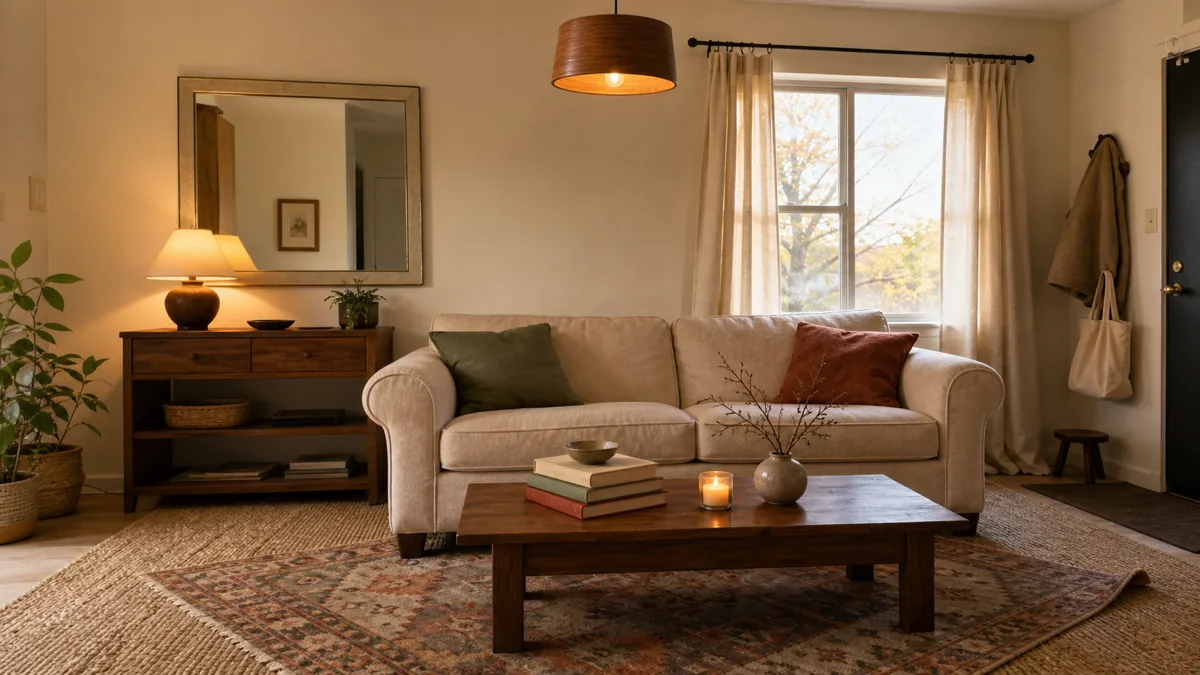
1:45pm-2:45pm. The living area is where you spend most of your awake time at home, so its system has to handle daily clutter without daily effort.
- Side table drawer: clear it completely.
- Add a tray on top for items you reach for from the sofa — remote, phone, a small notepad.
- Drawer holds what you reach for less often — current book, charging cable, a single pen. Nothing else.
- Drawer fills again within a week? You are storing the wrong things.
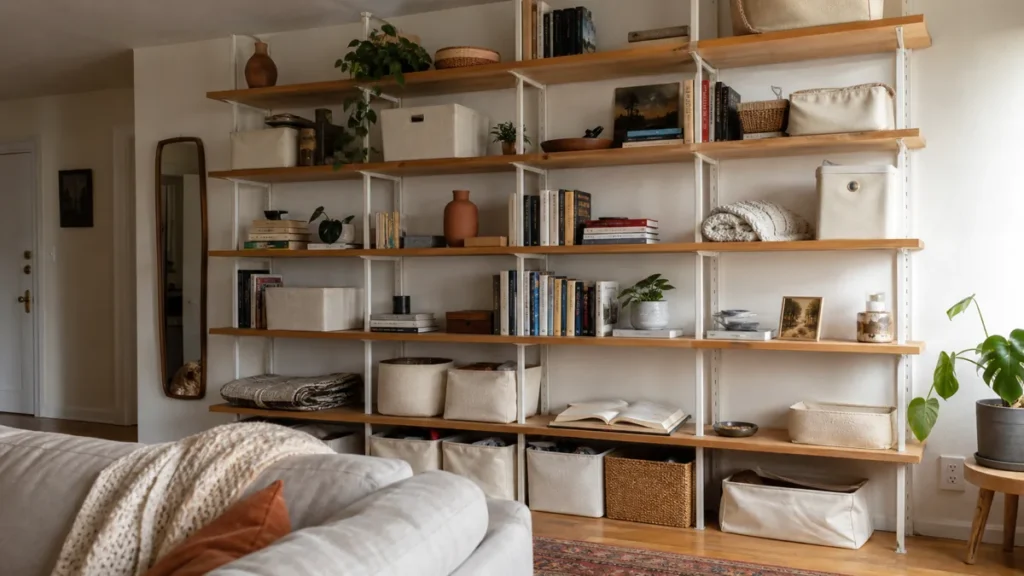
- One closed storage cabinet or basket for blankets.
- A tall woven basket beside the sofa with three folded throws is enough.
- The folded-throw-over-the-sofa look migrates to crumpled-blanket-on-the-floor by Tuesday.
- A basket prevents that drift.
- Coffee table system: a single tray for coasters + a small bowl for items you set down (phone, glasses, charger).
- Beyond what fits the tray and bowl → goes to a zone.
- Test from the sofa. Reach for the remote (tray), phone (bowl), throw blanket (basket).
- Each motion under 5 seconds. If not, the zone needs adjustment.
The living area should now feel calm at first glance — no surface chaos, no floor clutter, every daily item in a clear home. Move to the Bedroom block to close out Zone 1.
Saturday Afternoon Zone 1 — Set Up the Bedroom (75 min)

2:45pm-4pm. The bedroom is the longest Zone 1 block because three sub-zones (dresser top, nightstand, closet floor) each need a real system, and bedrooms hold the most slowly-accumulating clutter.
- Dresser top (15 min): keep it calm and minimal.
- What stays: jewelry dish + framed photo + small lamp + phone charging spot.
- Nothing else competing — the dresser top is the canary for whether your maintenance system is working.
- Nightstand drawer (15 min): add a 3-compartment organizer.
- Compartment 1 — reading items: current book, glasses, lip balm.
- Compartment 2 — cables: one charging, one earbuds.
- Compartment 3 — anything else you reach for in bed: eye mask, small lotion, candle.
- Closet floor (45 min): exactly two bins.
- Bin 1: in-season shoes with a visible icon tag.
- Bin 2: off-season clothing storage.
- That is the only floor storage allowed. Everything else triages into the bins or relocates.
- Make-the-bed pass at the end (5 min) — duvet straight, pillows stacked.
- A made bed anchors the whole bedroom regardless of how the rest looks. This becomes part of the daily reset later.
The bedroom should now have three calm surfaces — dresser top, nightstand, closet floor — each with a single visible system. Take photos of all three before stopping. Zone 1 done.
Most “one weekend organization” plans fail not because the ideas are wrong but because the execution drifts — the declutter expands past its timer, the donations stay in the apartment, the maintenance step gets skipped. These five rules are what turn the schedule into something you actually finish by Sunday 3pm.
Sunday Morning Zone 2 — Set Up the Kitchen (90 min)

9am-10:30am. The kitchen is the most-used and most-chaotic zone in any apartment. Sunday morning energy is best because you can taste-test what you actually use as you sort.
The storage system you build here is a specific application of the vertical-thinking playbook for small spaces — vertical storage is the single largest lever for small kitchens.
- Pick the two highest-friction cabinets — most-opened + most-chaotic.
- Do not touch the other cabinets this weekend. They are next weekend’s optional follow-up.
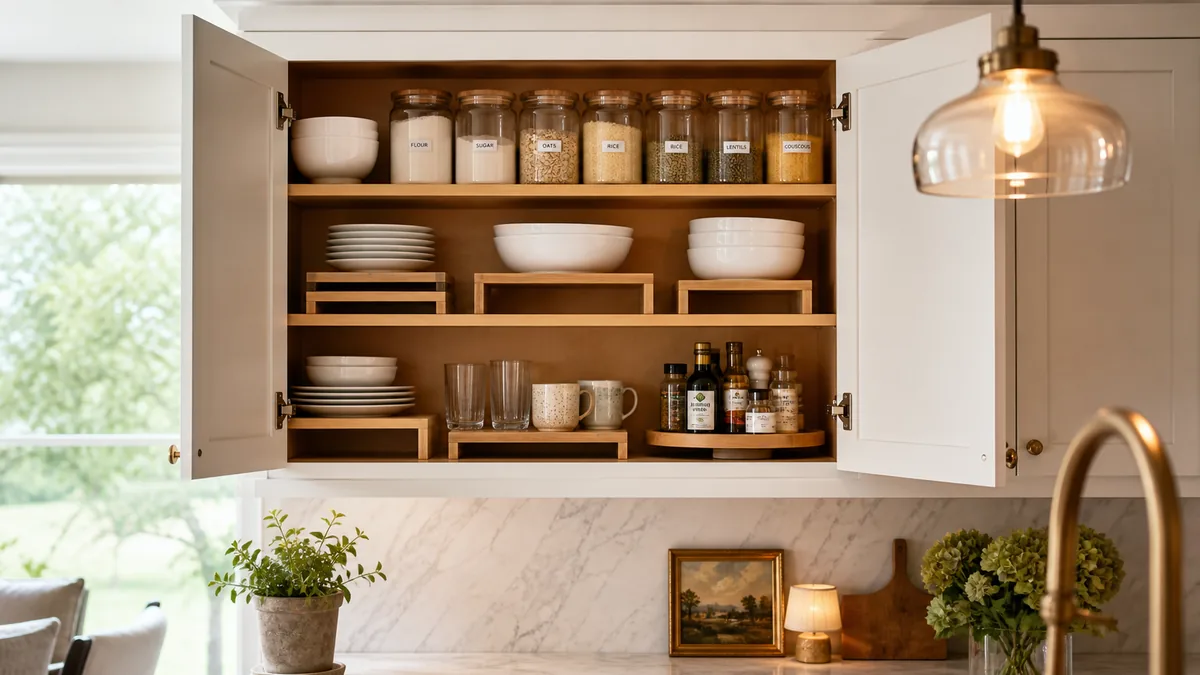
- Drawer dividers in your utensil drawer. Pull the drawer fully open — do not sort by reaching in.
- Dump everything onto a cloth on the counter. Install a plain wood 3-4 compartment divider tray.
- Sort by type: forks, spoons, knives, plus a 4th compartment for small tools (peeler, can opener, whisk).
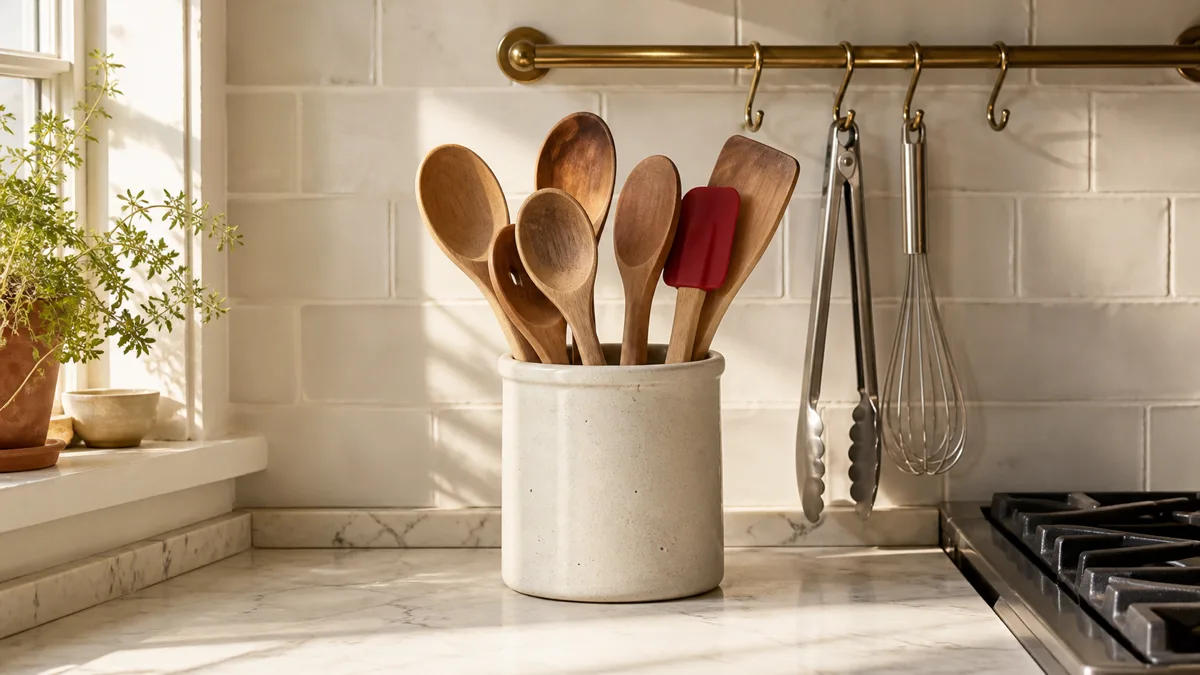
- Single utensil tray beside the stove for cooking-in-progress tools (wooden spoon, spatula).
- Live in one of two places only — drawer system or counter tray. Never floating.
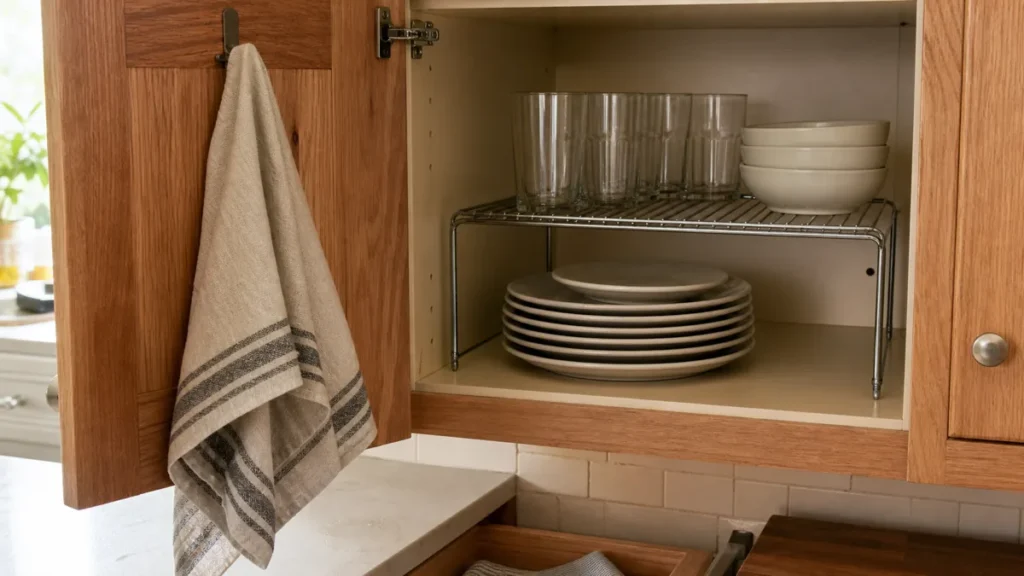
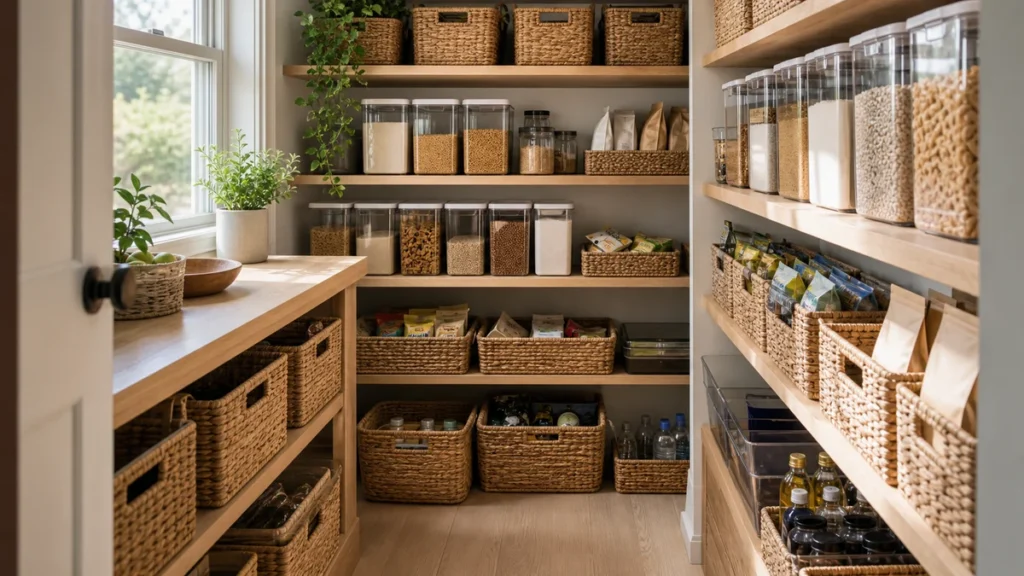
- A wire riser for cans in your most-opened cabinet. A $10 riser doubles visible can capacity.
- No more “discovering” expired chicken broth at the back.
- Two-bin pantry zone next to the riser: one for snacks, one for breakfast.
- Decant only if the bins are otherwise underused. Most apartments do not need uniform amber jars to function.
- Sunday-morning bonus: clear the fridge while the kitchen is open (10 min).
- Past expiration → trash. “Bought to try” three weeks ago → trash.
- Anything not labeled → into a clear-glass leftover container.
By 10:30 the kitchen has two organized cabinets, a clean counter, and a triaged fridge. Move directly to the bathroom block.
Sunday Morning Zone 2 — Set Up the Bathroom (60 min)

10:30am-11:30am. Bathroom setup is shorter because the zones are smaller, but the mechanisms matter more — every product fights for the same small surfaces.
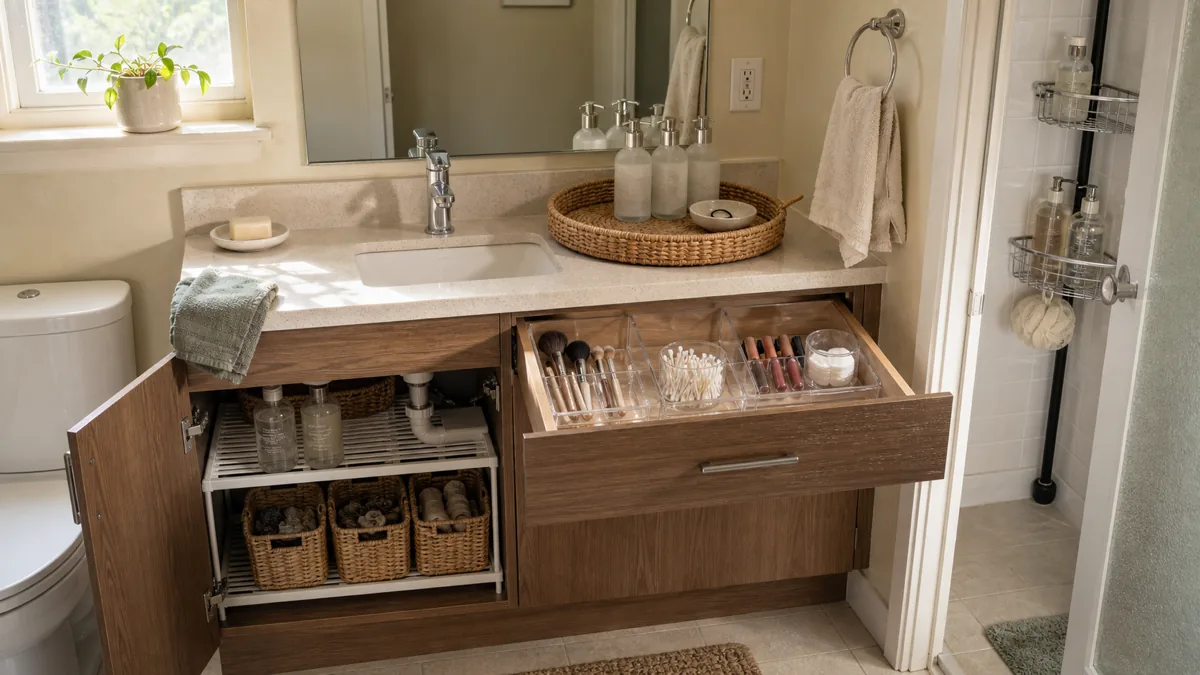
- Under-sink riser with U-cutout — fits around the curved P-trap pipe. This is the foundation.
- Tension rod across the upper cabinet — spray bottles hang head-down by trigger handles.
- 2 adhesive wire baskets on the cabinet door — cotton pads + small daily pumps.
- Counter: a single ceramic tray holding exactly four items.
- The four: toothbrush tumbler + cleanser pump + moisturizer jar + hand soap pump.
- Anything else on the counter → migrates to the medicine cabinet or under-sink.
- Four is the magic number. Five turns into ten within a month.
- Medicine cabinet: three vertical levels.
- Top — daily (vitamins, daily skincare).
- Middle — weekly (deep conditioner refill, weekly mask).
- Bottom — monthly (backup toothpaste, cotton swab box, first-aid).
- Want more under-sink ideas? The dedicated 20-mechanism under-sink guide goes deeper, but riser + tension rod + door baskets hit 80% of the value.
By 11:30 the bathroom has three calm zones — under-sink, counter, medicine cabinet — each with a visible system. Linen closet block to close out Zone 2.
Sunday Morning Zone 2 — Set Up the Linen Closet or Hallway Storage (30 min)

11:30am-12pm. The linen closet (or your equivalent storage area — hallway built-in, dedicated closet, even a single tall shelf in the bathroom) is a 30-minute zone because the system is simple: vertical bands by category.
- Top shelf: folded bath towels. Same-direction folds, fold edges facing out.
- Keep only what you actually use. Most apartments have 2-3× more towels than they need.
- The rest → donate.
- Middle shelf: folded fitted sheet bundles. One bundle per sheet set.
- The fitted-sheet-folding videos online are real. Learn it once, the system holds forever.
- Bottom shelf: off-season blankets and seasonal storage (winter throws in summer, beach blanket in winter).
- Two folded items max. More than that and the shelf becomes a dumping ground.
- Small basket on the door interior with spare washcloths.
- A woven basket with two washcloths is the right scale — grab a fresh one without opening the main shelves.
Zone 2 is now done. You have set up six zones across Saturday and Sunday morning. Lunch and a 30-minute break before the maintenance block — you have earned it.
The 5-Block Weekend Organization Plan
- 1Friday Night — 60-Minute PrepWalk every room with a notepad and pick the top six chaos hotspots. Measure four storage zones for tomorrow afternoon. Stack every storage bin you already own in one pile. Pick up trash bags + donation bags + a label marker for Saturday morning.
- 2Saturday Morning — 3-Hour Declutter (9am-12pm)Six zones, 30 minutes each. Three piles only: keep, donate, trash. No maybe pile. When the timer beeps you move on. Donations to your car at noon before lunch — out of the apartment, out of mind.
- 3Saturday Afternoon — 3-Hour Zone 1 Setup (1pm-4pm)Three high-friction public zones get a permanent storage system: Entry (45 min: hooks + bench + tray), Living (60 min: side table drawer + remote tray + storage cabinet), Bedroom (75 min: dresser top + nightstand + closet floor bins).
- 4Sunday Morning — 3-Hour Zone 2 Setup (9am-12pm)Three high-friction wet + storage zones: Kitchen (90 min: 2 highest-friction cabinets with dividers + tray + riser + pantry zone), Bathroom (60 min: under-sink + counter + medicine cabinet), Linen closet OR hallway storage (30 min: one zone, one bin system).
- 5Sunday Afternoon — 2-Hour Maintenance (1pm-3pm)Build the daily reset rule (10 min/day at fixed time), weekly catch-up rule (1 hr/Sunday), monthly purge rule (30 min first Saturday/month, donate 5 items). Write the rules on a card with icon symbols, tape it to the inside of the pantry door. Monday morning, do your first 10-minute daily reset.
styledhomenotes.com
Sunday Afternoon Maintenance — The Daily Reset Rule (15 min planning + nightly 10 min)

1pm-1:15pm. The maintenance block is the most important block of the entire weekend because without it the setup decays in 4-6 weeks. Start with the daily rule.
- Pick a fixed evening time — most people use post-dinner.
- Set a phone alarm labeled “daily reset.” No other label, no description.
- Define the walk: every zone you set up, in the same order each night.
- Order: entry → living → kitchen → bathroom → bedroom → linen.
- 5 seconds per zone is enough.
- The action: move anything misplaced back home.
- Mug on the coffee table → back to kitchen.
- Jacket on the sofa → back to the entry hook.
- Throw blanket on the floor → back to the basket.
- Wipe ONE surface with a microfiber — counter, side table, dresser, your pick.
- Ten minutes total, every night. The first week feels forced.
- By the second week the alarm becomes Pavlovian. The walk becomes background.
The daily reset is the single highest-leverage maintenance habit. Tape the alarm time to your fridge if you tend to forget. Build the weekly rule next.
Sunday Afternoon Maintenance — The Weekly Catch-Up Rule (10 min planning + Sunday 1 hr)

1:15pm-1:25pm. The weekly catch-up is the safety net for whatever the daily reset misses.
- Pick a fixed Sunday hour — most people use post-lunch, pre-dinner.
- One hour, blocked on the calendar.
- The action: walk the six declutter zones from Saturday morning and re-triage.
- The six zones: entry, living, kitchen counter, bathroom counter, dresser top, closet floor.
- 10 minutes per zone.
- Look for items that drifted into the wrong zone.
- Look for items that entered this week but have no home yet.
- Look for surfaces that accumulated drift.
- Same 3-pile rule applies: keep, donate, trash. No maybe pile, even on the weekly version.
- Print a paper weekly schedule sheet with the six zones.
- Paper, not phone — checking off paper feels different than tapping a screen.
- Tape it inside a kitchen cabinet so the system lives near the apartment without cluttering surfaces.
The weekly catch-up is your wind-back-the-drift rule. Maintenance is small. Skipping four weeks equals next big Saturday-morning declutter. Build the monthly rule next.
Sunday Afternoon Maintenance — The Monthly Purge Rule (5 min planning + first Saturday 30 min)

1:25pm-1:30pm. The monthly purge is the slowest of the three maintenance rules, but it is the rule that prevents accumulation over years.
- Pick the first Saturday of every month. Block 30 minutes on the calendar.
- Set a recurring monthly reminder labeled “purge 5 items.” No other label.
- The action: walk with a small canvas tote and find exactly five items to donate.
- Not ten, not three — five.
- Small enough you will actually do it. Big enough to compound.
- 12 months × 5 items = 60 items removed from circulation per year.
- The items can be anything — a sweater you have not worn this season, a book you finished and will not re-read, a worn pair of shoes, an unused candle.
- Variety prevents boredom — do not let the rule become “donate 5 sweaters every month.”
- Donations go to your car immediately and to the drop-off the next time you are out.
- The tote lives in the entry hallway so the bag itself is a visible monthly cue.
Five is the magic number. Anything less and the rule does not compound. Anything more and the rule becomes a chore you skip. Build the final piece — the visible rule card — next.
Sunday Afternoon Maintenance — Make the Rule Card + Monday Morning First Reset (40 min)

1:30pm-3pm. The card is the visible anchor that keeps the maintenance system real. Without the visible card the rules live only in your head and they will fade in 4-6 weeks. With the card on a door you cannot ignore, the system holds for years.
- Cut a 5×7 inch piece of plain card paper.
- Draw four lines, each with an icon symbol on the left.
- Circle = daily reset. Square = weekly catch-up. Triangle = monthly purge. Arrow = “do not buy storage before measuring.”
- Beside each icon, hand-write the rule in your own words.
- Icons are decoration; the words are the rule.
- Tape the card inside your pantry door with four small strips of blue painter’s tape, one at each corner.
- Painter’s tape removes cleanly if you ever move apartments.
- The pantry door is the right surface — you open it daily but it does not show to guests.
- Set the three recurring phone reminders now while the rule card is in hand.
- The three alarms: daily reset 10 min + weekly catch-up Sunday 1 hr + monthly purge first Saturday 30 min.
- Get all three set before you close this block.
- Monday morning, before work: your first daily reset (10 min).
- Walk every zone, move misplaced items back, wipe one surface.
- Note which zone broke first. That is where the system needs a tweak.
- Add the tweak to next Sunday’s catch-up.
Sunday 3pm — you are done. The apartment is organized. The maintenance system is taped to your pantry door. The recurring alarms are set. Monday morning you walk through a finished space.
If anything slid in the first week, you will know exactly which zone needs a tweak and you can fix it in the next ten-minute reset.
The schedule worked because every block had a start time, a duration, and three to five things to actually do. Save this page so the next time you want to redo a weekend (or send it to a friend who has been “meaning to organize”), the plan is already written.